A life in context
The person behind the prize
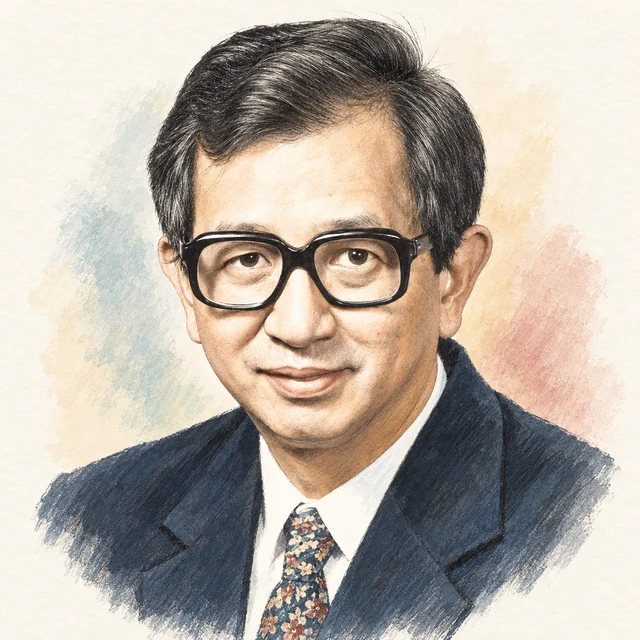
Lee grew up in Hsinchu, enjoying science, sport and music. He graduated from National Taiwan University in 1959, studied at National Tsing Hua University and moved to Berkeley in 1962. His doctorate with Bruce Mahan was completed in 1965. Joining Herschbach at Harvard in February 1967, he helped build a versatile crossed-beam instrument with colleagues and skilled technical staff. He moved to Chicago in 1968 and returned to Berkeley in 1974, extending experiments to a much wider range of reactions.
The contribution
Lee developed powerful crossed-beam methods with sensitive, broadly applicable detection. Neutral products could be ionised after the collision and identified by mass analysis. Measuring their angles and energies helped test reaction mechanisms under controlled conditions. These are distributions inferred from detected particles, not films of individual atoms moving. He received one third of the Chemistry Prize.
The idea in plain language
A bulk reaction combines enormous numbers of collisions, concealing their individual dynamics. Herschbach developed experiments in which directed molecular beams meet at low density. Lee’s versatile instruments extended detection to many reactions, measuring product scattering and energy under controlled conditions. Neutral products can be ionised after collision for mass analysis.
Read the full award story ↗