A life in context
The person behind the prize
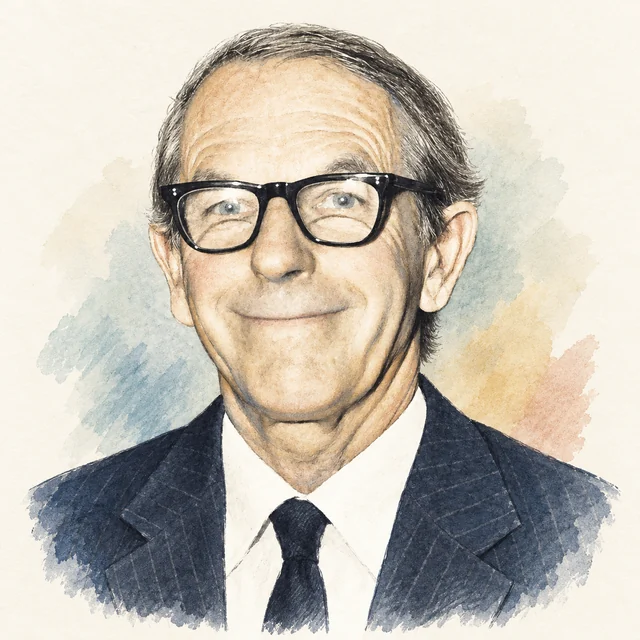
Sanger chose biochemistry rather than following his father into medicine. At Cambridge, research training with Albert Neuberger taught him laboratory methods and the habits of investigation. His determination of insulin’s amino-acid sequence earned the 1958 Chemistry Prize, separate from the 1980 award. He joined the Medical Research Council staff in 1951 and moved to its Laboratory of Molecular Biology in 1962. He then turned the central problem of sequencing toward RNA and DNA. Work with colleagues including Alan Coulson and Steve Nicklen produced the chain-termination method published in 1977. Sanger emphasized collaboration and concentrated on basic research; his retirement in 1983 followed the second Nobel award.
The contribution
Sanger developed enzymatic methods to determine nucleic-acid sequences, including chain termination with Coulson and Nicklen. He received one quarter of the 1980 Chemistry Prize for sequencing. His earlier 1958 award concerned proteins; both belong to one person and one biography.
The idea in plain language
Knowing that DNA contains four kinds of base is different from knowing their order, and different again from joining chosen DNA molecules. Berg’s biochemical work made such joining possible in a test tube. His group’s 1972 recombinant-DNA construction combined material from viral and bacterial sources, opening an experimental route to studying gene structure and function.
Read the full award story ↗