A life in context
The person behind the prize
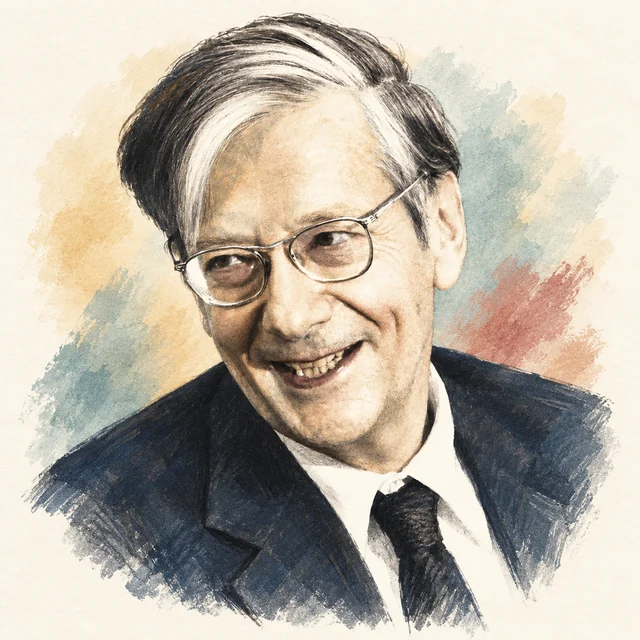
Bloembergen studied physics at Utrecht during the German occupation and completed his master’s-level degree before the university closed in 1943. After the war he went to Harvard, arriving soon after the first nuclear magnetic resonance experiments there. Work with Edward Purcell and Robert Pound led to a major study of magnetic relaxation and his Leiden doctorate in 1948. He returned to Harvard in 1949 and developed a three-level solid-state maser proposal in 1956. From 1961 his group explored nonlinear optics: the strong coherent light of lasers made matter respond in ways unavailable with ordinary weak illumination. His career connected magnetic resonance, microwave physics and optical spectroscopy; his Harvard retirement in 1990 came after the award.
The contribution
Bloembergen developed nonlinear optical methods that expanded what laser spectroscopy could measure. Light fields can interact through a material, generating signals at combinations of their frequencies. He received one quarter of the Physics Prize, sharing the laser-spectroscopy half with Arthur Schawlow; Kai Siegbahn received the other half for electron spectroscopy.
The idea in plain language
Atoms and molecules exchange energy in characteristic ways, but a crowded or blurred spectrum can hide useful detail. Bloembergen developed nonlinear optical methods: strong light fields interact through matter and can produce new signals at combinations of their frequencies. Schawlow developed precision laser spectroscopy, including techniques with Hänsch that reduce broadening caused by atomic motion. Narrow, tunable laser light made transitions easier to distinguish.
Read the full award story ↗