A life in context
The person behind the prize
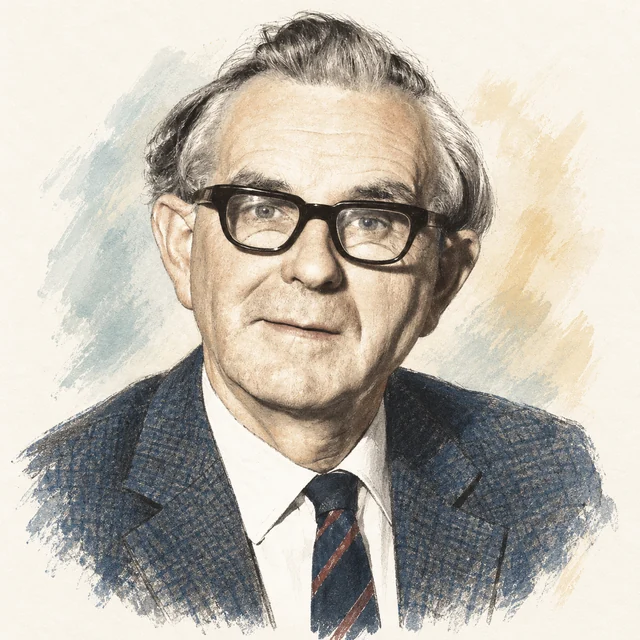
Porter studied biochemistry at Liverpool, graduating in 1939. Army service delayed his research training; he completed a Cambridge doctorate with Frederick Sanger in 1948. Work at the National Institute for Medical Research included chromatographic protein separation with Archer Martin. Returning to antibody structure, he used papain in 1958–1959 to produce three fragments from a common antibody: two retained antigen binding and the third did not. At St Mary’s Hospital Medical School, he developed the peptide-chain model in 1962. He became Oxford’s Whitley professor of biochemistry in 1967. Subsequent research considered binding sites, immunoglobulin markers and complement components. The prize recognised a progressive structural investigation, not a claim that one experiment in 1959 completed all immunology.
The contribution
Porter used enzymatic fragmentation to distinguish antibody binding regions and helped establish the heavy- and light-chain model. He received half the Medicine Prize.
The idea in plain language
Edelman broke disulfide links and separated polypeptide chains. Porter used the enzyme papain to split a common antibody into three fragments: two retained antigen-binding capacity and one did not. Chain separation and fragment separation answer different questions and should not be treated as identical operations.
Read the full award story ↗