c.curionodeThe Nobel Archive

1901 · Physics

Make hidden structures visible with X-rays

Röntgen investigated an unexpected radiation that passed through some materials opaque to visible light. Differences in transmission could produce images of structures inside objects and bodies.

X-raysImagingExperimental physics
1901Physics

Visual guide

The prize, pictured

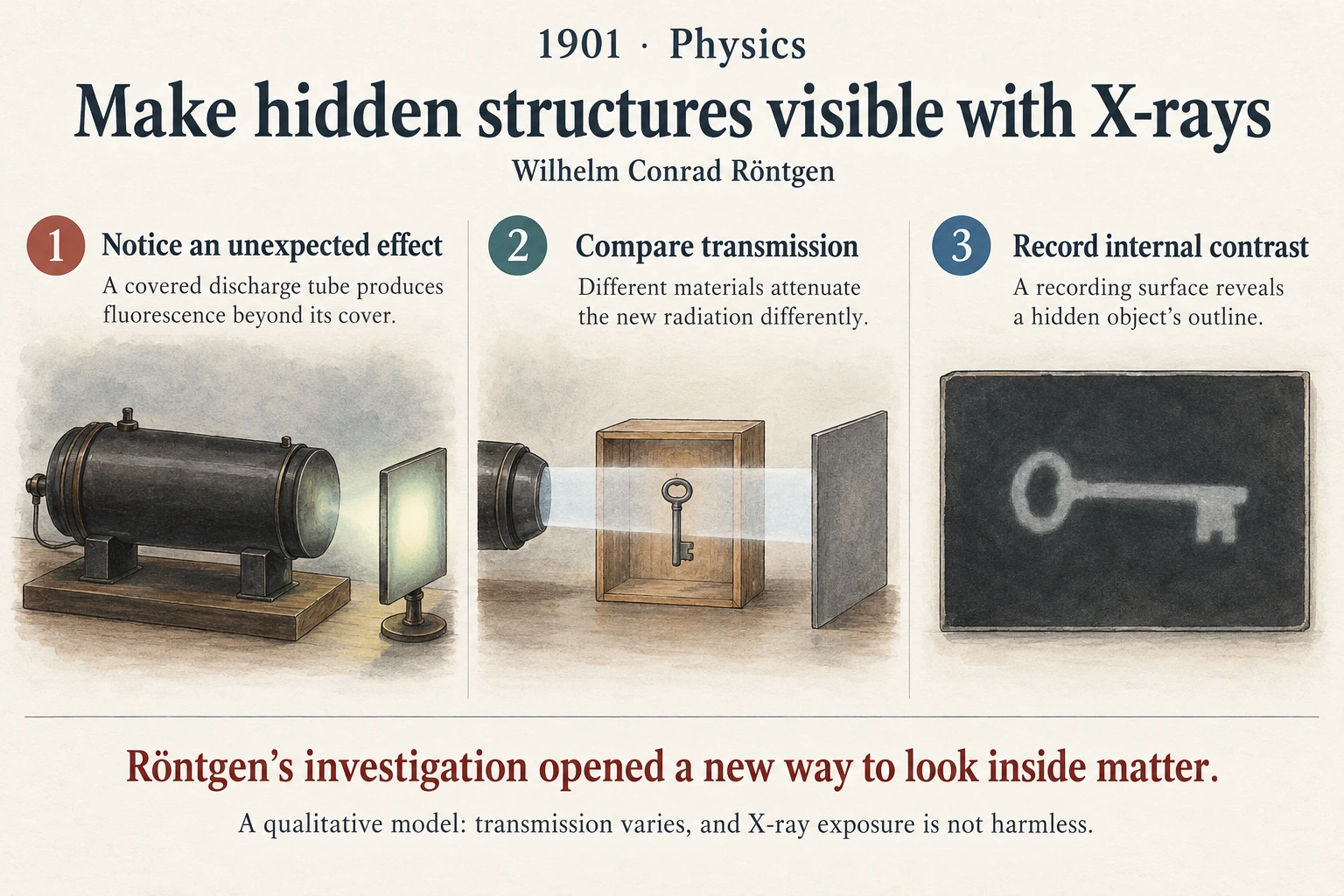
Infographic explaining Make hidden structures visible with X-rays
Original AI-generated infographic. A conceptual overview; the explanations and sources below provide context.
Read the poster text

Röntgen’s investigation opened a new way to look inside matter.

  1. Notice an unexpected effect

    A covered discharge tube produces fluorescence beyond its cover.

  2. Compare transmission

    Different materials attenuate the new radiation differently.

  3. Record internal contrast

    A recording surface reveals a hidden object’s outline.

A qualitative model: transmission varies, and X-ray exposure is not harmless.

01 · The discovery

The idea, in everyday language

While studying electrical discharges in 1895, Röntgen found fluorescence outside a covered tube. Further experiments established a distinct radiation, its penetration through different materials and its ability to affect photographic plates.

An image forms because different parts of an object attenuate X-rays differently. What reaches a detector varies across the image. In modern terms X-rays are electromagnetic radiation, distinct from the electron streams called cathode rays.

Why it matters

The discovery opened a powerful way to locate hidden structures and foreign objects, especially in medicine, and created new directions for physical research. Later imaging methods developed far beyond the original photographic experiments.
02 · The people

Who brought the idea to life?

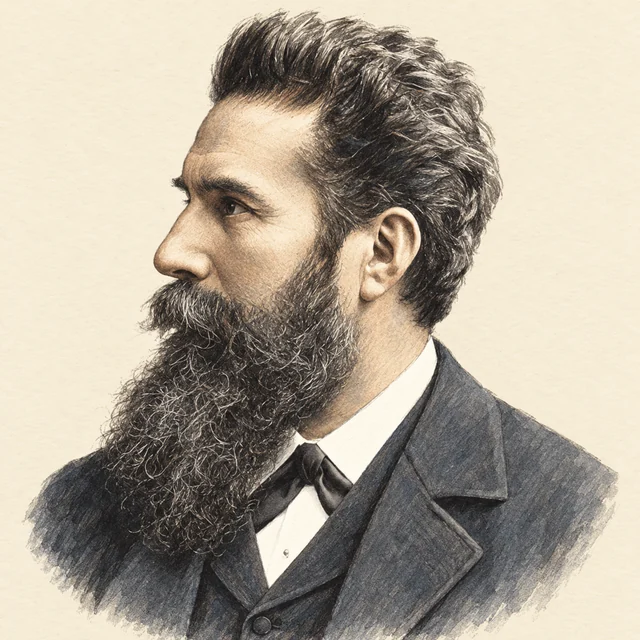
Illustrated portrait of Wilhelm Conrad Röntgen

Wilhelm Conrad Röntgen

Prize share · 1

Röntgen discovered and investigated X-rays in 1895. The full 1901 Physics Prize recognised this new radiation, whose different transmission through materials opened ways to examine structures hidden from visible light.

Read the biography ↗

03 · Years in the making

The path here

  1. 1845

    Röntgen is born in Lennep.

  2. 1869

    He completes his doctorate in Zurich.

  3. 1888

    He returns to Würzburg as professor of physics.

  4. 1895

    On 8 November he discovers X-rays; his initial report appears in December.

  5. 1896

    He presents the discovery publicly in Würzburg.

  6. 1900

    He moves to Munich.

  7. 1901

    He receives the full first Physics Prize.

  8. 1923

    He dies in Munich.

04 · Read further

From the original sources

Original explanations by Curionode, based on the official records below. Biographical details and affiliations refer to the award year.

  1. Official award summary nobelprize.org
  2. Award ceremony speech nobelprize.org
  3. University of Würzburg archive: Röntgen’s research and discovery uni-wuerzburg.de