c.curionodeThe Nobel Archive

1905 · Physics

Take cathode rays beyond the discharge tube

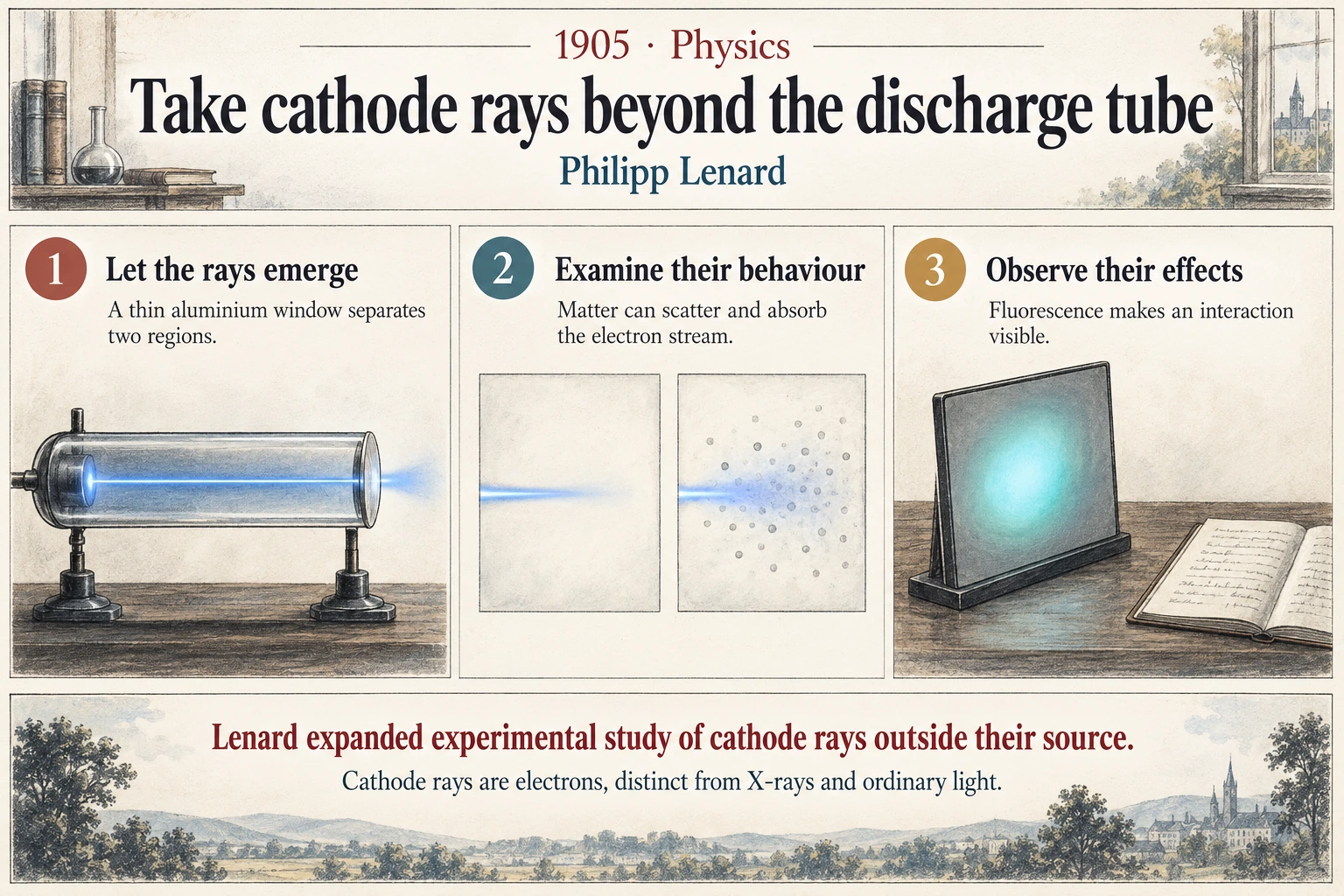
Studying a ray only where it is produced can make its behaviour difficult to separate from its source. Lenard’s thin aluminium window let cathode rays emerge from a discharge tube for further investigation.

Cathode raysElectron experimentsThin metal window
1905Physics

Visual guide

The prize, pictured

Infographic explaining Take cathode rays beyond the discharge tube
Original AI-generated infographic. A conceptual overview; the explanations and sources below provide context.
Read the poster text

Lenard expanded experimental study of cathode rays outside their source.

  1. Let the rays emerge

    A thin aluminium window separates two regions.

  2. Examine their behaviour

    Matter can scatter and absorb the electron stream.

  3. Observe their effects

    Fluorescence makes an interaction visible.

Cathode rays are electrons, distinct from X-rays and ordinary light.

01 · The discovery

The idea, in everyday language

Following Hertz’s observation that cathode rays could pass through thin metal foil, Lenard developed a window that maintained the separation between the tube and an external region. This arrangement made it possible to study the rays beyond their source.

He investigated scattering, absorption, fluorescence and electrical effects. Cathode rays are streams of electrons, not X-rays or ordinary light. Their interpretation emerged through the work of several investigators; Lenard’s full 1905 prize recognised his experiments on these rays.

Why it matters

The experiments broadened access to electron behaviour and helped connect gas-discharge research with the structure of matter. They formed part of the experimental foundation of electron physics, alongside distinct contributions by Hertz, Perrin, Thomson and others.
02 · The people

Who brought the idea to life?

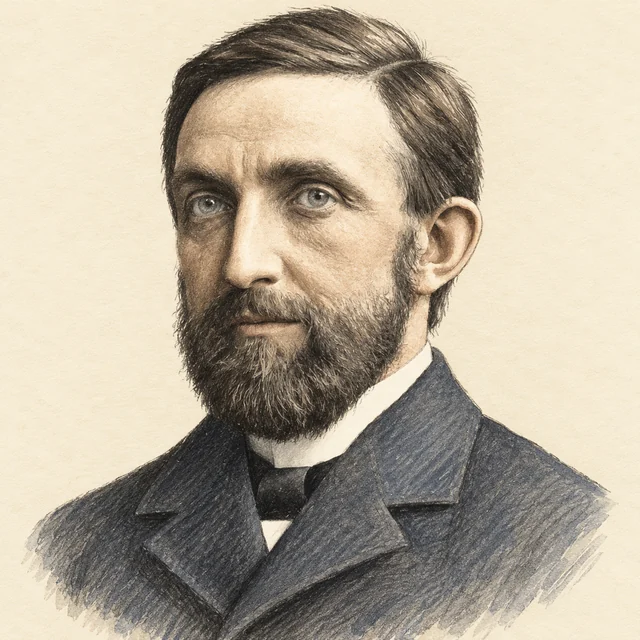
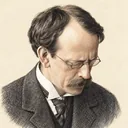
Illustrated portrait of Philipp Lenard

Philipp Lenard

Prize share · 1

Lenard received the full Physics Prize for work on cathode rays. His thin aluminium window made it possible to study their behaviour outside the discharge tube, extending experimental electron research.

Read the biography ↗

03 · Years in the making

The path here

  1. 1886

    Lenard completes his doctorate at Heidelberg.

  2. 1892

    He begins working as Hertz’s assistant in Bonn.

  3. 1894

    He publishes work on the thin aluminium window.

  4. 1898

    He becomes professor at Kiel.

  5. 1905

    The Physics Prize recognises his work on cathode rays.

  6. 1907

    He returns to Heidelberg.

  7. 1931

    He retires from his professorship.

04 · Read further

From the original sources

Original explanations by Curionode, based on the official records below. Biographical details and affiliations refer to the award year.

  1. Official award summary nobelprize.org
  2. Award ceremony speech nobelprize.org
  3. Heidelberg Physics: Lenard’s research and antisemitism physik.uni-heidelberg.de