01 · The discovery
The idea, in everyday language
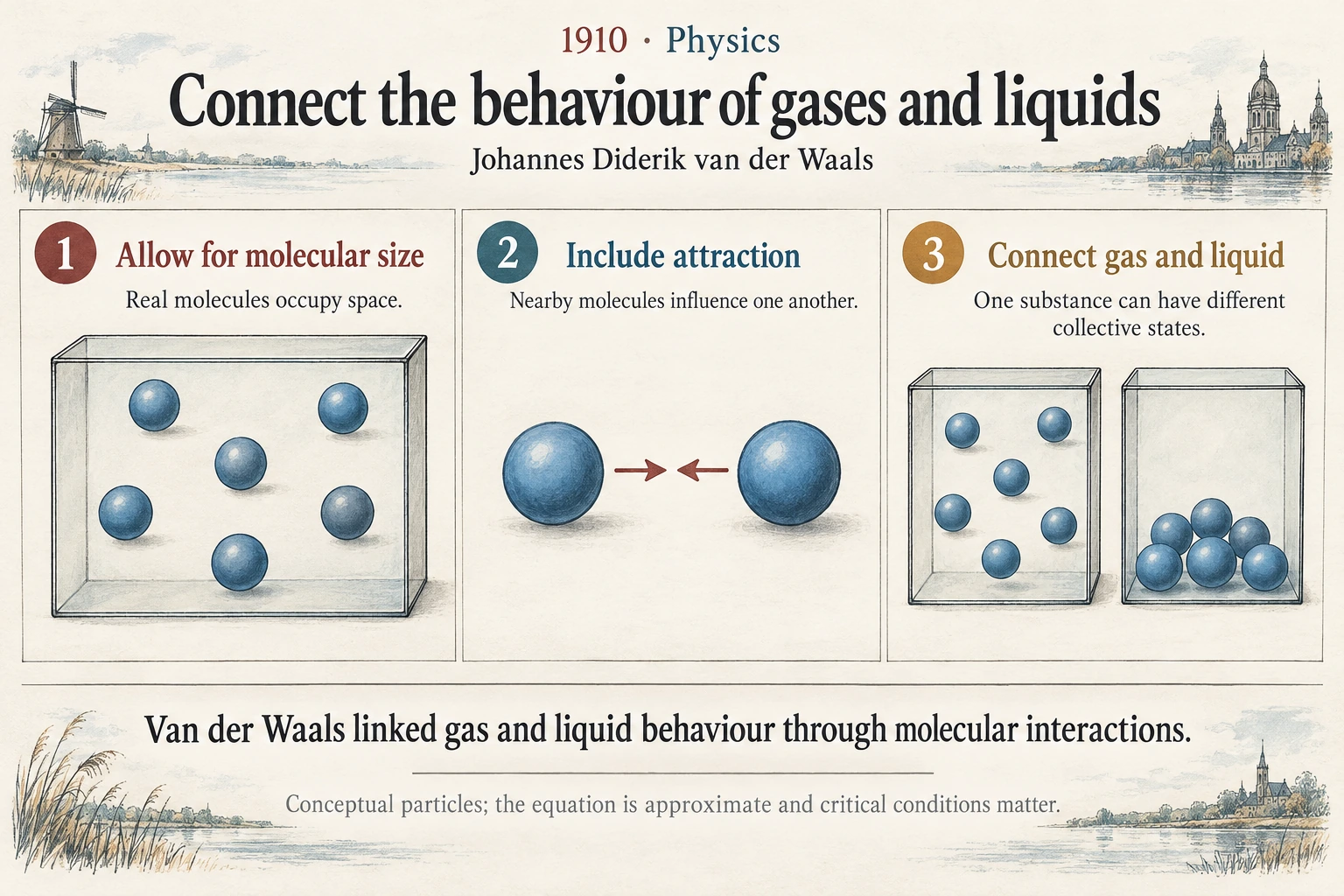
An ideal gas model treats particles as having negligible volume and no mutual attraction. This can work well for dilute gases, but becomes inadequate as molecules crowd together or attractions matter more. Van der Waals modified the relation between pressure, volume and temperature to account approximately for both effects. The same substance could then be understood in gaseous and liquid states without inventing a different kind of molecule for each.
The framework explained a critical temperature above which compression alone cannot turn a gas into a liquid. It also supported the principle of corresponding states: pressure, temperature and volume can be compared after scaling each by the substance’s own critical value. This reveals similarities between different fluids, though real substances do not all follow one exact universal curve. The full 1910 Physics Prize recognised this work on the equation of state of gases and liquids.
Why it matters
The work linked macroscopic measurements with molecular properties and helped organise research on critical phenomena and liquefaction. It gave low-temperature laboratories a theoretical guide, while experiments and later theories supplied further tests and refinements.