01 · The discovery
The idea, in everyday language
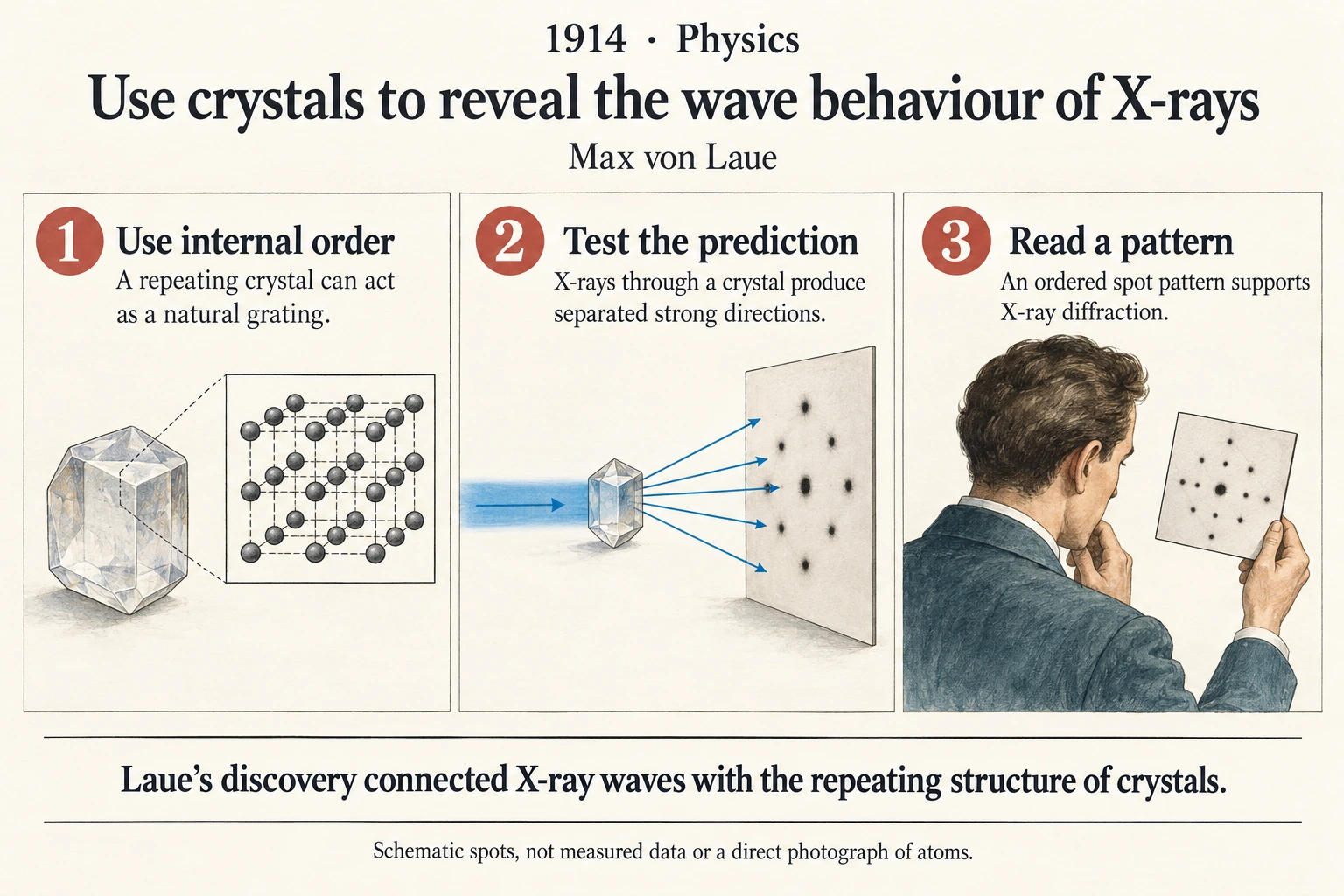
The nature of X-rays was still debated. If their wavelength was extremely short, an ordinary optical grating would be too coarse to reveal a clear diffraction pattern. Laue recognised that the repeating arrangement within a crystal could provide a much finer natural grating. He developed a theoretical account of how scattered waves could reinforce in particular directions.
Friedrich and Knipping directed X-rays through crystals and recorded patterns on photographic material. The arranged spots agreed with the idea of interference from a regular structure. This connected two questions: whether X-rays showed wave behaviour and whether crystals possessed a repeating internal arrangement. Laue received the full 1914 prize; the award was announced on 11 November 1915.
Why it matters
The discovery established a way to investigate X-rays and crystals together. It opened the path to X-ray crystallography, including the Braggs’ later methods of structural analysis. Discovering diffraction and developing those structural methods were related but distinct achievements.