01 · The discovery
The idea, in everyday language
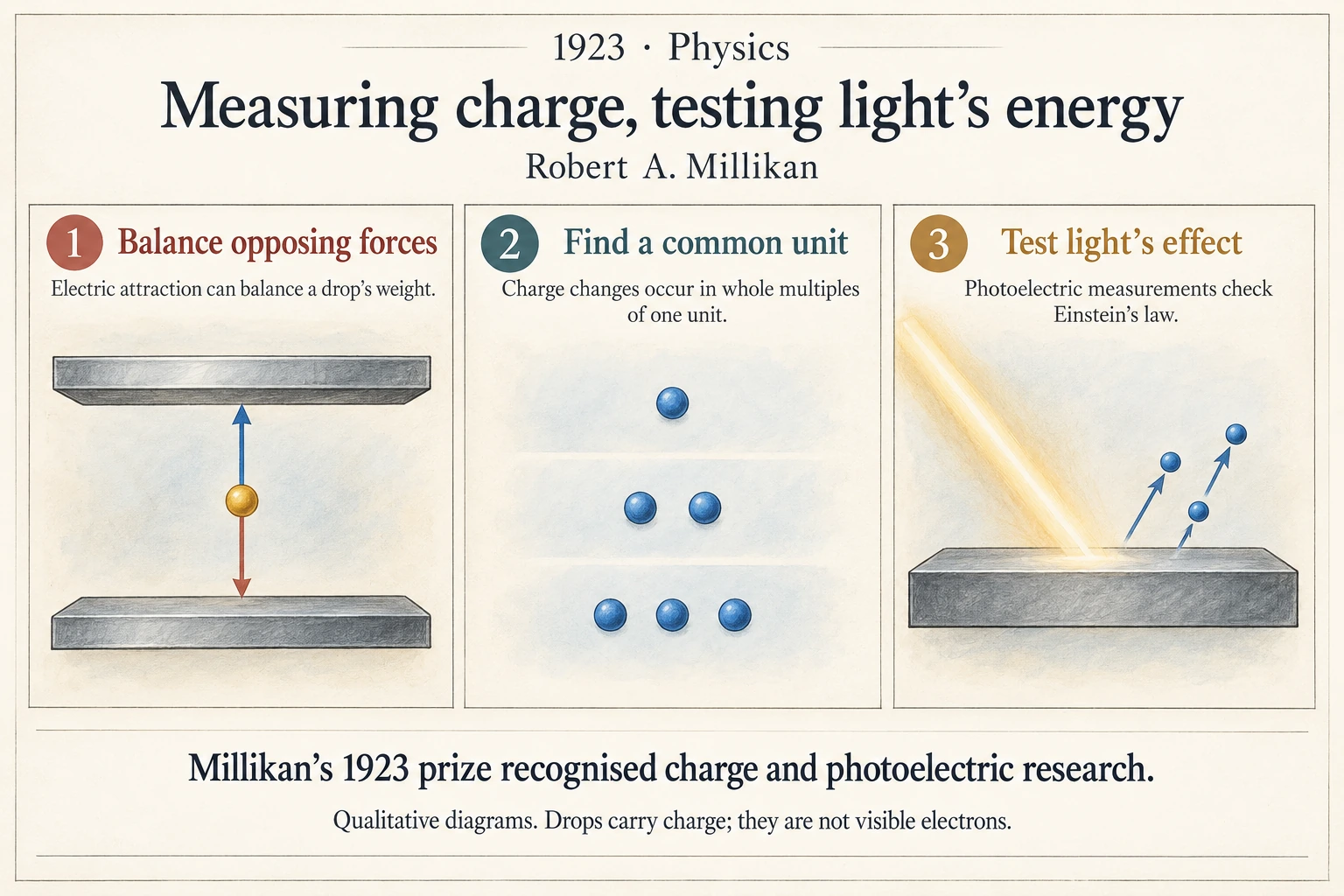
How could the size of an elementary electric charge be measured? Millikan studied tiny charged oil drops between metal plates. By comparing their motion under gravity and electrical forces, and observing changes when a drop gained or lost charge, he could infer a common unit. The drops carried charge; the experiment did not show individual electrons as visible balls.
A separate line of work tested the photoelectric effect, in which light releases electrons from a material. Einstein’s law relates the energy available to the light’s frequency. Millikan’s precise measurements supported that relation, rather than an account based on brightness alone. These were distinct experiments about charge and the interaction of light with matter, not one measurement proving every part of quantum theory.
Why it matters
A reliable value for the elementary charge improved the quantitative foundations of physics. The photoelectric measurements supplied an independent test of a central relation in early quantum theory. Both achievements depended on careful experimental methods and interpretation.