01 · The discovery
The idea, in everyday language
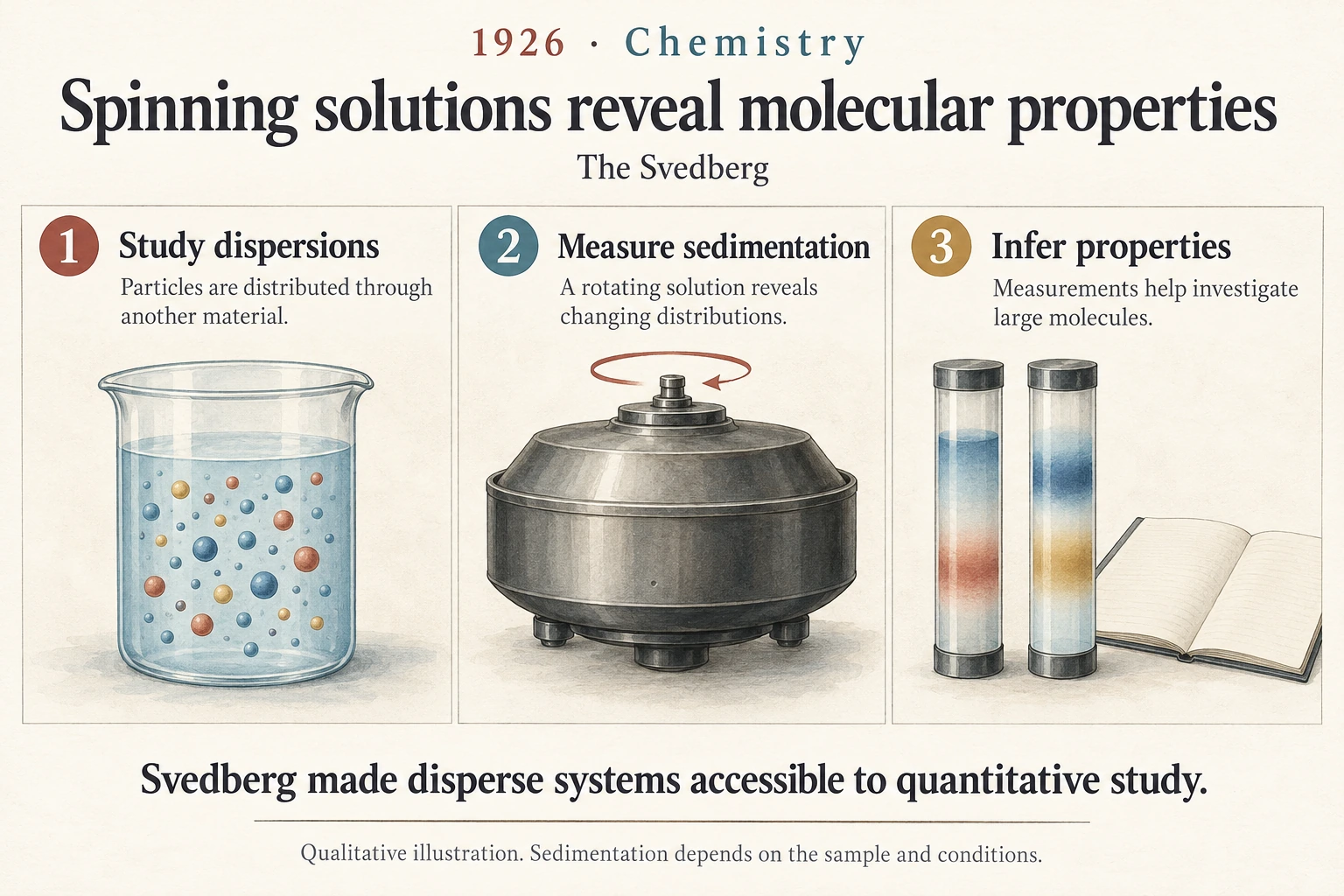
In a disperse system, small particles or large molecules are distributed through another material. They may be too small to study by ordinary visual inspection. Svedberg investigated their diffusion, motion and concentration fluctuations, connecting colloid chemistry with the molecular picture of matter.
His ultracentrifuge made the redistribution of material in a rotating solution observable and measurable. Concentration profiles and their changes could help infer molecular properties, including masses, under specified conditions. Protein studies helped distinguish relatively uniform preparations from mixtures. The 1926 Chemistry Prize recognised his broader work on disperse systems, alongside Perrin’s separate full Physics Prize.
Why it matters
The ultracentrifuge became a powerful analytical instrument for colloids and biological macromolecules. It helped make proteins objects of quantitative physical chemistry rather than substances described only by their biological source.