c.curionodeThe Nobel Archive

1930 · Physics

Reading molecular clues in scattered light

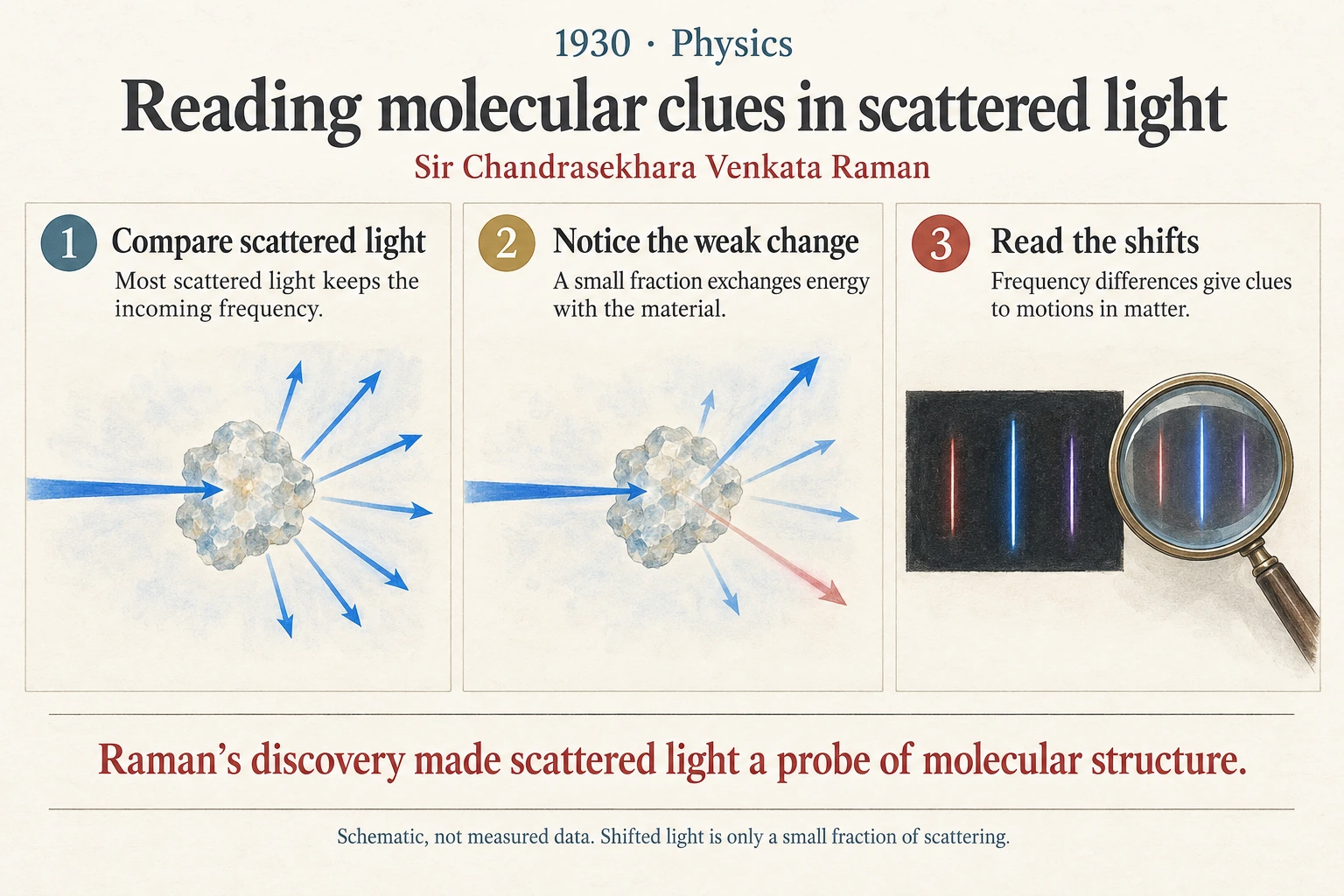
Raman’s 1928 work revealed changed frequencies in a small fraction of scattered light. The shifts give information about energy exchanged with matter.

Raman scatteringMolecular spectroscopyEnergy exchangeOptics
1930Physics

Visual guide

The prize, pictured

Infographic explaining Reading molecular clues in scattered light
Original AI-generated infographic. A conceptual overview; the explanations and sources below provide context.
Read the poster text

Raman’s discovery made scattered light a probe of molecular structure.

  1. Compare scattered light

    Most scattered light keeps the incoming frequency.

  2. Notice the weak change

    A small fraction exchanges energy with the material.

  3. Read the shifts

    Frequency differences give clues to motions in matter.

Schematic, not measured data. Shifted light is only a small fraction of scattering.

01 · The discovery

The idea, in everyday language

Ordinary elastic scattering changes light’s direction without changing its frequency. Raman’s experiments revealed something additional: weak lines at frequencies different from the incoming light. Filtered light from a mercury lamp made the comparison clearer. The original 1928 announcement in Nature was co-authored by Raman and K. S. Krishnan. The Nobel Prize was awarded to Raman alone.

In the shifted scattering, light exchanges energy with the material. The frequency difference can reveal changes in molecular vibration or rotation and other excitations in matter. Light may lose or gain energy in that exchange, so shifted lines can occur on either side of the incident frequency. Studying these offsets turned a subtle optical effect into a way to investigate molecular motions and chemical structure.

Why it matters

Raman spectroscopy became an important way to investigate materials and molecular structure. The 1928 experiments used the light sources and optical instruments of their time. Lasers and many modern instruments arrived later; they were not part of the original discovery.
02 · The people

Who brought the idea to life?

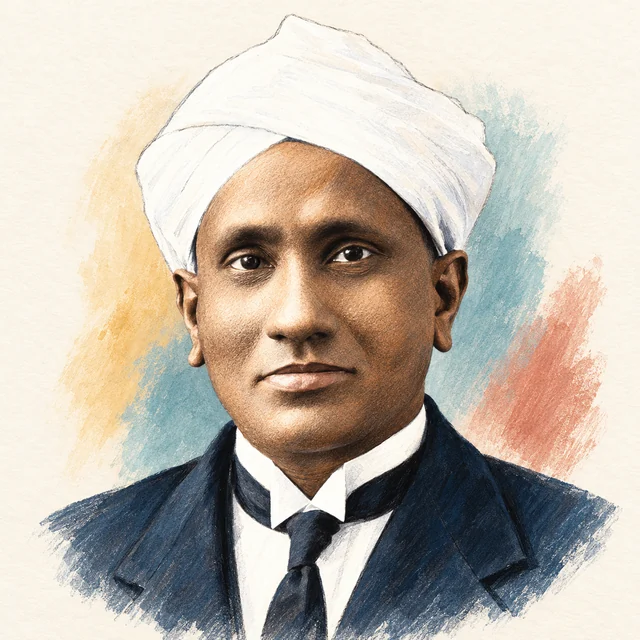
Illustrated portrait of Sir Chandrasekhara Venkata Raman

Sir Chandrasekhara Venkata Raman

Prize share · 1

Raman received the full Physics Prize for research on light scattering and discovery of the effect bearing his name. The changed frequencies in a small fraction of scattered light opened a way to study molecular energy changes and structure.

Read the biography ↗

03 · Years in the making

The path here

  1. 1917

    Raman becomes Palit Professor of Physics at Calcutta University.

  2. 1928

    Raman and Krishnan report the new scattered radiation.

  3. 1930

    Raman receives the full Physics Prize for light-scattering research and the new effect.

04 · Read further

From the original sources

Original explanations by Curionode, based on the official records below. Biographical details and affiliations refer to the award year.

  1. Official award summary nobelprize.org
  2. Award ceremony speech nobelprize.org
  3. 1928 paper: Raman and Krishnan nature.com