01 · The discovery
The idea, in everyday language
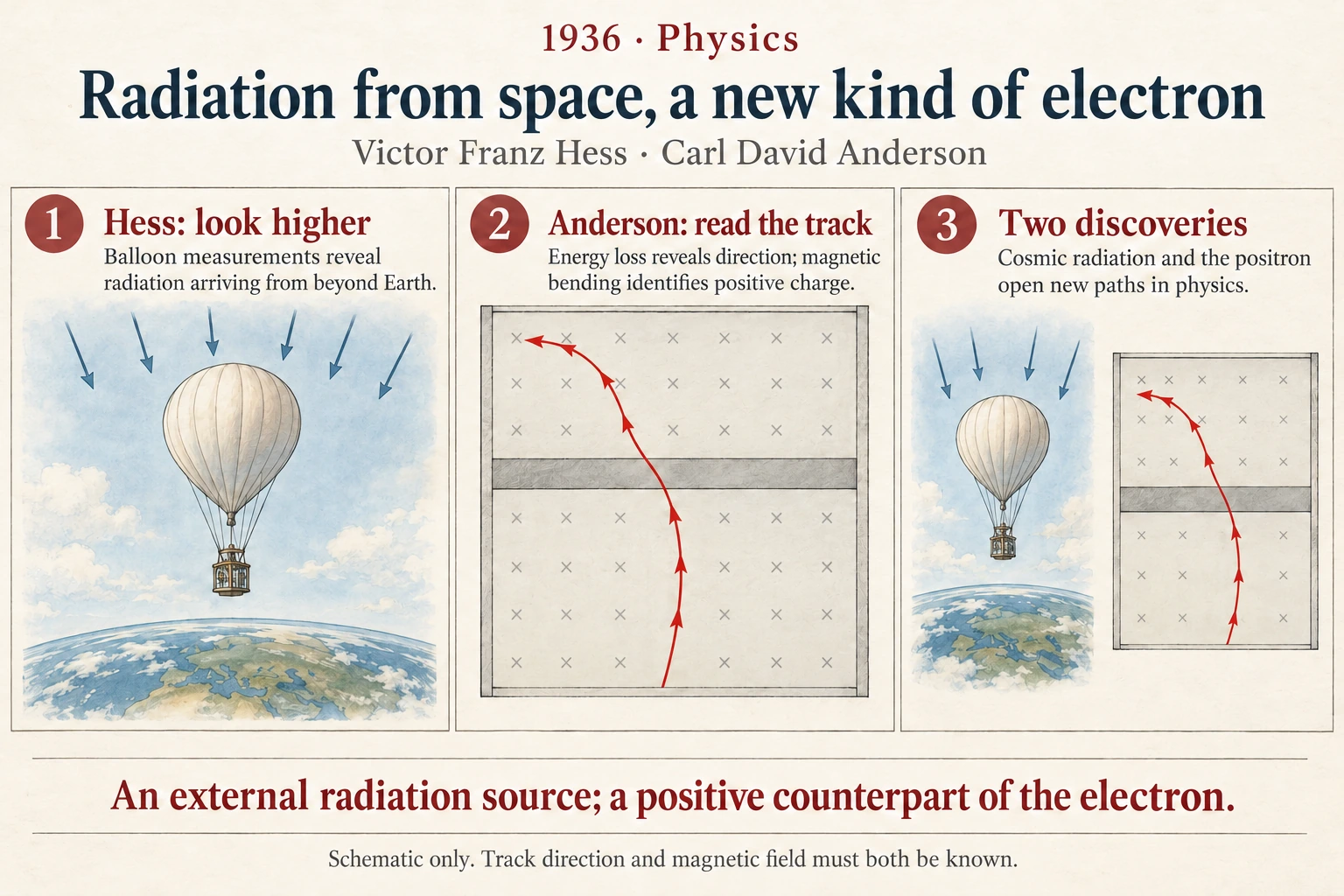
Why did an insulated electrical instrument slowly lose its charge even when carefully shielded? Radiation could ionise the surrounding air and make it conductive, but radioactivity in the ground did not explain all the observations. Hess took improved instruments into balloons in 1911–1912. Ionisation first fell, then rose markedly at greater heights. Combined with night and eclipse observations, this supported radiation arriving from outside Earth, rather than a simple explanation based on the ground or ordinary sunlight.
Cosmic-ray research also opened a way to investigate particles. At Caltech, Anderson photographed cloud-chamber tracks in a magnetic field. Curvature alone left an ambiguity between charge and direction. A lead plate helped resolve it: energy loss made a particle curve more tightly after crossing, indicating which way it travelled. With the magnetic field known, the bending then established positive charge. The track’s properties were consistent with an electron-like mass rather than a proton. The 1932 evidence identified the positron, now understood as the electron’s antiparticle.
Why it matters
The work connected atmospheric measurements with particle physics. Cosmic rays supplied naturally occurring high-energy particles, while the positron provided experimental evidence for a positive counterpart of the electron. The award did not credit Hess and Anderson with the same experiment or with every later discovery involving antimatter.