01 · The discovery
The idea, in everyday language
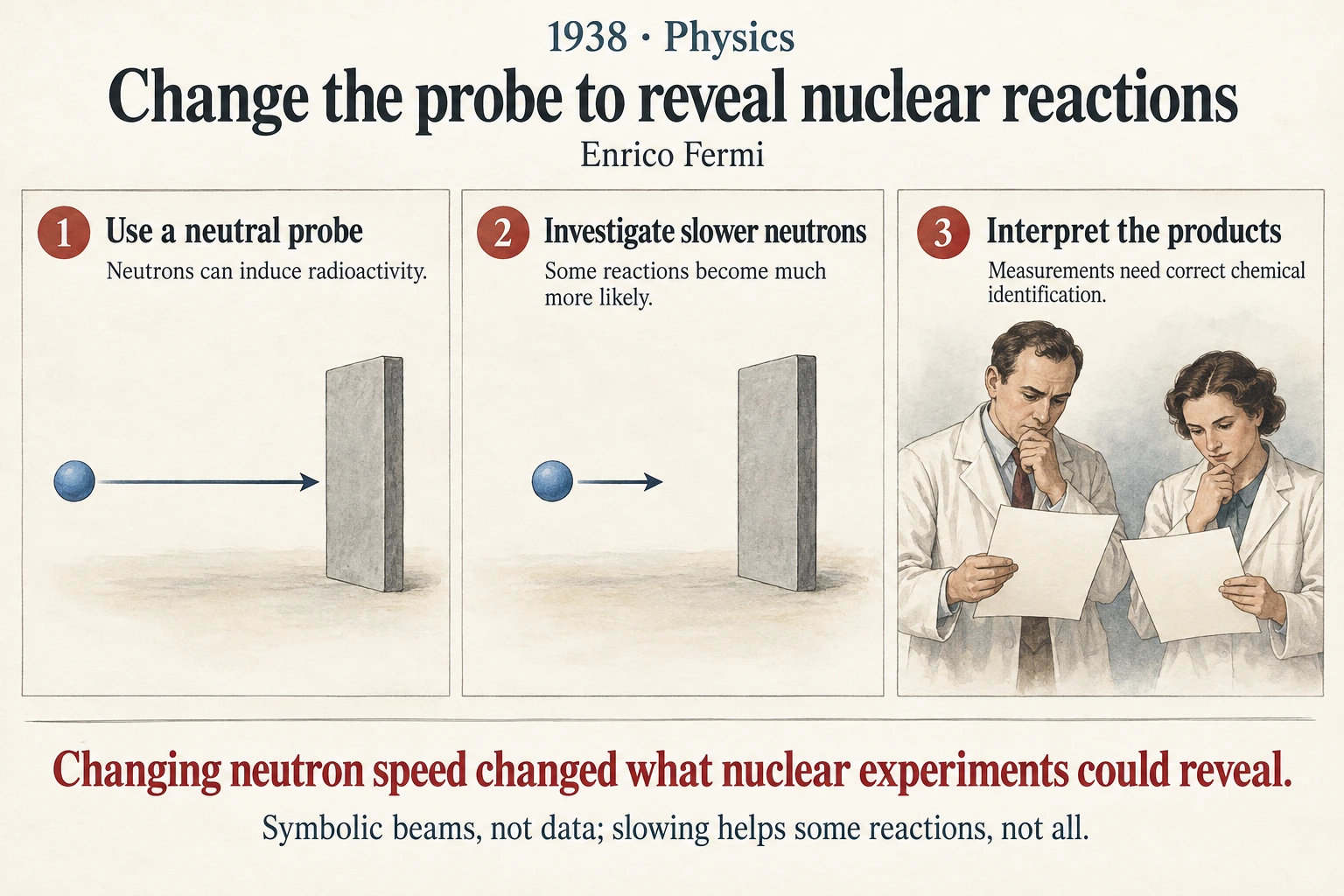
How could researchers investigate nuclei without relying only on charged projectiles? A neutron has no electric charge, so it does not face the same electrostatic repulsion as a positively charged projectile approaching a nucleus. In 1934 Fermi and his Roman collaborators explored the radioactivity produced when elements were exposed to neutrons. Chemical separation and radiation measurements helped them investigate the products.
They then found that neutron speed mattered in a surprising way: slowing the neutrons greatly increased the probability of certain interactions. Faster was not always more effective. The result opened a broad programme of work on neutron reactions, absorption and scattering. It also illustrates why measuring an effect and identifying its cause are different tasks. The complicated activities produced in uranium were initially interpreted as evidence of elements beyond uranium; that interpretation missed fission products among the mixture.
Why it matters
Neutron-induced radioactivity and the study of slow neutrons gave nuclear research new experimental reach. Later work connected these findings with the understanding of fission and chain reactions. Fermi’s 1942 Chicago reactor was a later collaborative achievement. His 1938 award should not be described as the discovery of that reactor or as a correct identification of all the early uranium products.