01 · The discovery
The idea, in everyday language
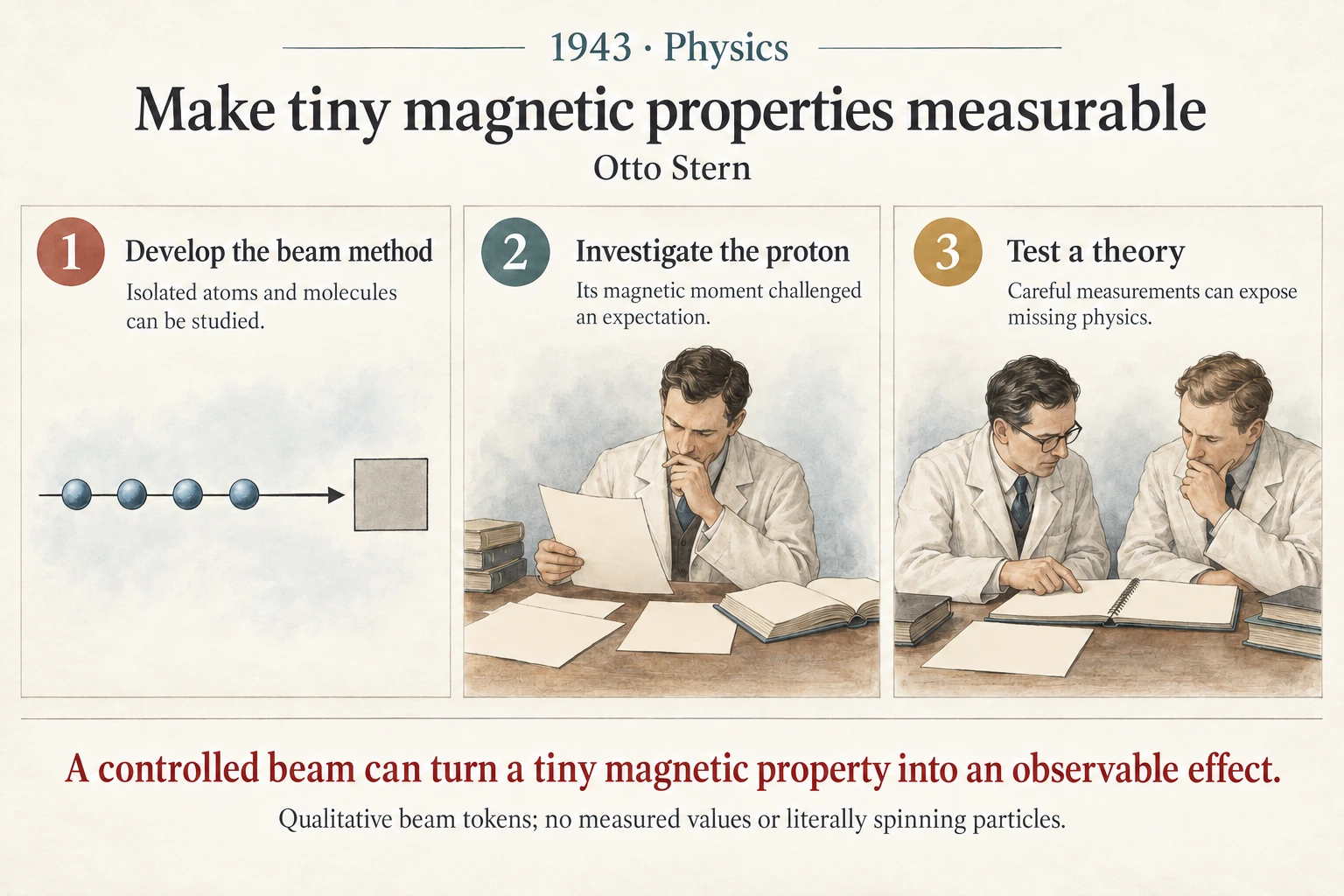
How can the magnetic properties of a particle far too small to see become measurable? A narrow beam of isolated atoms or molecules lets investigators connect microscopic properties with the beam’s observable motion. Stern developed and refined this approach rather than treating a substance only as a bulk sample.
The 1922 Stern–Gerlach experiment with silver atoms revealed distinct beam components in a non-uniform magnetic field, challenging the expected continuous spread. A later programme at Hamburg reached a different target: nuclear magnetic properties. In 1933 Stern and colleagues found the proton’s magnetic moment substantially different from a simple theoretical expectation. The 1943 award recognised both his development of the beam method and this proton result; it should not be reduced to the silver-beam experiment alone.
Why it matters
The beam method made important quantum and magnetic questions experimentally accessible. The unexpected proton result showed the limits of a simple account of the particle and supplied a challenge for theory. It was not, by itself, a direct image of the proton’s internal structure or a discovery of the later quark model.