c.curionodeThe Nobel Archive

1949 · Physics

A short-range force suggests a new particle

Yukawa connected the very short reach of nuclear forces with the mass of a proposed particle, opening a new way to understand binding inside nuclei.

Meson predictionShort-range forceMuon and pion
1949Physics

Visual guide

The prize, pictured

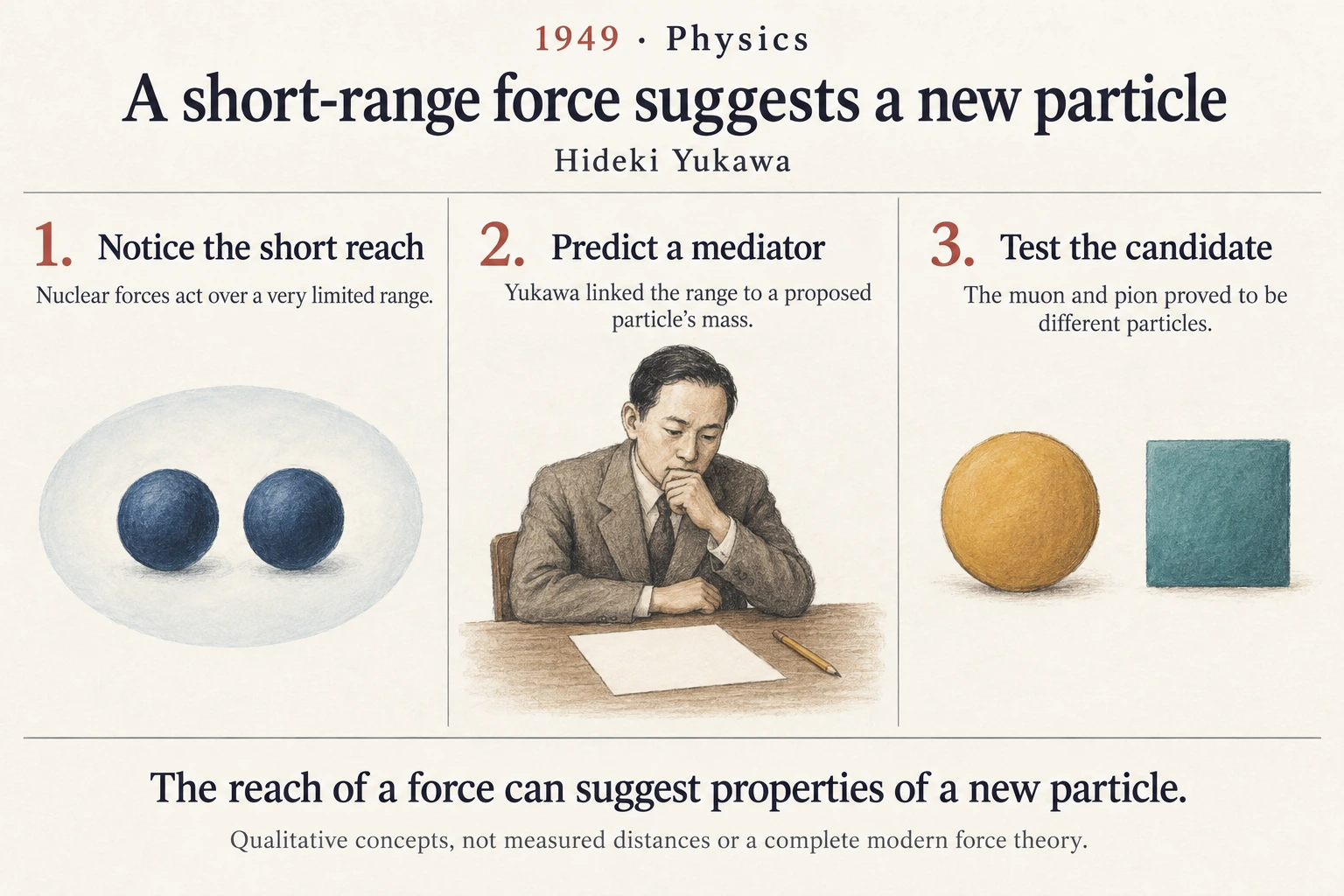
Infographic explaining A short-range force suggests a new particle
Original AI-generated infographic. A conceptual overview; the explanations and sources below provide context.
Read the poster text

The reach of a force can suggest properties of a new particle.

  1. Notice the short reach

    Nuclear forces act over a very limited range.

  2. Predict a mediator

    Yukawa linked the range to a proposed particle’s mass.

  3. Test the candidate

    The muon and pion proved to be different particles.

Qualitative concepts, not measured distances or a complete modern force theory.

01 · The discovery

The idea, in everyday language

Why do protons and neutrons bind together inside a nucleus, while this powerful attraction has such a limited reach? Yukawa proposed that an interaction carried by a particle with mass would have a characteristic short range. The observed scale of nuclei therefore suggested a previously unknown particle, heavier than the electron but lighter than a proton. He developed the idea in 1934 and published it in 1935.

Finding a particle of roughly suitable mass was not enough. The cosmic-ray particle identified in the 1930s, now called the muon, did not show the strong nuclear interactions required by the proposal. The pion identified in 1947 provided different evidence. The 1949 prize recognised Yukawa’s theoretical prediction; the experimental discoveries involved other researchers, including the Bristol team whose photographic methods were recognised in 1950.

Why it matters

The theory made the range of a force a clue to the properties of a particle. Meson-exchange ideas became important in describing residual nuclear forces between protons and neutrons, and prediction could be tested against the behaviour of newly observed particles.
02 · The people

Who brought the idea to life?

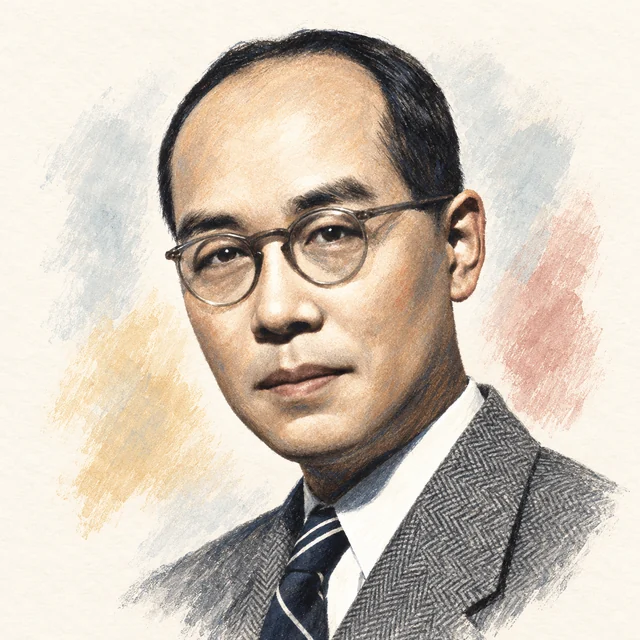
Illustrated portrait of Hideki Yukawa

Hideki Yukawa

Prize share · 1

Yukawa connected the short range of nuclear forces with the mass of an exchanged particle and predicted mesons. He received the full Physics Prize; experimental identification was the work of other researchers.

Read the biography ↗

03 · Years in the making

The path here

  1. 1929

    Yukawa graduates from Kyoto Imperial University.

  2. 1934

    He formulates a particle-exchange explanation of nuclear forces.

  3. 1935

    The theory is published in the Proceedings of the Physico-Mathematical Society of Japan.

  4. 1937

    Neddermeyer and Anderson publish Note on the Nature of Cosmic-Ray Particles, part of the early muon research.

  5. 1947

    The pion is identified in cosmic-ray research.

  6. 1949

    Yukawa receives the Physics Prize, with Columbia and Kyoto recorded as affiliations.

04 · Read further

From the original sources

Original explanations by Curionode, based on the official records below. Biographical details and affiliations refer to the award year.

  1. Official award summary nobelprize.org
  2. Award ceremony speech nobelprize.org
  3. Muon history: the 1936 observations muoncollider.web.cern.ch
  4. Neddermeyer and Anderson: 1937 publication record journals.aps.org
  5. Yukawa: original 1935 publication record jstage.jst.go.jp
  6. CERN: modern particle classification home.cern
  7. Official biography: Hideki Yukawa nobelprize.org