c.curionodeThe Nobel Archive

1954 · Chemistry

Connect chemical bonds with molecular structure

Pauling made quantum ideas useful for understanding chemical bonds, combining them with evidence about the arrangement of atoms.

Chemical bondingMolecular structureAlpha helix
1954Chemistry

Visual guide

The prize, pictured

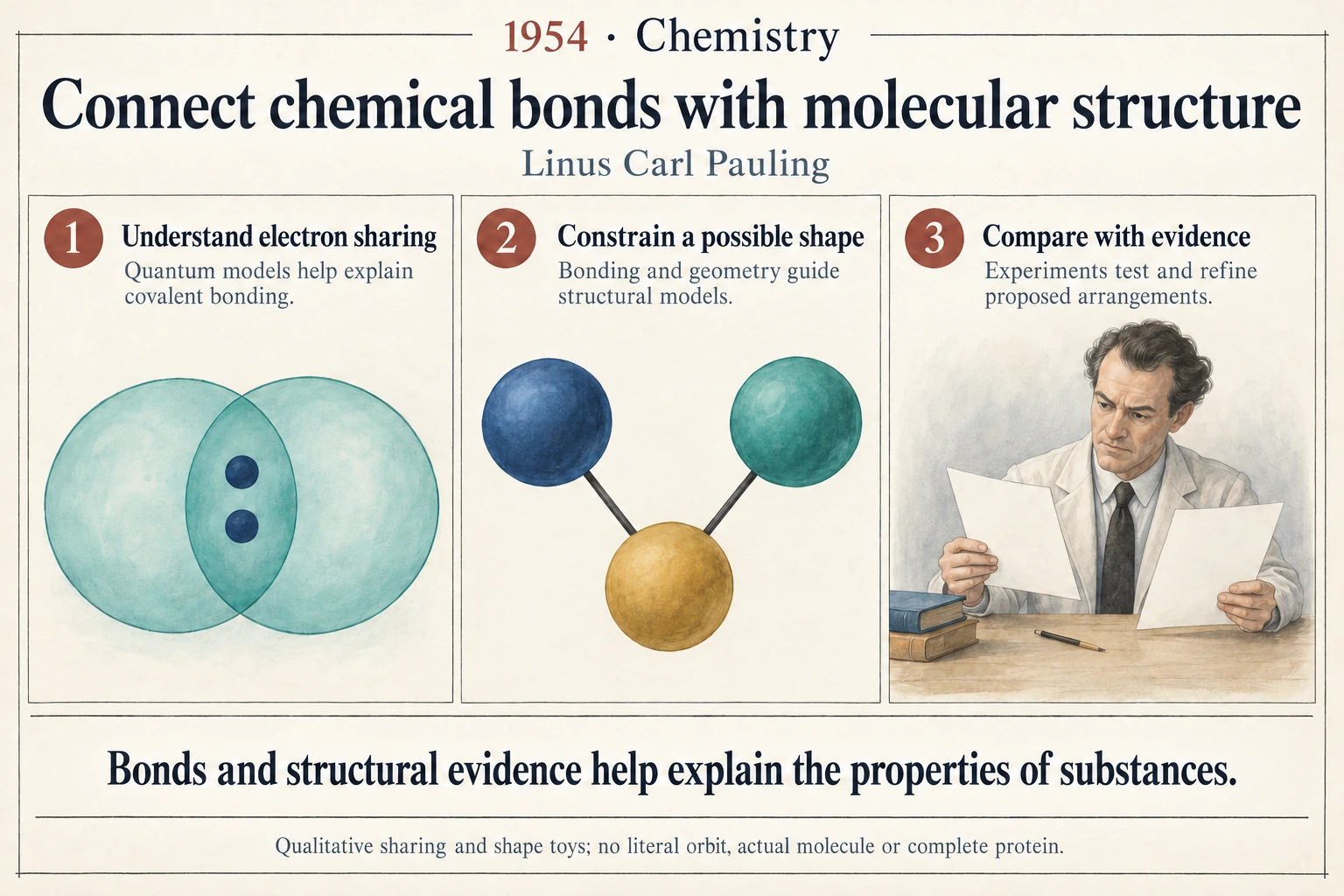
Infographic explaining Connect chemical bonds with molecular structure
Original AI-generated infographic. A conceptual overview; the explanations and sources below provide context.
Read the poster text

Bonds and structural evidence help explain the properties of substances.

  1. Understand electron sharing

    Quantum models help explain covalent bonding.

  2. Constrain a possible shape

    Bonding and geometry guide structural models.

  3. Compare with evidence

    Experiments test and refine proposed arrangements.

Qualitative sharing and shape toys; no literal orbit, actual molecule or complete protein.

01 · The discovery

The idea, in everyday language

Why do atoms join in particular ways, and how does bonding constrain a substance’s structure? Earlier pictures based only on attraction between opposite charges could not explain all compounds. Electron sharing and quantum mechanics provided a richer account. Pauling developed approximate methods that chemists could use to relate bonding to distances, directions and the properties of molecules and crystals.

His work joined theory to structural experiments, including X-ray and electron diffraction. The Nature of the Chemical Bond in 1939 brought these ideas together. Studies of amino acids and small peptides supplied constraints for work on proteins. In 1951 Pauling, R. B. Corey and H. R. Branson published their paper on hydrogen-bonded helical configurations of polypeptide chains. The alpha helix became an important local structural motif. The full 1954 prize recognised bonding and its application to complex substances, rather than the complete structure of every protein.

Why it matters

Relating bonds to structure helped chemists reason about the properties and reactions of substances. Experimental structures could test and refine theoretical models. The 1954 Chemistry Prize is separate from Pauling’s 1962 Peace Prize, received in 1963; the two prizes recognise different contributions.
02 · The people

Who brought the idea to life?

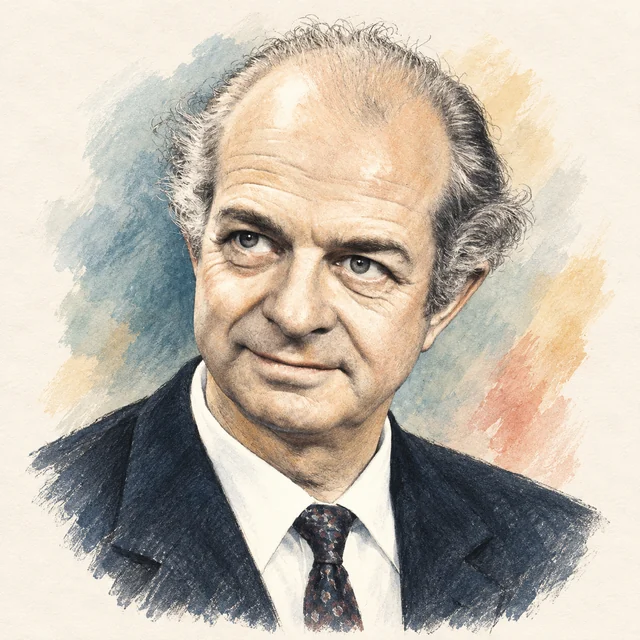
Illustrated portrait of Linus Carl Pauling

Linus Carl Pauling

Prize share · 1

Pauling applied quantum mechanics and experimental structural evidence to chemical bonding and complex substances. He received the full Chemistry Prize.

Read the biography ↗

03 · Years in the making

The path here

  1. 1901

    Pauling is born in Portland.

  2. 1922

    He receives his chemical-engineering bachelor’s degree.

  3. 1925

    He receives his Caltech chemistry doctorate.

  4. 1927

    He joins Caltech’s faculty.

  5. 1931

    He becomes professor.

  6. 1939

    The Nature of the Chemical Bond appears.

  7. 1951

    Pauling, Corey and Branson publish the protein-helix paper.

  8. 1954

    Pauling receives the full Chemistry Prize.

04 · Read further

From the original sources

Original explanations by Curionode, based on the official records below. Biographical details and affiliations refer to the award year.

  1. Official award summary nobelprize.org
  2. Award ceremony speech nobelprize.org
  3. Original protein-helix publication metadata pubmed.ncbi.nlm.nih.gov
  4. Official biography: Linus Carl Pauling nobelprize.org

More in Chemistry

Browse this subject ↗