c.curionodeThe Nobel Archive

1956 · Chemistry

Following the steps that sustain a chemical reaction

Hinshelwood and Semenov explained reaction mechanisms, including the continuation, branching and termination of chemical chains.

Reaction mechanismsChemical chainsBranching and termination
1956Chemistry

Visual guide

The prize, pictured

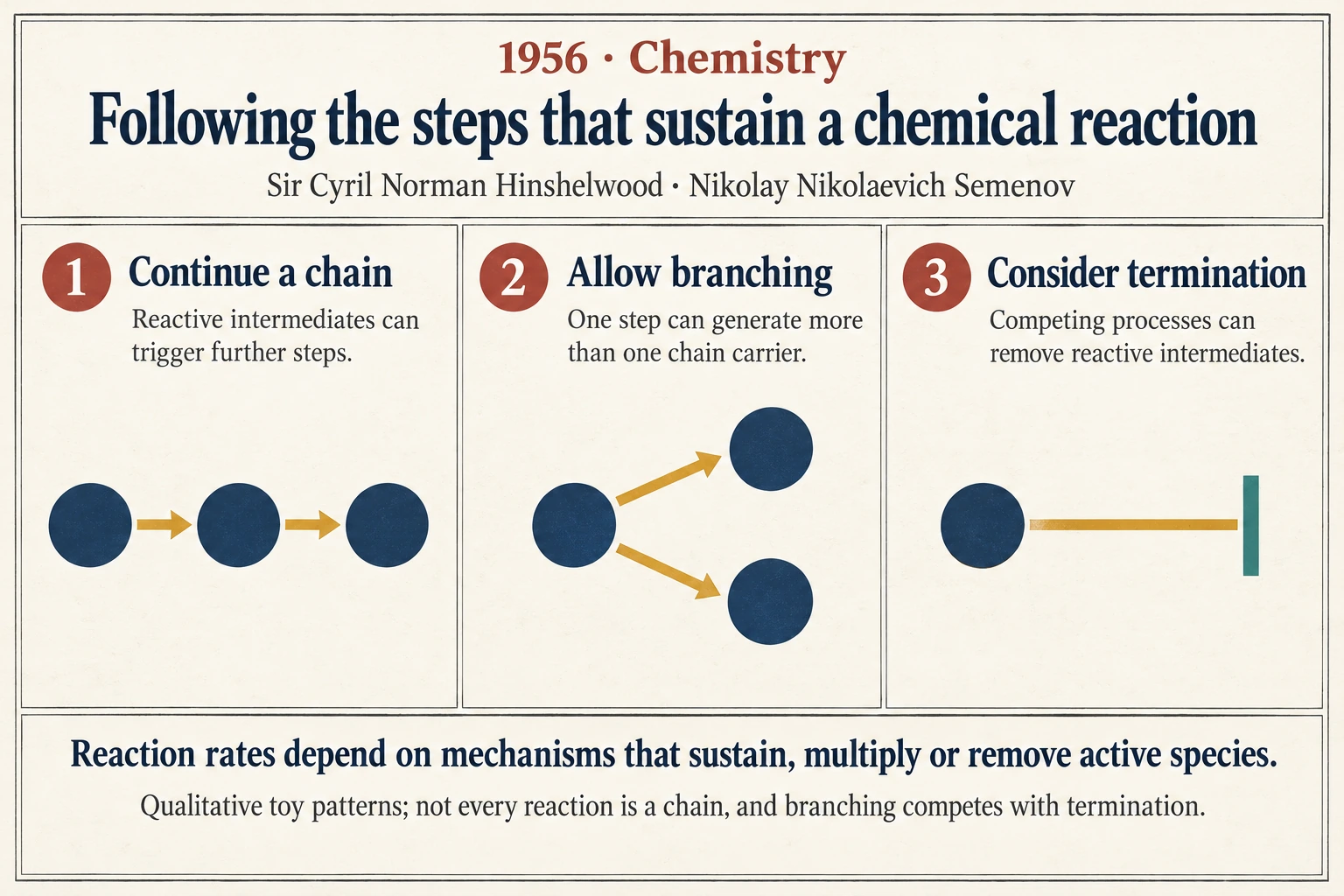
Infographic explaining Following the steps that sustain a chemical reaction
Original AI-generated infographic. A conceptual overview; the explanations and sources below provide context.
Read the poster text

Reaction rates depend on mechanisms that sustain, multiply or remove active species.

  1. Continue a chain

    Reactive intermediates can trigger further steps.

  2. Allow branching

    One step can generate more than one chain carrier.

  3. Consider termination

    Competing processes can remove reactive intermediates.

Qualitative toy patterns; not every reaction is a chain, and branching competes with termination.

01 · The discovery

The idea, in everyday language

A chemical equation can show starting substances and products without explaining the events in between or the reaction’s rate. Some reactions proceed through reactive intermediates that trigger further steps. Researchers needed to understand how such chains continue and why behaviour changes with conditions.

Hinshelwood and Semenov combined kinetic measurements with theoretical interpretation. Their groups investigated gas reactions and the competition between processes that sustain or remove reactive intermediates. Semenov developed the analysis of branching and induction periods; Hinshelwood also established the coexistence of chain and other mechanisms. Their work explained important features of oxidation and combustion without reducing all reactions to one pathway.

Why it matters

The research strengthened chemical kinetics and connected reaction mechanisms with experimental behaviour and practical questions in combustion. Hinshelwood and Semenov each received half of the 1956 prize. Their work built on earlier ideas from researchers including Bodenstein, Christiansen and Kramers, and on the experiments of their own groups.
02 · The people

Who brought the idea to life?

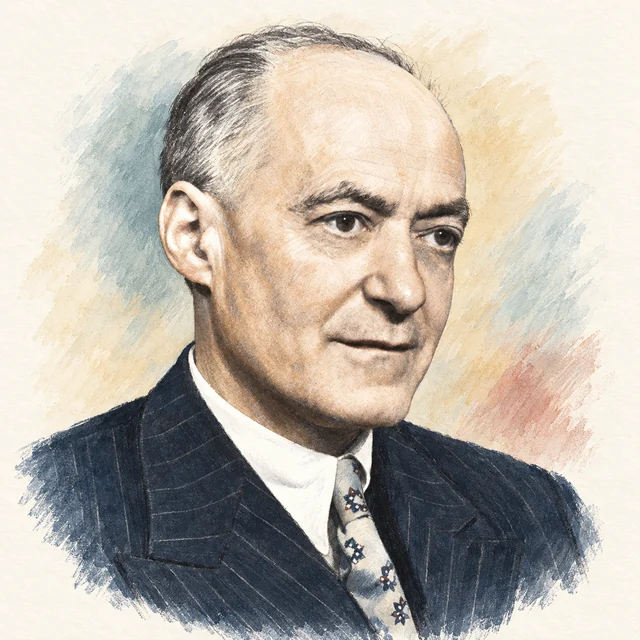
Illustrated portrait of Sir Cyril Norman Hinshelwood

Sir Cyril Norman Hinshelwood

Prize share · 1/2

Hinshelwood combined kinetic experiments and interpretation to explain chemical reaction mechanisms, including chain reactions and competing pathways. He received one half of the Chemistry Prize.

Read the biography ↗

03 · Years in the making

The path here

  1. 1913

    Bodenstein proposes an influential chemical-chain idea.

  2. 1917

    Semenov graduates at Petrograd.

  3. 1921

    Hinshelwood begins teaching at Trinity College, Oxford.

  4. 1923

    Christiansen and Kramers develop ideas of initiation and branching.

  5. 1926

    Hinshelwood’s kinetics book appears; phosphorus oxidation becomes an important experimental question.

  6. 1931

    Semenov becomes director of the Institute of Chemical Physics.

  7. 1934–1935

    Semenov’s chain-reaction book appears in Russian and then English.

  8. 1937

    Hinshelwood becomes Oxford’s chemistry professor.

  9. 1943–1944

    Semenov’s institute moves to Moscow and he becomes a Moscow State professor.

  10. 1956

    Hinshelwood and Semenov each receive half of the Chemistry Prize.

04 · Read further

From the original sources

Original explanations by Curionode, based on the official records below. Biographical details and affiliations refer to the award year.

  1. Official award summary nobelprize.org
  2. Award ceremony speech nobelprize.org
  3. Official biography: Sir Cyril Norman Hinshelwood nobelprize.org
  4. Official biography: Nikolay Nikolaevich Semenov nobelprize.org

More in Chemistry

Browse this subject ↗