01 · The discovery
The idea, in everyday language
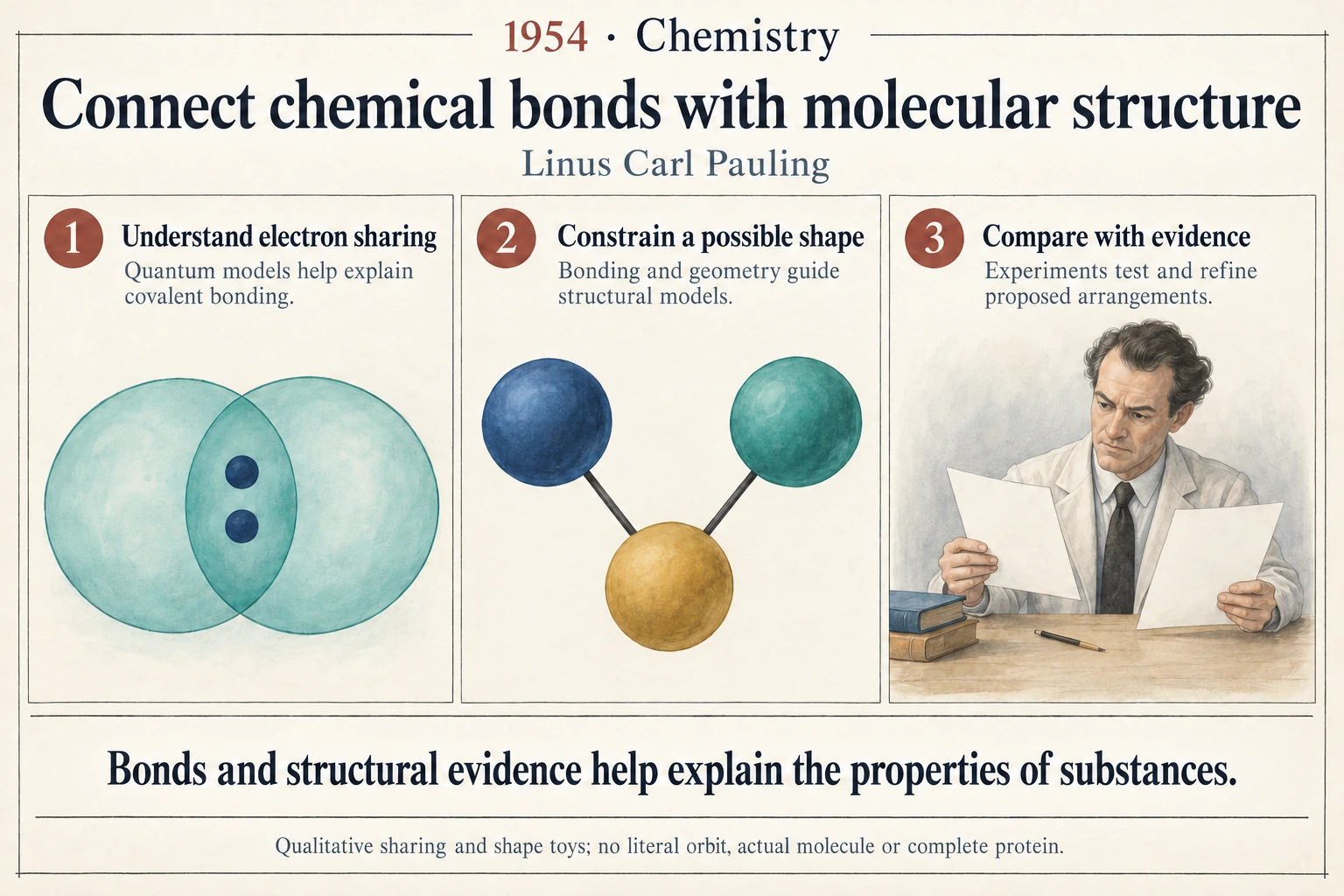
Why do atoms join in particular ways, and how does bonding constrain a substance’s structure? Earlier pictures based only on attraction between opposite charges could not explain all compounds. Electron sharing and quantum mechanics provided a richer account. Pauling developed approximate methods that chemists could use to relate bonding to distances, directions and the properties of molecules and crystals.
His work joined theory to structural experiments, including X-ray and electron diffraction. The Nature of the Chemical Bond in 1939 brought these ideas together. Studies of amino acids and small peptides supplied constraints for work on proteins. In 1951 Pauling, R. B. Corey and H. R. Branson published their paper on hydrogen-bonded helical configurations of polypeptide chains. The alpha helix became an important local structural motif. The full 1954 prize recognised bonding and its application to complex substances, rather than the complete structure of every protein.
Why it matters
Relating bonds to structure helped chemists reason about the properties and reactions of substances. Experimental structures could test and refine theoretical models. The 1954 Chemistry Prize is separate from Pauling’s 1962 Peace Prize, received in 1963; the two prizes recognise different contributions.