01 · The discovery
The idea, in everyday language
Pressure and blood flow inside the circulation were difficult to study directly in people. Measurements available outside the heart could not answer every question about the right heart, pulmonary circulation or the oxygen content of blood returning from the body.
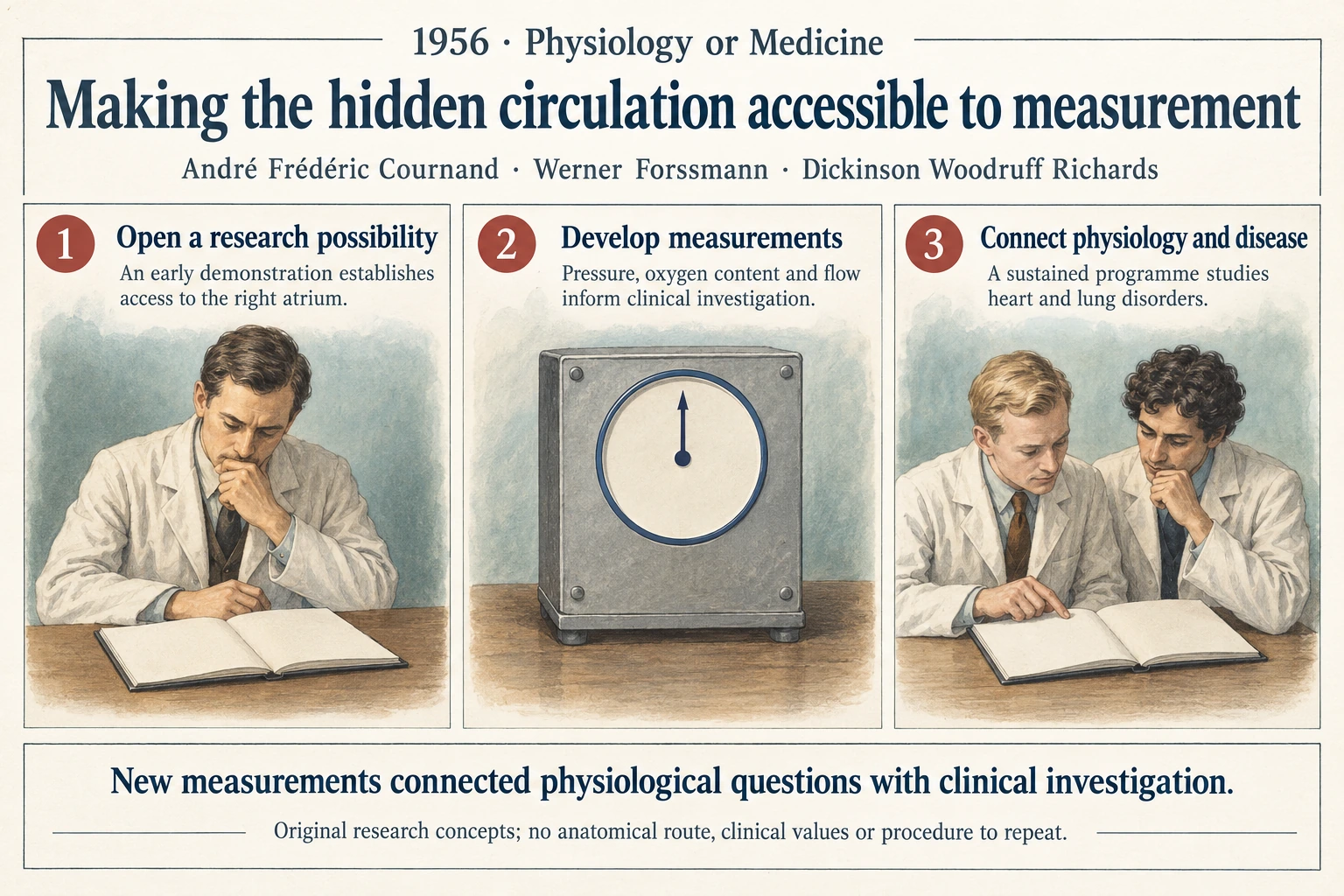
Forssmann’s 1929 self-experiment demonstrated access to the right atrium with a catheter. Cournand and Richards later developed the method through careful clinical investigation, publishing a human-catheterization report in 1941. Pressure measurements and blood samples, combined with oxygen-uptake measurements, made it possible to investigate blood flow and circulatory changes. Their group studied shock, heart failure, congenital abnormalities and the relationship between chronic lung disease and the right heart.
Why it matters
The work connected physiological methods with clinical questions and improved understanding of cardiopulmonary disorders. Forssmann’s early demonstration and Cournand and Richards’ later programme were distinct contributions made at different times. Each received one third of the 1956 prize. Further diagnostic and therapeutic advances depended on additional researchers and clinical development.