01 · The discovery
The idea, in everyday language
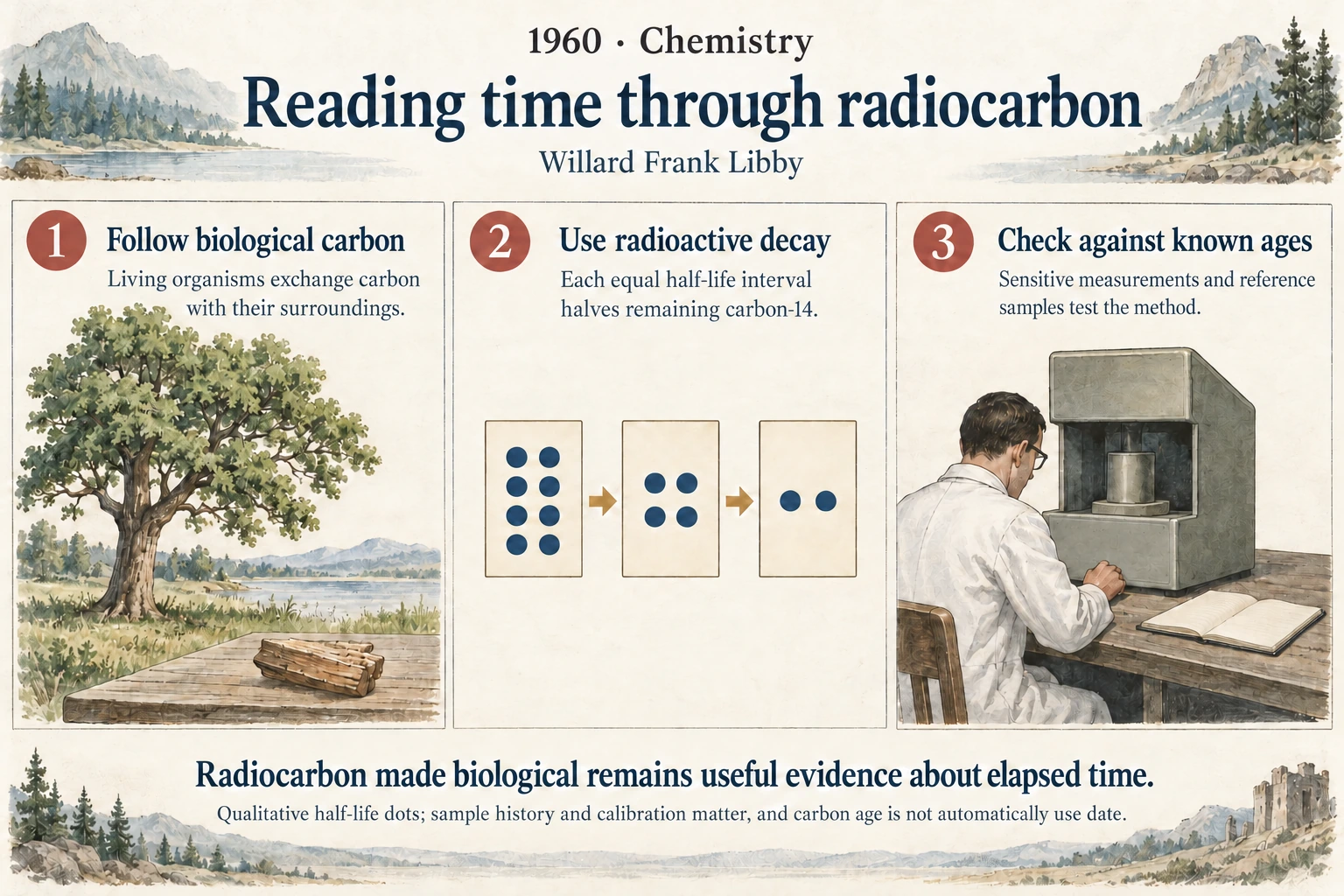
Archaeologists and geologists could often put remains in relative order, but needed independent estimates of elapsed time. A dating method required a natural process whose change could be measured and checked against samples of known age.
Libby connected carbon-14 in the atmosphere with carbon entering living organisms. Once exchange of that carbon stops, its radioactive component diminishes through decay. His team established natural radiocarbon, developed sufficiently sensitive measurements and tested known-age materials. Libby and Arnold reported their comparison in 1949.
Why it matters
The method gave numerical age estimates for biological carbon, complementing historical records and geological evidence. Anderson, Arnold and other collaborators contributed to the research. Libby’s full prize recognised its development and wide importance, rather than a claim that every object or fossil can be dated this way.