c.curionodeThe Nobel Archive

1962 · Chemistry

Revealing the shapes of globular proteins

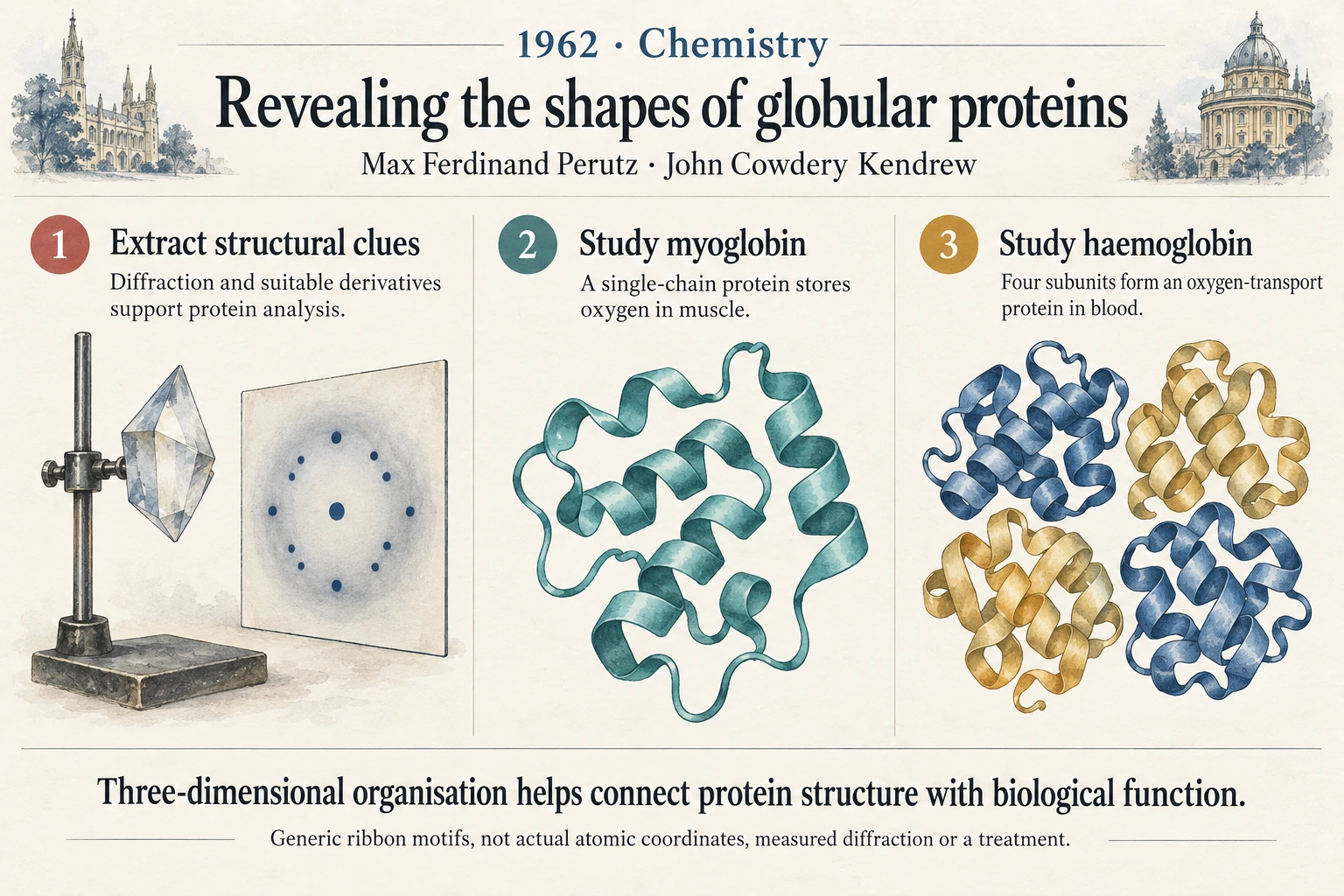
Perutz’s haemoglobin and Kendrew’s myoglobin studies made complex three-dimensional protein structures accessible.

Protein crystallographyStructure and functionHaemoglobin and myoglobin
1962Chemistry

Visual guide

The prize, pictured

Infographic explaining Revealing the shapes of globular proteins
Original AI-generated infographic. A conceptual overview; the explanations and sources below provide context.
Read the poster text

Three-dimensional organisation helps connect protein structure with biological function.

  1. Extract structural clues

    Diffraction and suitable derivatives support protein analysis.

  2. Study myoglobin

    A single-chain protein stores oxygen in muscle.

  3. Study haemoglobin

    Four subunits form an oxygen-transport protein in blood.

Generic ribbon motifs, not actual atomic coordinates, measured diffraction or a treatment.

01 · The discovery

The idea, in everyday language

Knowing a protein’s ingredients does not show how its chain folds in space. Protein crystals produce diffraction patterns, but measurements alone leave a difficult phase problem and require extensive calculations.

Perutz and collaborators used heavy-atom derivatives to extract structural information from changed diffraction patterns. Kendrew’s team applied related methods to myoglobin. An early six-ångström myoglobin model was achieved in 1957 and reported in 1958; the 1960 two-ångström report revealed much finer detail. Perutz’s haemoglobin model was reported at 5.5-ångström resolution in the same 1960 issue.

Why it matters

The work established that complicated globular proteins could be structurally analysed. Myoglobin is a single-chain oxygen store in muscle; haemoglobin has four subunits and transports oxygen in blood. Their structures connect spatial organisation with biological function. Each laureate received one half, with experimental, mathematical and computational collaborators contributing.
02 · The people

Who brought the idea to life?

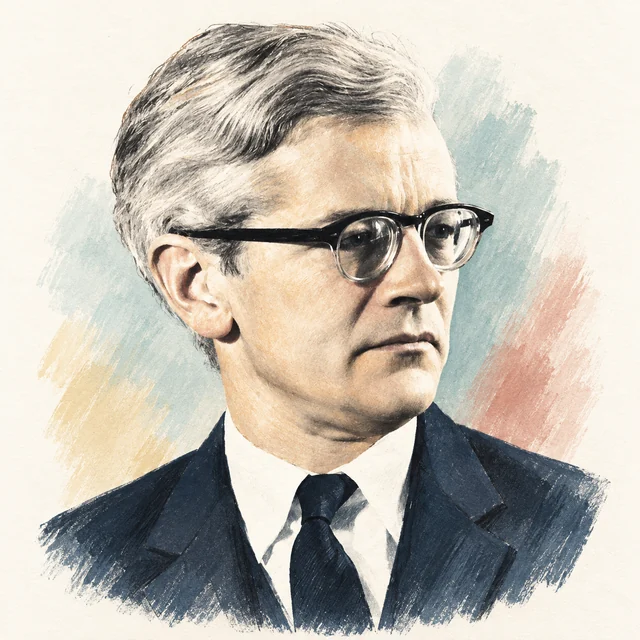
Illustrated portrait of John Cowdery Kendrew

John Cowdery Kendrew

Prize share · 1/2

Kendrew and collaborators established myoglobin’s three-dimensional structure and demonstrated detailed protein structure determination. He received one half.

Read the biography ↗

03 · Years in the making

The path here

  1. 1936

    Perutz begins Cambridge crystallographic research.

  2. 1937

    He begins studying haemoglobin.

  3. 1946

    Kendrew joins the Cambridge protein research.

  4. 1953

    Perutz advances heavy-atom derivative methods.

  5. 1957–1958

    A low-resolution myoglobin model is achieved and reported.

  6. 1960

    Myoglobin and haemoglobin structure reports appear in Nature.

  7. 1962

    Perutz and Kendrew share the Chemistry Prize.

04 · Read further

From the original sources

Original explanations by Curionode, based on the official records below. Biographical details and affiliations refer to the award year.

  1. Official award summary nobelprize.org
  2. Award ceremony speech nobelprize.org
  3. RCSB protein structure guide pdb101.rcsb.org
  4. Myoglobin early model publication nature.com
  5. Haemoglobin 1960 publication metadata nature.com
  6. Myoglobin 1960 publication metadata nature.com
  7. Official biography: Max Ferdinand Perutz nobelprize.org
  8. Official biography: John Cowdery Kendrew nobelprize.org

More in Chemistry

Browse this subject ↗