01 · The discovery
The idea, in everyday language
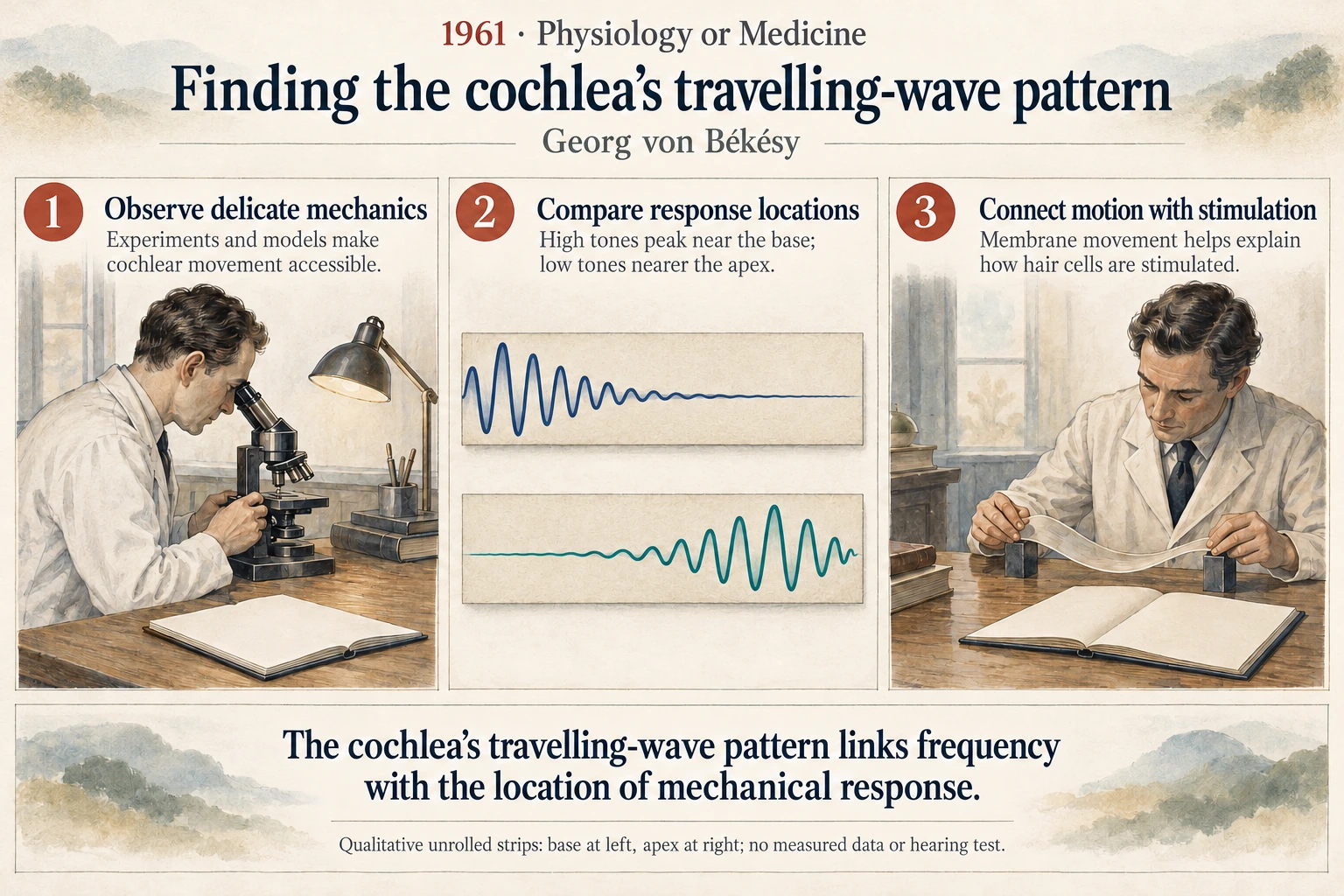
Sound reaches the inner ear through vibrations transmitted by the eardrum and middle-ear bones. How the cochlea’s delicate structures responded, and how this response distinguished frequencies, required direct physical investigation.
Békésy combined careful observation, stroboscopic microscopy and mechanical models. Motion from the stapes produces a travelling wave along the basilar membrane, from its stiffer base toward its more flexible apex. The largest response occurs nearer the base for high-frequency tones and nearer the apex for low-frequency tones. He also investigated how motion stimulates sensory hair cells.
Why it matters
The work supplied a physical foundation for understanding the cochlea as a frequency analyser and supported further auditory research. Békésy received the full prize for discoveries about stimulation within the cochlea. Mechanical motion is part of a larger sequence that includes hair-cell signals, the auditory nerve and brain processing.