c.curionodeThe Nobel Archive

1961 · Physics

Two precise ways to investigate nuclei

Electron scattering revealed spatial structure, while recoilless gamma-ray resonance opened exceptionally sensitive measurements.

Electron scatteringNucleon structureRecoilless resonance
1961Physics

Visual guide

The prize, pictured

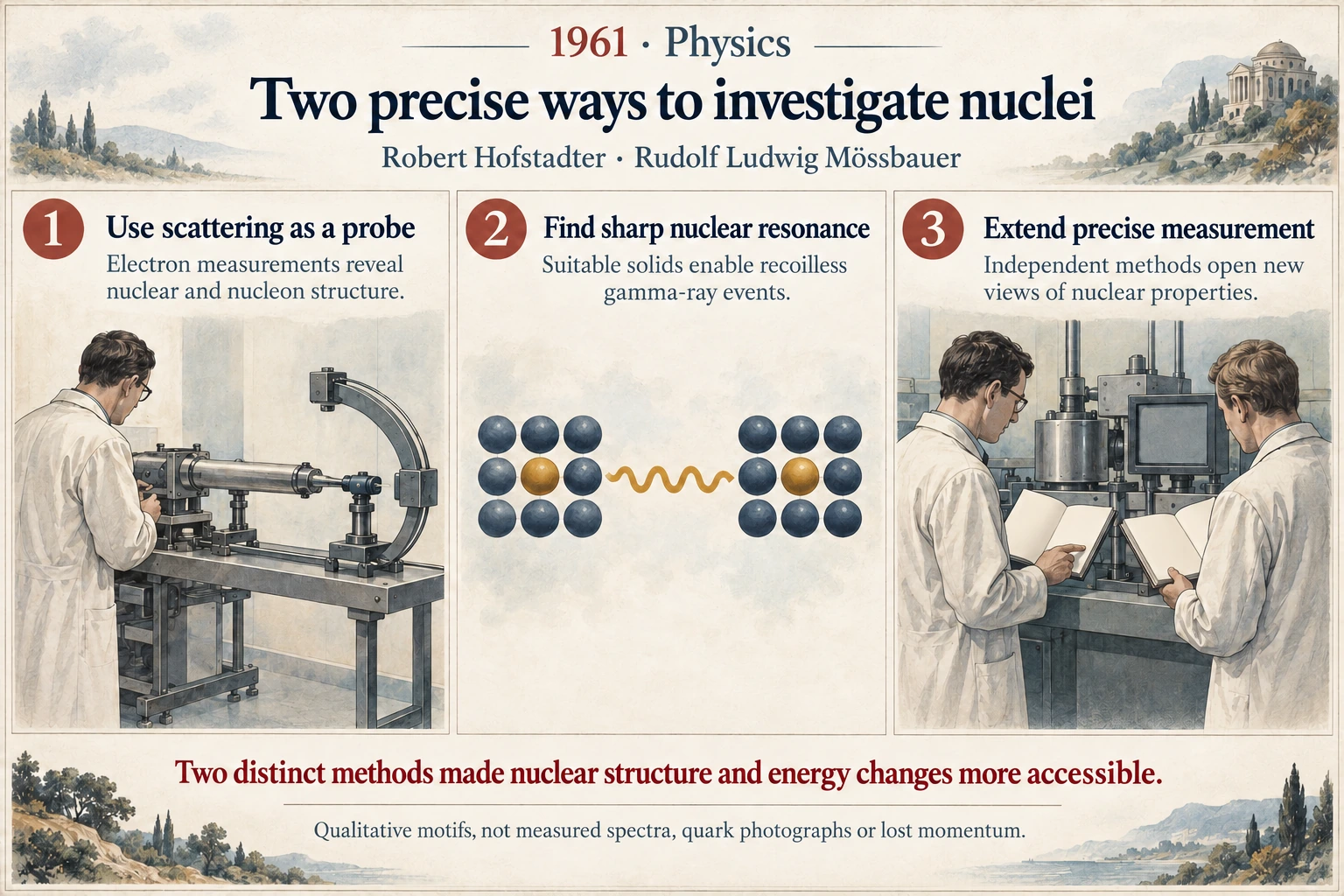
Infographic explaining Two precise ways to investigate nuclei
Original AI-generated infographic. A conceptual overview; the explanations and sources below provide context.
Read the poster text

Two distinct methods made nuclear structure and energy changes more accessible.

  1. Use scattering as a probe

    Electron measurements reveal nuclear and nucleon structure.

  2. Find sharp nuclear resonance

    Suitable solids enable recoilless gamma-ray events.

  3. Extend precise measurement

    Independent methods open new views of nuclear properties.

Qualitative motifs, not measured spectra, quark photographs or lost momentum.

01 · The discovery

The idea, in everyday language

Nuclei and their proton and neutron constituents are too small for ordinary inspection. Researchers needed ways to infer their internal distributions and to measure tiny changes in nuclear energy levels.

Hofstadter built precise high-energy electron-scattering experiments. The energies and directions of scattered electrons constrained nuclear charge distributions and the charge and magnetic structure of nucleons. Independently, Mössbauer discovered that a significant fraction of gamma-ray emission and absorption in suitable solids can occur without the usual recoil-energy loss, allowing very sharp nuclear resonance.

Why it matters

The scattering work established structural properties of nuclei and nucleons. Mössbauer’s effect enabled precise studies of nuclear levels and their surroundings, with applications extending into solid-state physics. Each laureate received one half for his distinct contribution; this was not a single joint experiment.
02 · The people

Who brought the idea to life?

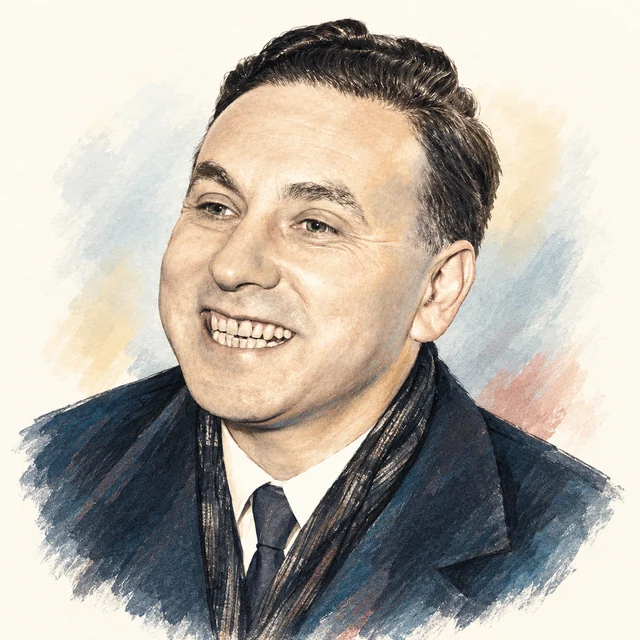
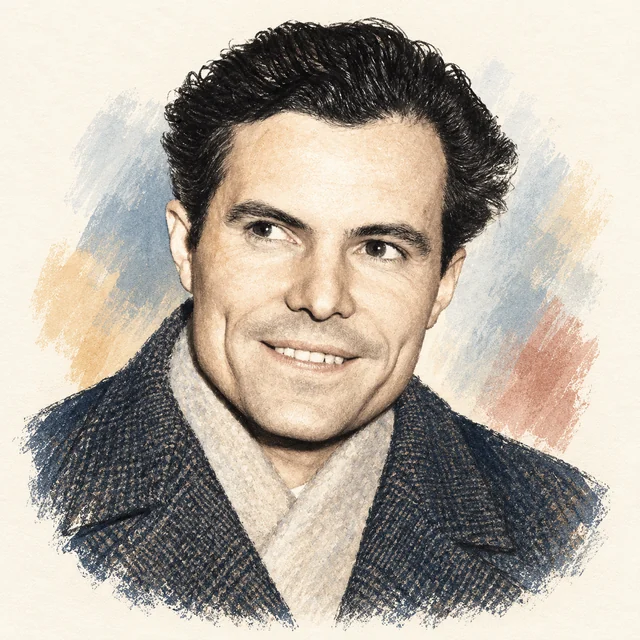
Illustrated portrait of Robert Hofstadter

Robert Hofstadter

Prize share · 1/2

Hofstadter developed electron-scattering measurements that revealed nuclear and nucleon structure. He received one half of the Physics Prize.

Read the biography ↗

03 · Years in the making

The path here

  1. 1938

    Hofstadter completes his Princeton doctorate.

  2. 1950

    He begins Stanford research.

  3. 1953

    Electron scattering becomes his principal interest.

  4. 1955–1957

    Mössbauer investigates gamma absorption in Heidelberg.

  5. 1958

    His doctorate and published recoilless-resonance discovery follow.

  6. 1960

    Mössbauer joins Caltech.

  7. 1961

    The two physicists receive separate half shares.

04 · Read further

From the original sources

Original explanations by Curionode, based on the official records below. Biographical details and affiliations refer to the award year.

  1. Official award summary nobelprize.org
  2. Award ceremony speech nobelprize.org
  3. Official biography: Robert Hofstadter nobelprize.org
  4. Official biography: Rudolf Ludwig Mössbauer nobelprize.org