01 · The discovery
The idea, in everyday language
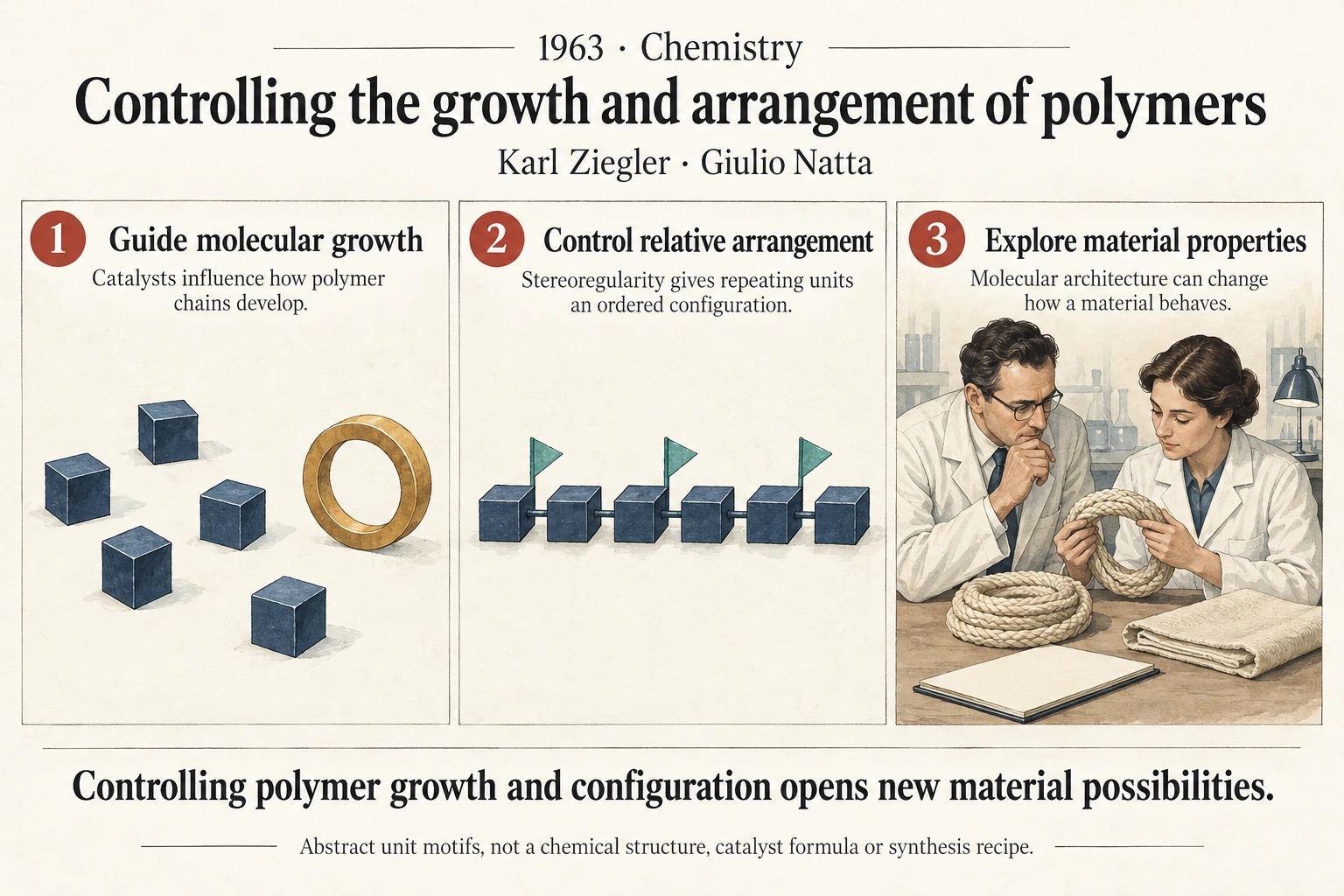
A polymer contains many linked units. Its properties depend on how the chain grows and how its parts are arranged, not only on the identity of the starting molecules. Chemists needed ways to control these features.
Ziegler’s organometallic mixed catalyst systems enabled important new polymerisation reactions, including polyethylene formation. Natta extended related work toward stereoregular polymers such as isotactic polypropylene. A Politecnico diary records polypropylene work on 11 March 1954, preceding the Nobel facts page’s 1955 discovery date. Research teams and Montecatini helped develop industrial applications.
Why it matters
The discoveries opened major routes to synthetic materials and showed how molecular arrangement influences properties. Isotactic polypropylene entered industrial production in 1957. Each laureate received one half. The prize recognised particular advances, rather than the invention of every plastic or every polymerisation method.