01 · The discovery
The idea, in everyday language
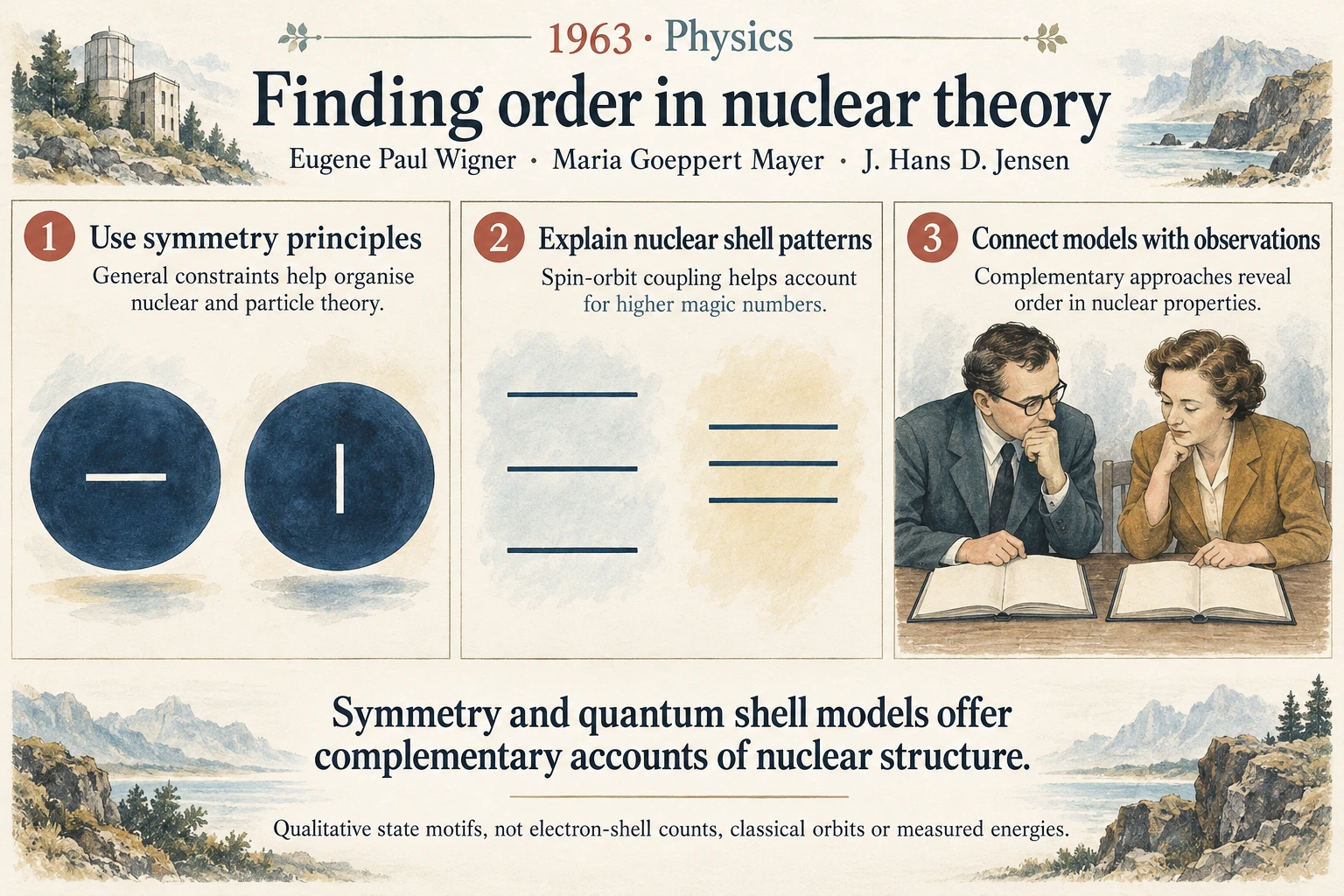
A nuclear theory must explain patterns in many observations despite incomplete knowledge of the forces involved. Wigner developed mathematical symmetry methods that constrain possible states, interactions and reactions. The methods became important in atomic, nuclear and elementary-particle physics.
Some proton or neutron counts produce especially strong closed-shell patterns. Goeppert Mayer and, independently, Haxel, Jensen and Suess explained higher magic numbers using spin-orbit coupling in a quantum shell model. The coupling changes the pattern of available nuclear states. Mayer and Jensen later collaborated; their work was distinct from Wigner’s broader symmetry contributions.
Why it matters
Symmetry supplied general tools for theory, while shell models organised nuclear observations and supported predictions about low-energy properties. Wigner received one half of the prize; Mayer and Jensen each received one quarter. Haxel and Suess were important collaborators in the independent shell-model work.