01 · The discovery
The idea, in everyday language
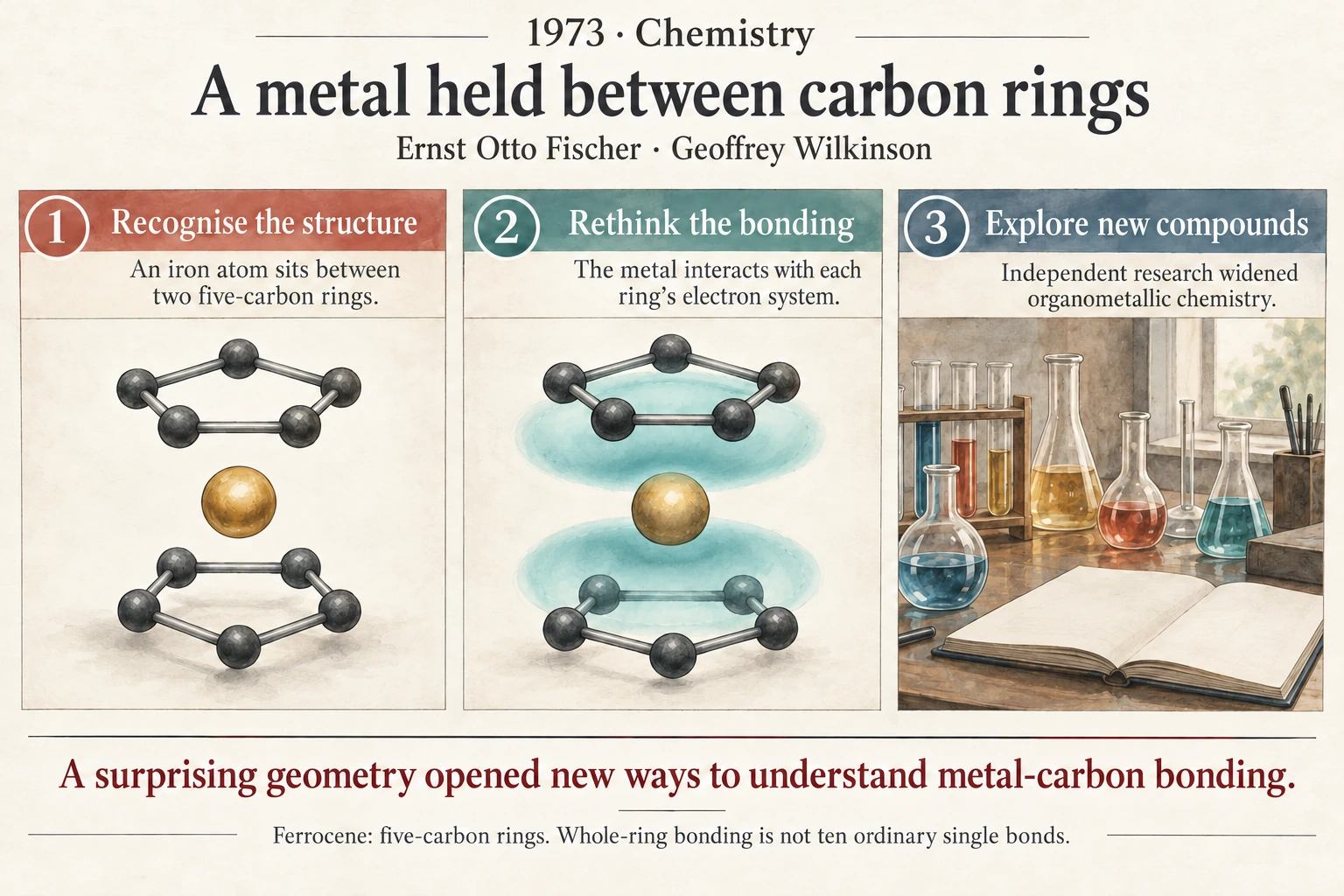
Other chemists had already prepared ferrocene. In 1952, Fischer and Wilkinson independently helped explain its surprising structure: an iron atom sits between two five-carbon cyclopentadienyl rings. The interaction involves each ring’s electron system, rather than two ordinary single bonds to isolated ring atoms. Its symmetry and stability challenged the first proposed structural picture.
The work grew into the preparation and study of many related metal complexes. Changing metals and ligands revealed new structures and reactivity. Fischer explored additional classes of metal compounds; Wilkinson’s wider transition-metal research included homogeneous catalysis. Their paths were independent, and not every catalyst or organometallic compound has a sandwich structure.
Why it matters
The discoveries broadened chemists’ understanding of metal-carbon bonding and ways to design new compounds. Organometallic chemistry became an important meeting point of inorganic and organic chemistry, with useful connections to reaction mechanisms and catalysis.