01 · The discovery
The idea, in everyday language
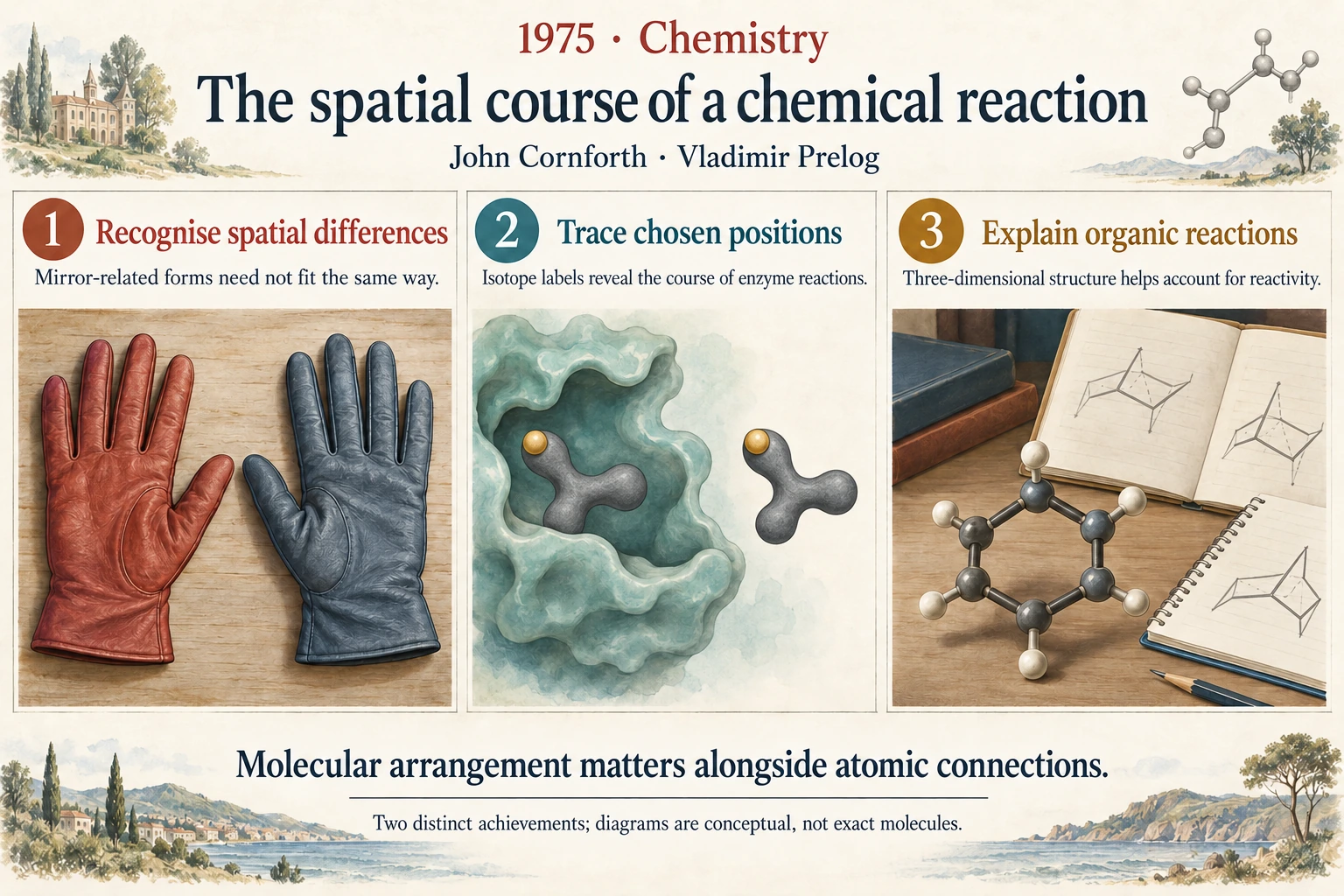
Two molecules can contain the same connected atoms yet differ in spatial arrangement. Some form mirror-related structures that cannot be superimposed, like left and right hands. Such differences matter when a molecule meets another asymmetric structure, including an enzyme. Prelog investigated these connections in organic molecules and reactions, studying natural compounds, ring structures and the relation between spatial arrangement and chemical behaviour. Stereochemistry asks more than which atoms are present: it asks how they are placed.
Cornforth used isotopic substitution to make otherwise difficult-to-distinguish positions traceable. Hydrogen isotopes share chemical identity but differ in mass, allowing carefully designed experiments to follow particular atoms and determine the spatial course of enzyme-catalysed transformations. Work with Rita Cornforth, George Popjak, Hermann Eggerer and other collaborators helped reveal the selectivity of biosynthetic reactions. Cornforth and Prelog each received one half for distinct contributions. This was not one joint reaction or a claim that mass alone determines every reaction rate.
Why it matters
The research helped turn stereochemical questions into experimentally testable explanations of molecular reactions. It clarified the spatial precision of enzyme chemistry and extended the study of organic structure, giving researchers stronger ways to understand and design transformations.