01 · The discovery
The idea, in everyday language
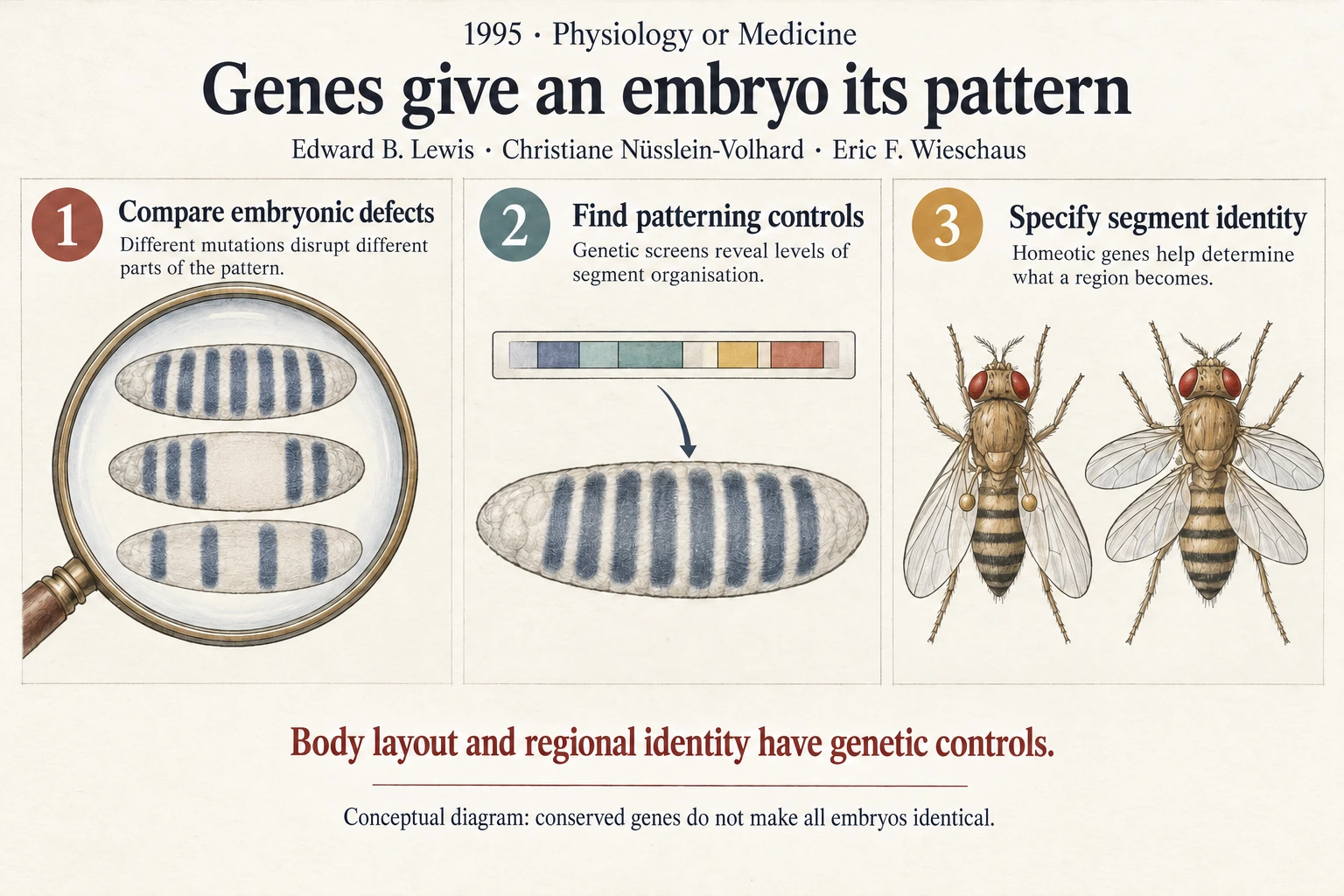
An embryo does not become a patterned animal merely by growing larger. Regions must be established, repeated units arranged and different structures assigned to particular positions. Nüsslein-Volhard and Wieschaus systematically searched for fruit-fly mutations that disrupted early segmentation. Their screen distinguished defects affecting broad regions, alternating segments and the organisation within individual segments, revealing different levels of genetic control.
Lewis investigated a complementary question: why a segment makes one structure rather than another. His analysis of homeotic genes, especially the bithorax complex, connected gene organisation with segment identity along the body axis. In a striking mutant, a region normally forming balancing organs instead develops an extra pair of wings. Together the discoveries showed that genetic control of body pattern could be studied experimentally, and related genes were subsequently found in other animals.
Why it matters
The work established a systematic genetic approach to embryonic development. Finding related control genes and mechanisms across species connected fruit-fly research to broader animal biology, including humans. It improved understanding of how development can go wrong, without being itself a treatment for congenital disorders.