c.curionodeThe Nobel Archive

1996 · Literature

Small moments, unsettled certainties

Szymborska’s poetry uses precise irony and changes of perspective to reveal more than an everyday scene first seems to contain.

Polish poetryironyperspectiveeveryday experience
1996Literature

Visual guide

The prize, pictured

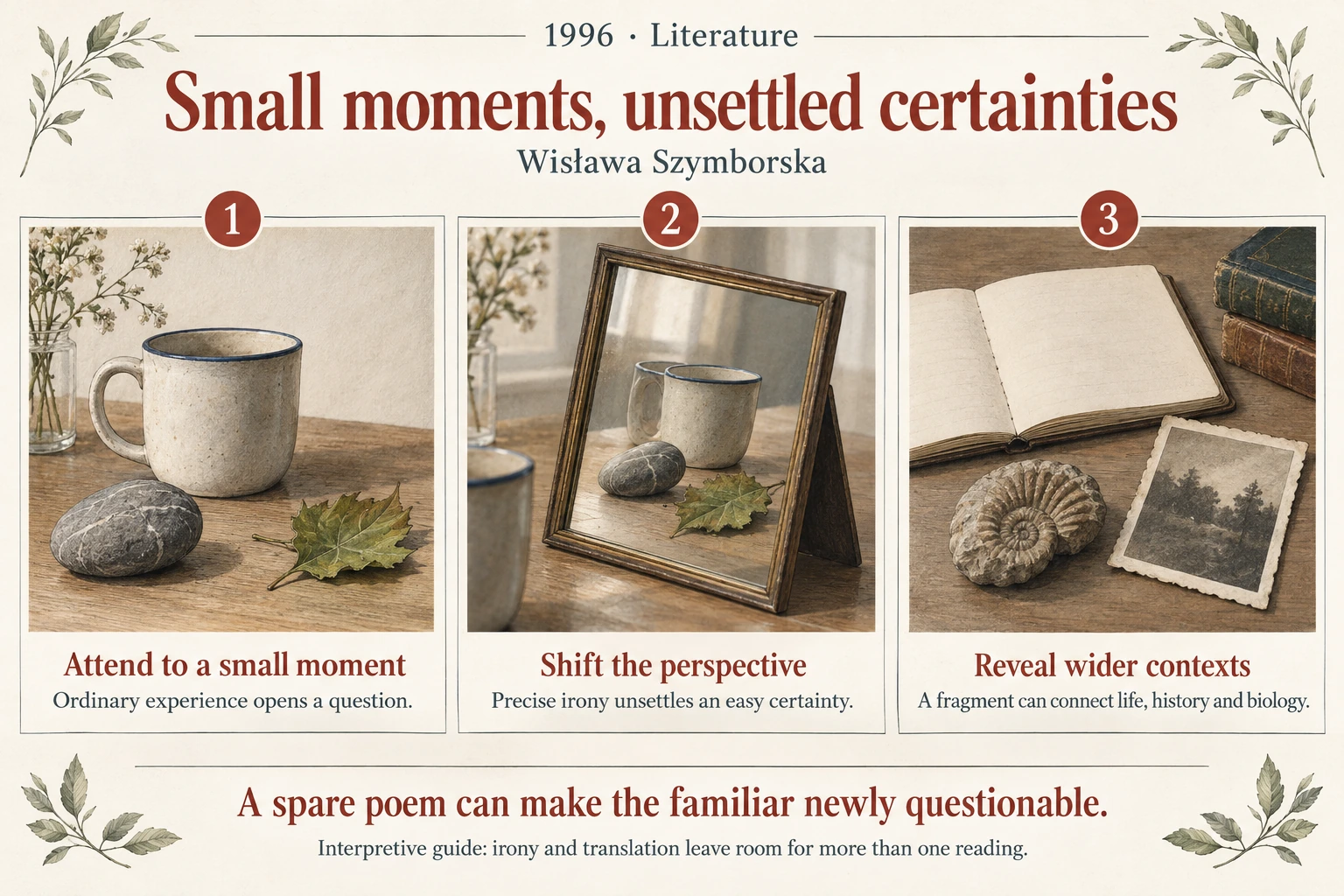
Infographic explaining Small moments, unsettled certainties
Original AI-generated infographic. A conceptual overview; the explanations and sources below provide context.
Read the poster text

A spare poem can make the familiar newly questionable.

  1. Attend to a small moment

    Ordinary experience opens a question.

  2. Shift the perspective

    Precise irony unsettles an easy certainty.

  3. Reveal wider contexts

    A fragment can connect life, history and biology.

Interpretive guide: irony and translation leave room for more than one reading.

01 · The contribution

The idea, in everyday language

A small encounter or an ordinary observation can carry questions about time, history and what it means to be human. Szymborska’s Polish poetry works through such fragments rather than announcing a total explanation. A seemingly simple statement may shift under a question, a contrast or an unexpected viewpoint. The familiar becomes strange enough to be examined again.

The 1996 award recognised a body of work whose restraint gives irony unusual force. Her poems combine intellectual inventiveness with empathy, bringing historical and biological contexts into the present without reducing an individual life to a formula. Collections such as Calling Out to Yeti and The End and the Beginning show the range of this approach; the recognition was not for a single book.

Why it matters

Her work offers a way to question certainty while remaining attentive to particular lives. Translation helped readers beyond Polish encounter its wit and compassion. The poems invite interpretation and renewed observation rather than supplying a fixed lesson that every reader must extract.


02 · The people

Who brought the idea to life?

Illustrated portrait of Wisława Szymborska

Wisława Szymborska

Prize share · 1/1

The award recognised a body of Polish poetry in which precise irony opens small moments onto history, biology and the uncertainties of human existence. Szymborska often unsettles an apparently obvious view through a change of perspective. Her writing joins intellectual play with empathy, without turning a poem into a single moral or doctrine. The prize was not attached to one collection or a newly invented literary technique.

Read the biography ↗

03 · Years in the making

The path here

  1. 1945

    Szymborska’s first published poem appears in a Kraków newspaper.

  2. 1957

    Calling Out to Yeti marks an important stage in the later poetic voice.

  3. 1993

    The End and the Beginning is published.

  4. 1996

    The Literature Prize recognises her poetry’s ironic precision and wider contexts.

04 · Read further

From the original sources

Original explanations by Curionode, based on the official records below. Biographical details and affiliations refer to the award year.

  1. Official announcement nobelprize.org
  2. Official biobibliography nobelprize.org

More in Literature

Browse this subject ↗