c.curionodeThe Nobel Archive

1996 · Physiology or Medicine

An immune signal has a context

Killer T cells do not read foreign material in isolation. Specific recognition also depends on the body’s own presenting molecules.

T cellsMHC restrictionantigen presentationimmune specificity
1996Physiology or Medicine

Visual guide

The prize, pictured

Infographic explaining An immune signal has a context
Original AI-generated infographic. A conceptual overview; the explanations and sources below provide context.
Read the poster text

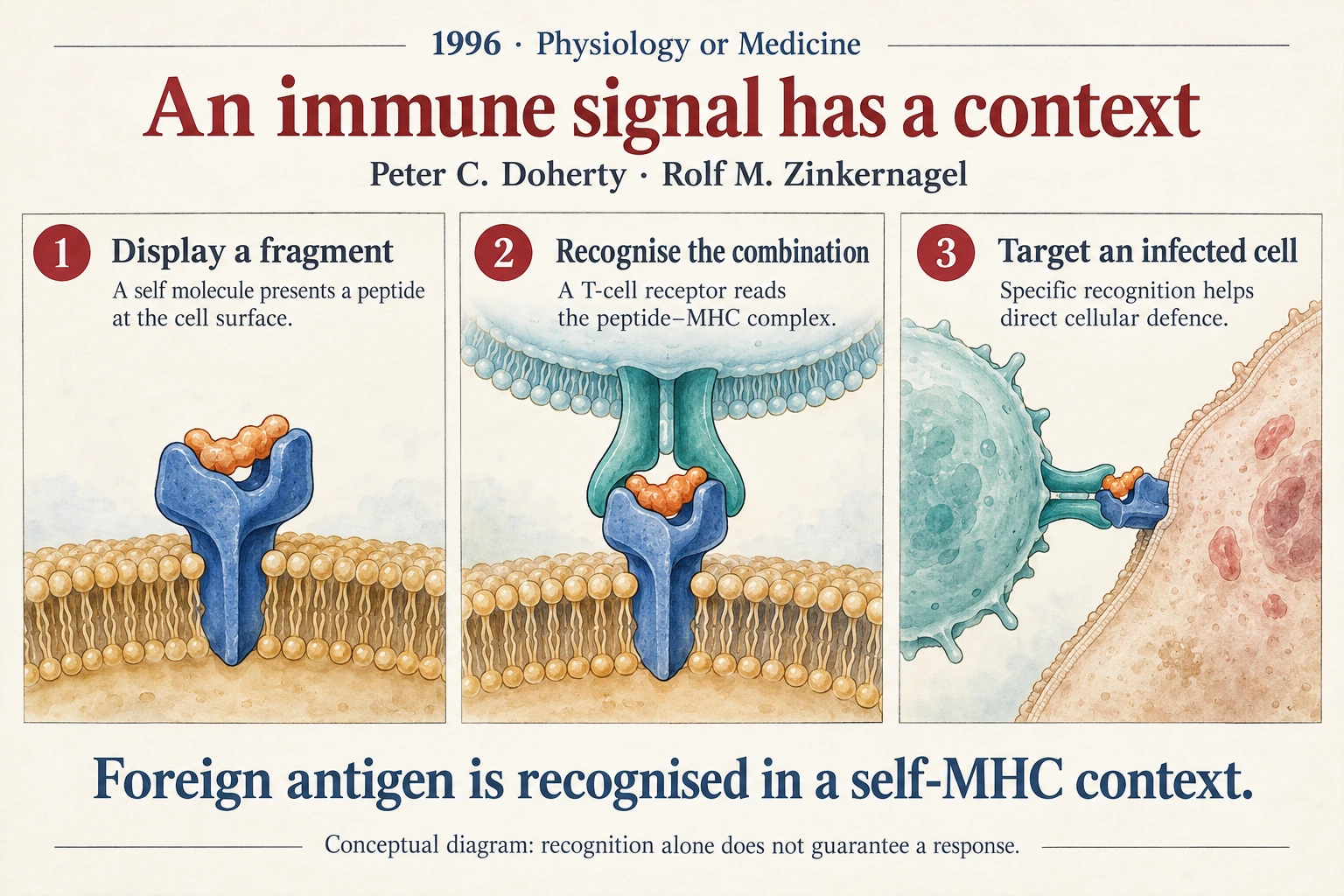
Foreign antigen is recognised in a self-MHC context.

  1. Display a fragment

    A self molecule presents a peptide at the cell surface.

  2. Recognise the combination

    A T-cell receptor reads the peptide–MHC complex.

  3. Target an infected cell

    Specific recognition helps direct cellular defence.

Conceptual diagram: recognition alone does not guarantee a response.

01 · The discovery

The idea, in everyday language

How does a T cell recognise a virus-infected cell? In experiments at the Australian National University during 1973–1975, Doherty and Zinkernagel studied T cells from infected mice. These could kill infected target cells from a compatible strain but failed against some targets from another strain, even when the same virus was present. Viral material alone did not explain the specificity.

Their 1974 papers established that recognition is restricted by self-MHC, the major histocompatibility molecules. Later molecular studies clarified the mechanism: a short peptide is held by an MHC molecule on the target cell’s surface, and a particular T-cell receptor recognises that combined structure. A molecule already associated with transplant compatibility was therefore central to everyday cellular immune defence.

Why it matters

MHC restriction became a foundation of cellular immunology. It helped explain immune development, transplant responses and why particular targets are recognised in infection. This knowledge informed later vaccine, cancer and inflammatory-disease research, without making the 1974 experiments a treatment or a cure in themselves.


02 · The people

Who brought the idea to life?

Illustrated portrait of Peter C. Doherty

Peter C. Doherty

Prize share · 1/2

With Zinkernagel, Doherty studied killer T cells from virus-infected mice. They found that these cells responded to an infected target only when its self-MHC context was compatible, not simply because it carried viral material. The 1974 publications established MHC restriction. Later research showed that a T-cell receptor recognises a complex of a peptide and the body’s own MHC molecule, explaining the experimental result.

Read the biography ↗
Illustrated portrait of Rolf M. Zinkernagel

Rolf M. Zinkernagel

Prize share · 1/2

Zinkernagel and Doherty compared how virus-reactive T cells behaved toward infected cells from different mouse strains. The response depended on the combination of foreign antigen and compatible self-MHC. This finding clarified why histocompatibility molecules matter in ordinary immune defence as well as transplantation. It established a principle of specific recognition, rather than a claim that all T cells attack every infected cell.

Read the biography ↗

03 · Years in the making

The path here

  1. 1973

    Doherty and Zinkernagel begin their Canberra collaboration on cellular immune defence.

  2. 1974

    Nature papers establish that virus-reactive T cells require a compatible self-MHC context.

  3. 1996

    The two researchers share the Physiology or Medicine Prize.

04 · Read further

From the original sources

Original explanations by Curionode, based on the official records below. Biographical details and affiliations refer to the award year.

  1. Official announcement nobelprize.org

More in Physiology or Medicine

Browse this subject ↗