01 · The discovery
The idea, in everyday language
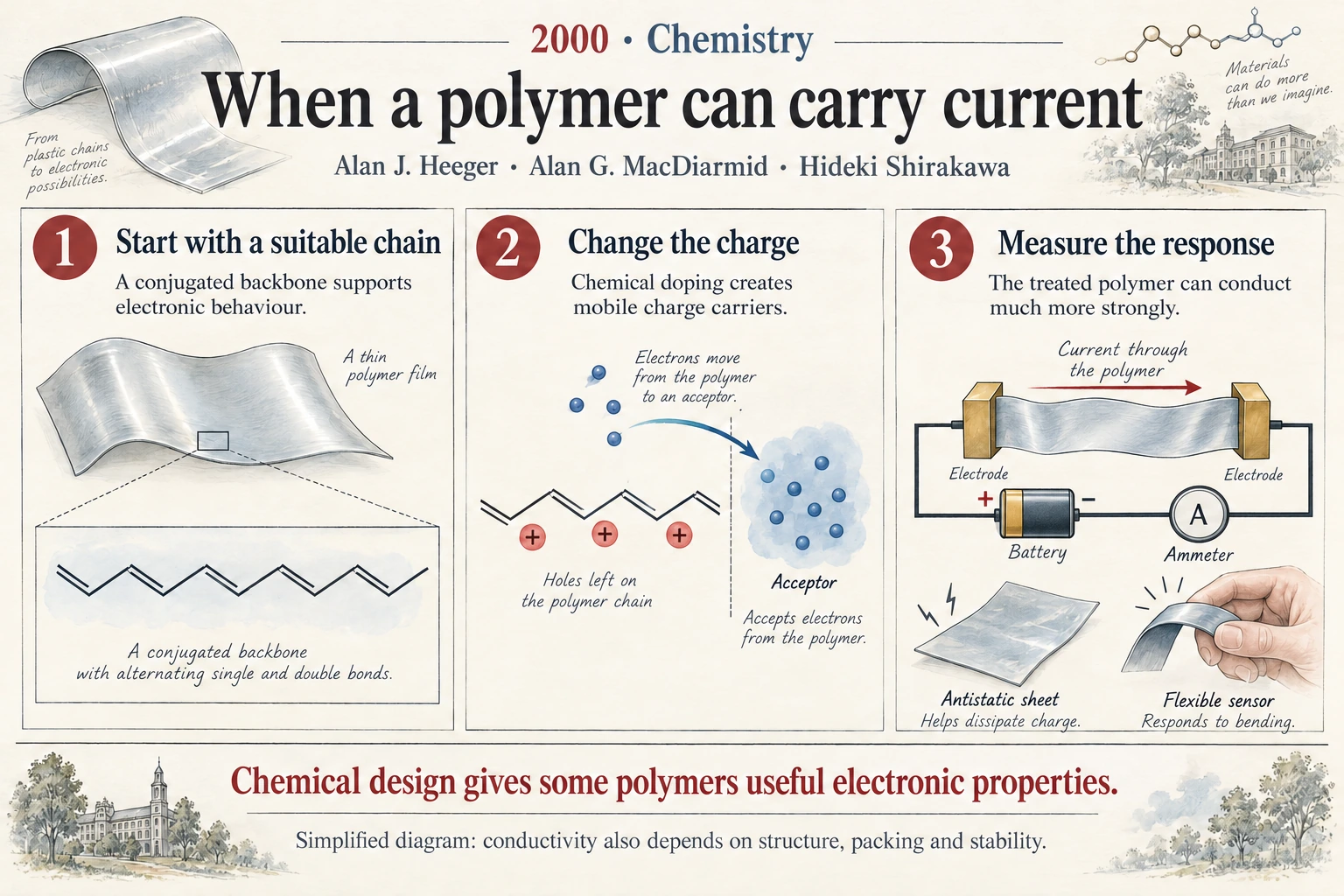
Most familiar plastics are useful electrical insulators. Polyacetylene offered a different possibility: its chain contains alternating single and double bonds, creating a conjugated electronic system. Shirakawa developed ways to make this polymer as a thin film. A metallic-looking surface was intriguing, but appearance alone did not establish good electrical conduction.
Working with MacDiarmid, Heeger and colleagues, the team found that chemical doping could greatly increase conductivity. Oxidation with iodine removes electrons from the polymer, producing charge carriers; other forms of doping can add electrons. Measurements linked the chemical treatment with a striking change in electrical behaviour. Their 1977 work helped launch a field of conducting polymers.
Why it matters
The discovery expanded the idea of what organic materials could do. Conducting and semiconducting polymers became important in research on flexible electronics, antistatic materials, sensors and light-emitting devices. Different applications use different materials and mechanisms; the original polyacetylene film is not the material inside every modern display.