01 · The discovery
The idea, in everyday language
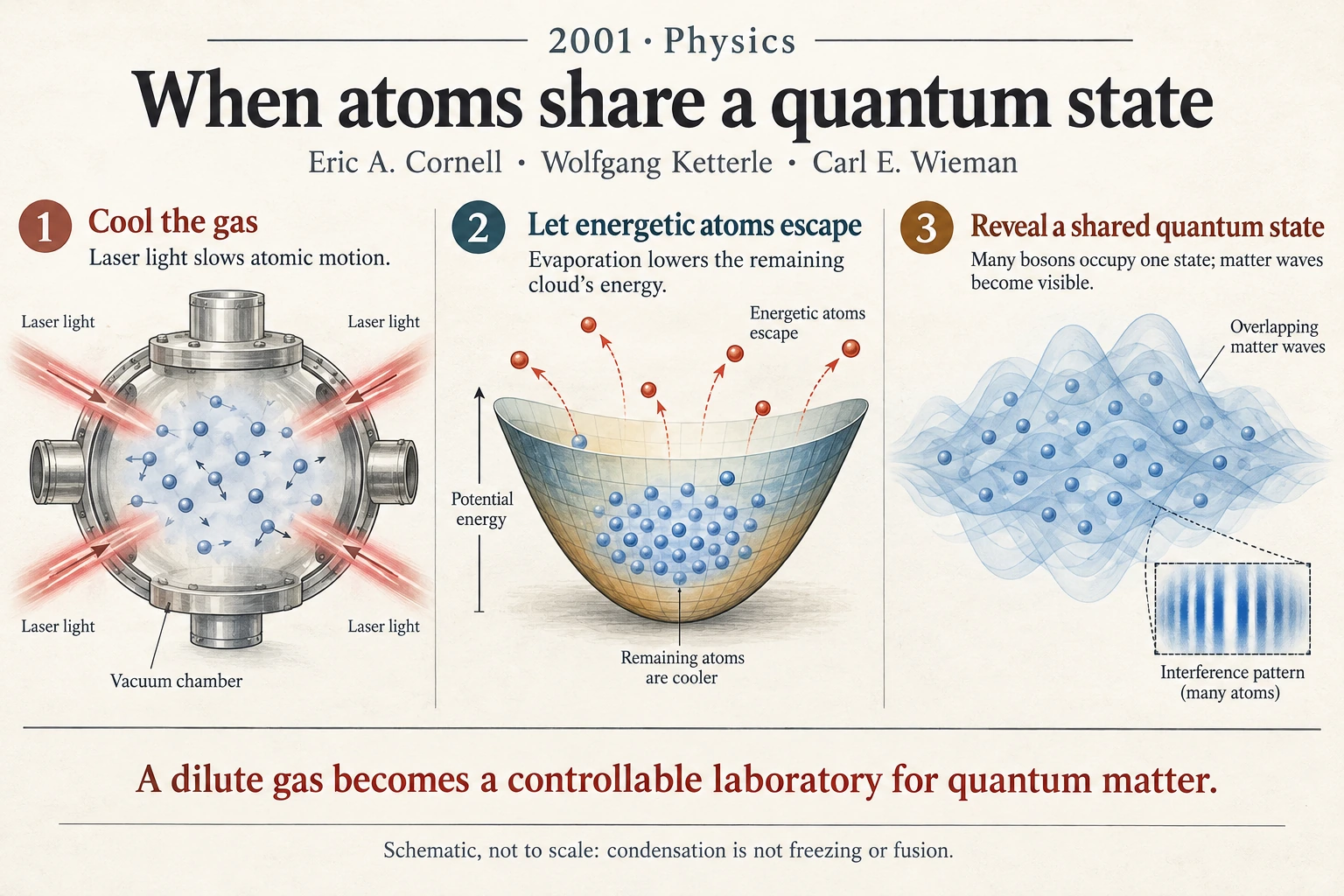
Atoms have wave-like quantum properties as well as particle-like ones. In an ordinary gas, thermal motion usually hides the most striking collective quantum effects. For suitable atoms called bosons, sufficient cooling and density can make a large number occupy the same quantum state. This is Bose–Einstein condensation, predicted long before it became possible to produce it in a dilute atomic gas.
Cornell and Wieman achieved condensation in rubidium atoms in 1995; Ketterle’s group independently achieved it in sodium that year. Laser cooling brought the gases part of the way, then evaporative cooling removed the more energetic atoms. The resulting condensates allowed researchers to study matter waves, including interference and coherence, in a system whose environment and interactions could be carefully controlled.
Why it matters
Ultracold gases became an experimental platform for studying quantum matter. Researchers could investigate coherence, superfluid behaviour and interactions with unusual control. The work helped establish atom optics and quantum simulation, where one controllable system is used to explore behaviour relevant to another. It created a laboratory tool for fundamental research, rather than a single finished consumer device.