01 · The discovery
The idea, in everyday language
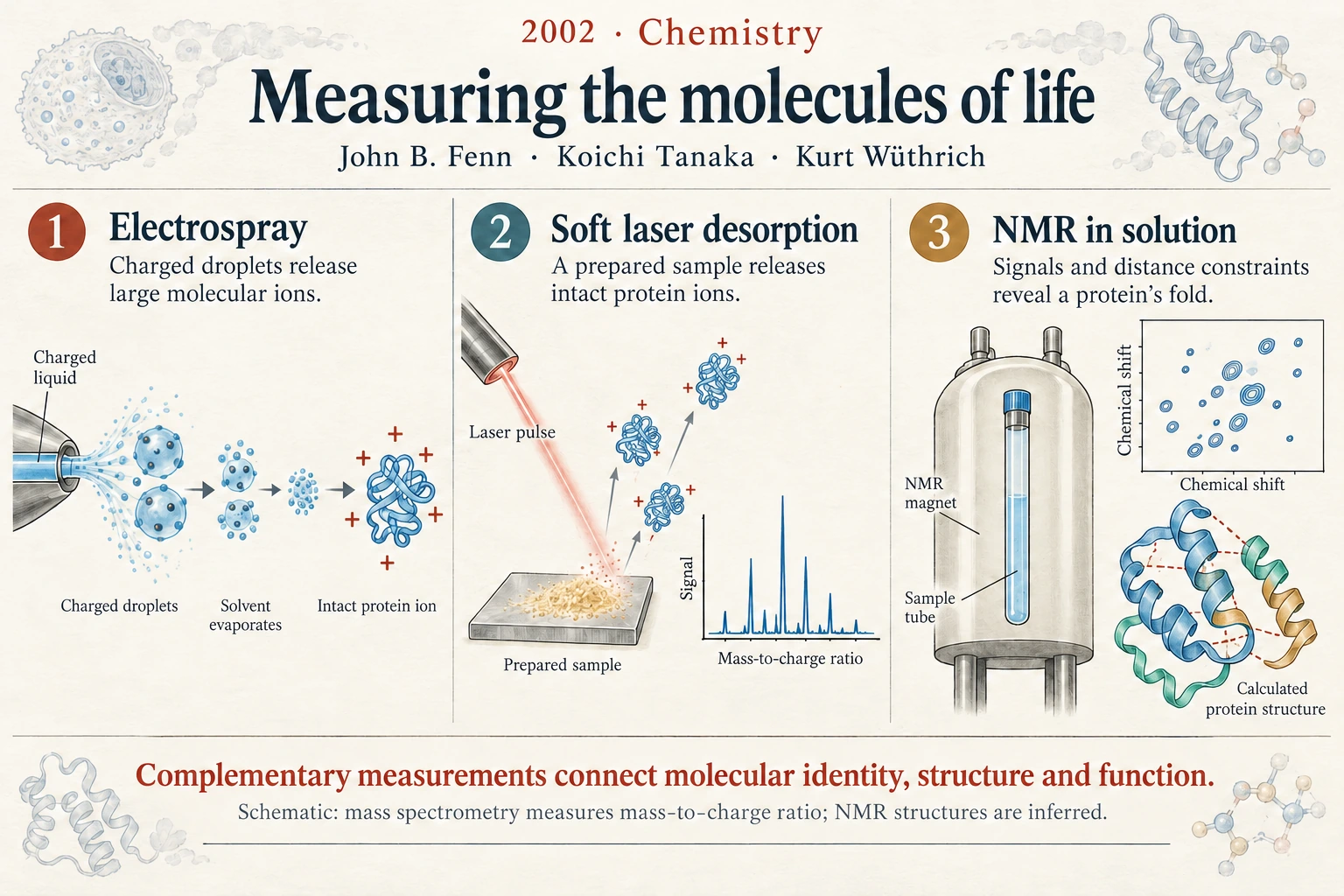
A protein is a large molecule whose identity, shape and interactions matter for its function. Mass spectrometry measures ions by their mass-to-charge ratio, but getting a fragile protein into the gas phase without extensive fragmentation was a major obstacle. Fenn’s electrospray and Tanaka’s soft laser desorption provided different ways to produce large molecular ions that an instrument could analyse.
Wüthrich tackled a complementary problem: how to find a protein’s three-dimensional structure while it is dissolved in liquid. Nuclear magnetic resonance produces signals associated with atomic nuclei, but a protein yields a crowded spectrum. Methods for assigning signals to particular nuclei and extracting distance constraints turned that complex pattern into information from which a structure could be calculated.
Why it matters
The methods expanded the study of proteins and other biological macromolecules. Soft ionisation made large molecules accessible to sensitive mass measurements and helped support proteomics, the study of many proteins in a biological system. NMR added a way to investigate structure, interactions and motion in solution, complementing crystallography. Together, the advances helped connect chemical measurements with biological function.