01 · The discovery
The idea, in everyday language
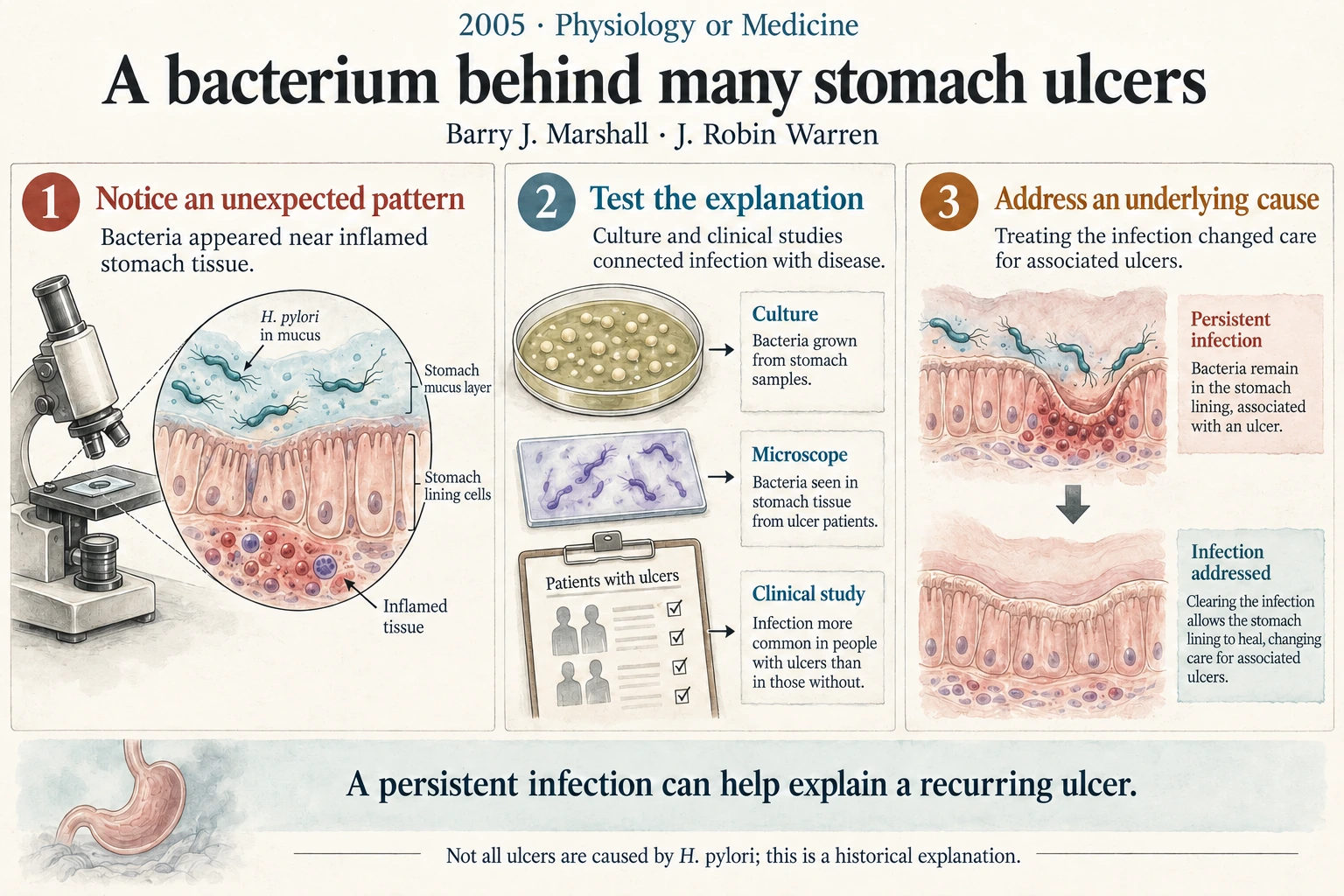
The stomach is an acidic environment, so bacteria were easy to overlook as an explanation for persistent disease there. Warren saw curved bacteria near inflamed areas of the stomach lining. Marshall joined the investigation and cultured the organism in 1982. Systematic studies connected its presence with gastritis and peptic ulcers, challenging the prevailing explanation centred on stress and lifestyle.
The organism, later called Helicobacter pylori, can establish a persistent infection in the stomach’s protective lining. Inflammation and the interaction between bacteria and host can contribute to tissue damage. Research showing that eradication of the infection could prevent recurrence of associated ulcers provided evidence that the bacterium was a cause, rather than merely an incidental visitor.
Why it matters
The discovery changed infection-related ulcer disease from a problem often managed through repeated symptom control into one where an underlying cause could be treated. It also strengthened the wider understanding of connections between chronic infection, inflammation and disease. The case illustrates how microscopy, culture and clinical evidence can reinforce one another.