01 · The discovery
The idea, in everyday language
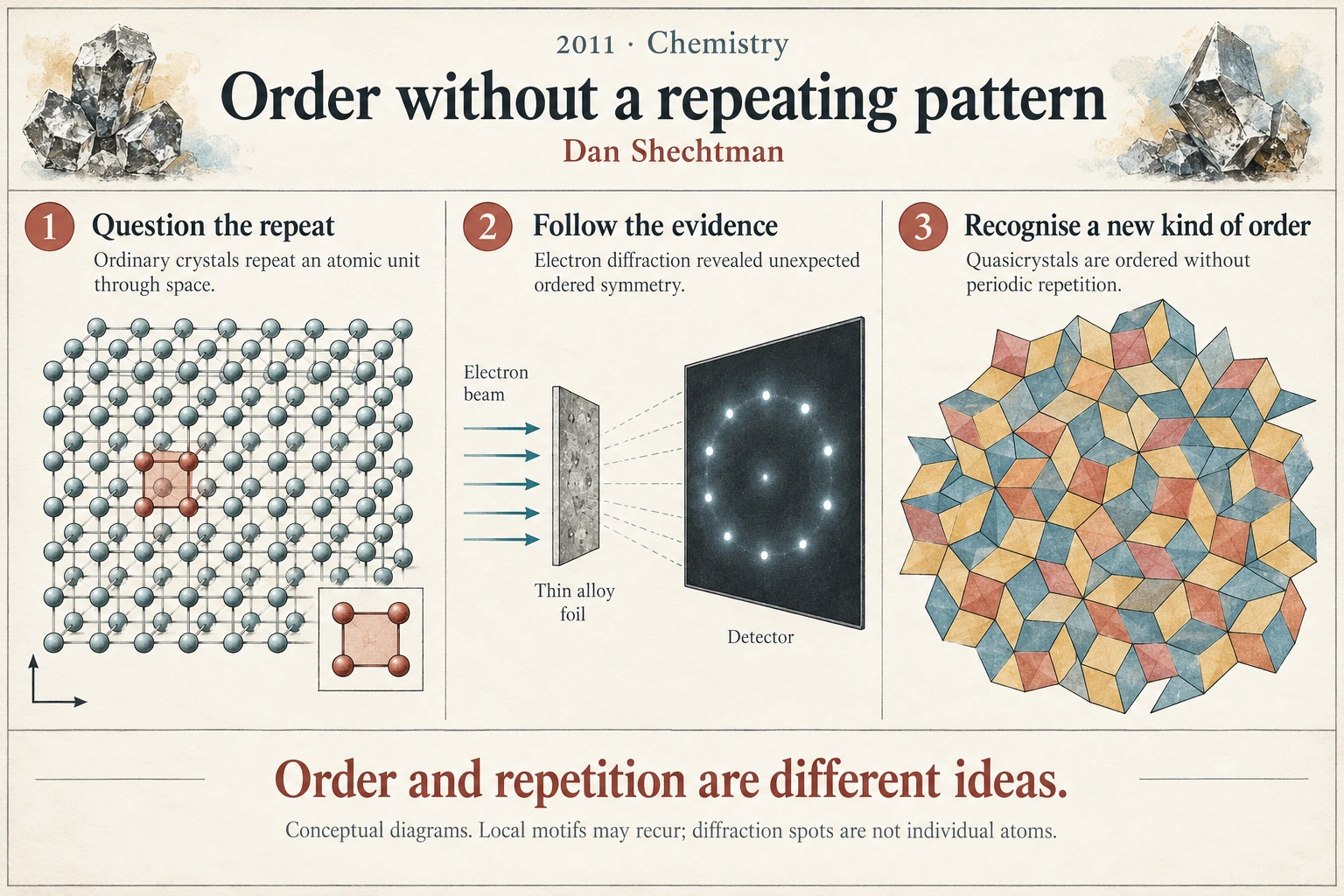
An ordinary periodic crystal can be described by a small atomic arrangement repeated through space. In April 1982 Shechtman studied a rapidly cooled aluminium–manganese alloy at the US National Bureau of Standards. Electrons passing through the sample produced sharp diffraction spots, evidence of order. But the symmetry of the pattern did not fit the rules for a conventional periodic crystal.
He checked whether overlapping crystal domains could explain the result. The evidence instead supported a different kind of structure: ordered, yet without the translational repetition of an ordinary crystal. Shechtman and colleagues published the observation in 1984. Theoretical work on aperiodic patterns helped make sense of these materials, which became known as quasicrystals. In 1992 the definition of a crystal was broadened to emphasise its diffraction pattern.
Why it matters
The discovery separated two ideas that had been treated as inseparable: order and periodic repetition. It opened a field of materials research and changed crystallography’s basic classification. It also illustrated why an unexpected observation deserves careful testing: the decisive step was reproducible evidence and the exclusion of alternatives, not disagreement with a textbook by itself.