c.curionodeThe Nobel Archive

2013 · Economic Sciences

What prices reveal—and what they cannot promise

Fama, Hansen and Shiller made asset prices a subject of systematic empirical testing.

The Sveriges Riksbank Prize in Economic Sciences in Memory of Alfred Nobel.

asset pricesempirical testingrisk and expectations
2013Economic Sciences

Visual guide

The prize, pictured

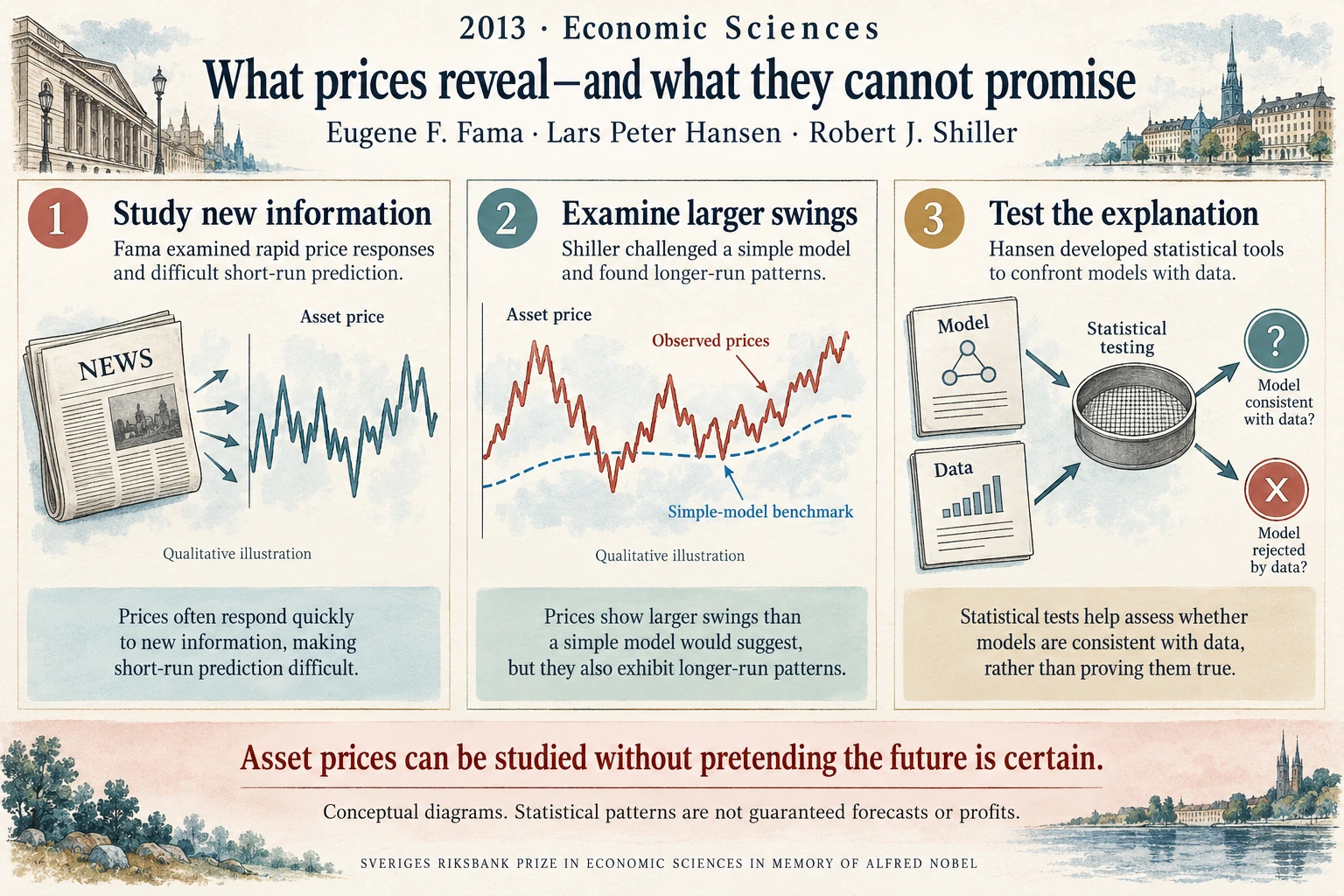
Infographic explaining What prices reveal—and what they cannot promise
Original AI-generated infographic. A conceptual overview; the explanations and sources below provide context.
Read the poster text

Asset prices can be studied without pretending the future is certain.

  1. Study new information

    Fama examined rapid price responses and difficult short-run prediction.

  2. Examine larger swings

    Shiller challenged a simple model and found longer-run patterns.

  3. Test the explanation

    Hansen developed statistical tools to confront models with data.

Conceptual diagrams. Statistical patterns are not guaranteed forecasts or profits.

01 · The discovery

The idea, in everyday language

A share price reflects expectations about future payments, but those expectations are uncertain. Fama’s research showed that past prices provide little help in forecasting immediate returns and that new information can enter prices rapidly. An obvious opportunity may disappear as investors act on it. This made short-run predictability, information and risk questions to investigate with data rather than confident stories about the next price movement.

Shiller found that stock prices fluctuated more than a simple dividend-based model with constant discounting could explain. Valuation measures also carried information about returns over longer horizons. Hansen developed the Generalized Method of Moments, which uses statistical relationships implied by a model to estimate and test it. It helped researchers assess whether theories linking consumption, risk and returns fitted actual observations. Together, these contributions established demanding ways to ask how prices are formed, even though the laureates did not share a single explanation for every pattern.

Why it matters

The work transformed financial economics by connecting theories with observable patterns and explicit statistical tests. It influenced studies of investment performance, risk and market behaviour, and encouraged explanations that consider both changing risk and human expectations. A theory that sounds persuasive still has to confront data and the assumptions used to measure a normal return.


02 · The people

Who brought the idea to life?

Illustrated portrait of Eugene F. Fama

Eugene F. Fama

Prize share · 1/3

Fama’s studies showed that short-run returns are difficult to forecast from past prices and that markets can respond quickly to new information. With collaborators, he developed influential event-study methods and investigated differences in average returns across stocks. These findings shaped research on market efficiency, risk and investment performance without proving that every market price is always correct.

Read the biography ↗
Illustrated portrait of Lars Peter Hansen

Lars Peter Hansen

Prize share · 1/3

In 1982 Hansen developed the Generalized Method of Moments, a flexible way to estimate and test models using statistical relationships they imply. Applied to asset pricing, it helped researchers assess whether theories about consumption and risk could account for observed returns. The method exposed limits of influential models and became useful far beyond finance; it does not remove uncertainty or make an inadequate model true.

Read the biography ↗
Illustrated portrait of Robert J. Shiller

Robert J. Shiller

Prize share · 1/3

Shiller showed that stock-price fluctuations were too large to fit a simple model based on dividends and a constant discount rate. He also found longer-horizon patterns in returns associated with valuation measures. His work helped build behavioural finance and stimulated alternative explanations involving changing risks. Such patterns are statistical tendencies, not a reliable calendar of future rises and crashes.

Read the biography ↗

03 · Years in the making

The path here

  1. 1969

    Fama and collaborators publish an influential event study of information and stock prices.

  2. 1981

    Shiller reports excess stock-price volatility relative to a simple dividend model.

  3. 1982

    Hansen introduces the Generalized Method of Moments.

04 · Read further

From the original sources

Original explanations by Curionode, based on the official records below. Biographical details and affiliations refer to the award year.

  1. Official award announcement nobelprize.org
  2. Nobel Committee’s accessible background nobelprize.org

More in Economic Sciences

Browse this subject ↗