c.curionodeThe Nobel Archive

2019 · Physics

Reading the universe, finding other worlds

A physical account of cosmic history and a new kind of planetary system changed our view of where Earth belongs.

CosmologyExoplanetsStellar motion
2019Physics

Visual guide

The prize, pictured

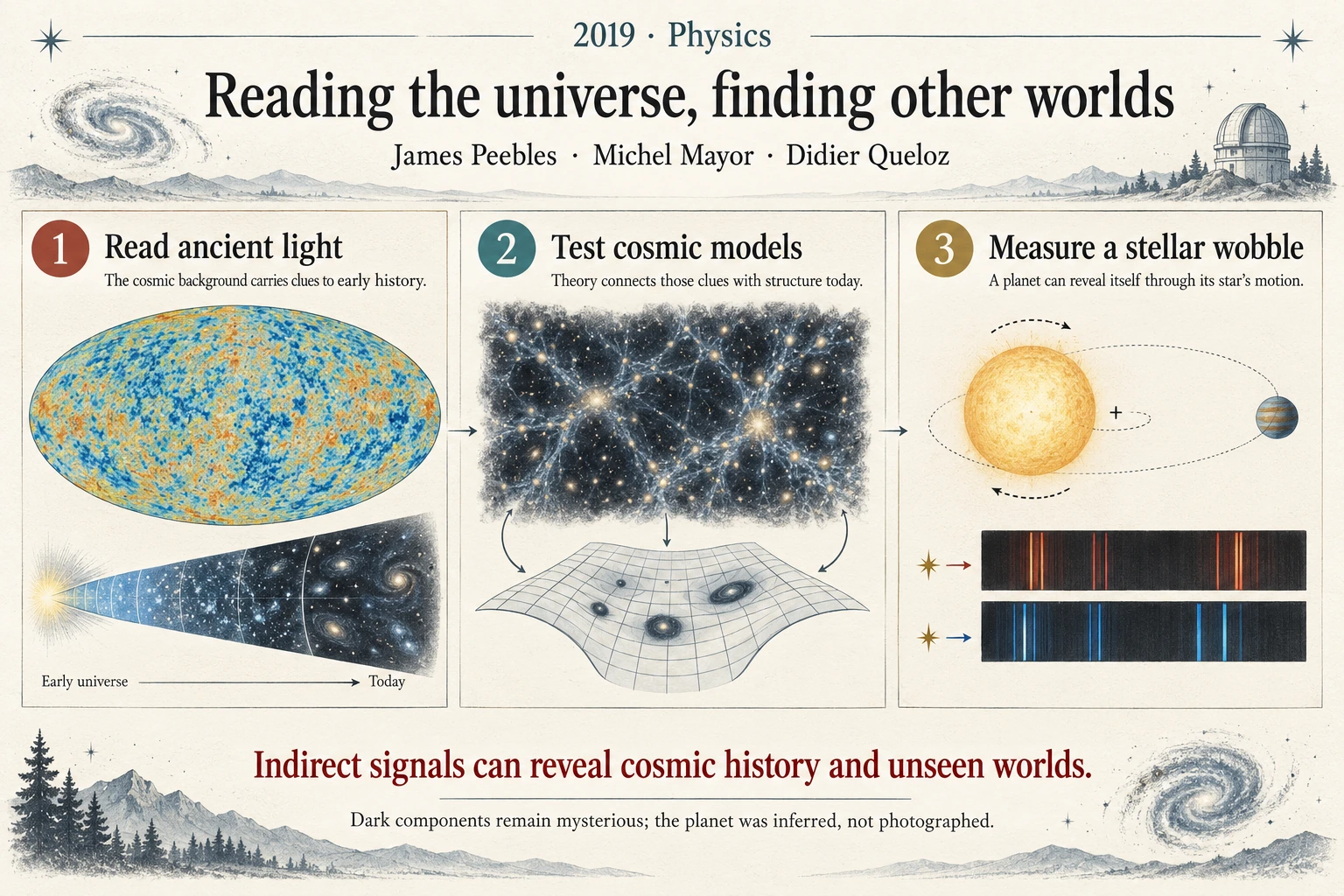
Infographic explaining Reading the universe, finding other worlds
Original AI-generated infographic. A conceptual overview; the explanations and sources below provide context.
Read the poster text

Indirect signals can reveal cosmic history and unseen worlds.

  1. Read ancient light

    The cosmic background carries clues to early history.

  2. Test cosmic models

    Theory connects those clues with structure today.

  3. Measure a stellar wobble

    A planet can reveal itself through its star’s motion.

Dark components remain mysterious; the planet was inferred, not photographed.

01 · The discovery

The idea, in everyday language

Peebles helped connect the universe’s early hot state to evidence we can measure today. The faint cosmic microwave background is a cooled remnant of an early stage when light began travelling freely. Its patterns, together with the distribution of galaxies, can test models of matter, gravity and cosmic evolution. His theoretical work helped make those comparisons possible.

Mayor and Queloz asked a more local question: does another Sun-like star have a planet? In 1995 they detected regular shifts in the spectrum of 51 Pegasi. A planet and its star orbit a shared centre of mass, so the star moves slightly toward and away from us. This wobble revealed a giant planet on a surprisingly short orbit.

Why it matters

The prize linked two changes in perspective. Cosmology gained a quantitative account of how structure developed, while exoplanet research showed that our Solar System is not a universal template. The discoveries opened questions about both cosmic ingredients and the diversity of planetary systems.

02 · The people

Who brought the idea to life?

Illustrated portrait of James Peebles

James Peebles

Prize share · 1/2

He developed ways to connect the early universe, the cosmic microwave background and the formation of galaxies. His work helped establish a framework in which ordinary matter, dark matter and dark energy have different roles in cosmic evolution.

Read the biography ↗
Illustrated portrait of Michel Mayor

Michel Mayor

Prize share · 1/4

With Queloz, he discovered 51 Pegasi b in 1995 by measuring periodic shifts in its host star’s light. It was the first confirmed exoplanet around a solar-type star, and its short orbit challenged expectations about giant planets.

Read the biography ↗
Illustrated portrait of Didier Queloz

Didier Queloz

Prize share · 1/4

He and Mayor detected the repeated stellar wobble associated with 51 Pegasi b. Measuring the star’s motion, rather than directly photographing the planet, revealed a giant planet unexpectedly close to a Sun-like star.

Read the biography ↗

03 · Years in the making

The path here

  1. 1965

    Peebles contributes to interpreting the cosmic microwave background.

  2. 1982

    His work develops a cosmological model with cold dark matter.

  3. 1995

    Mayor and Queloz announce 51 Pegasi b around a solar-type star.

04 · Read further

From the original sources

Original explanations by Curionode, based on the official records below. Biographical details and affiliations refer to the award year.

  1. Official award announcement nobelprize.org
  2. Nobel Committee’s accessible background nobelprize.org