c.curionodeThe Nobel Archive

2020 · Physiology or Medicine

Finding the virus behind a hidden illness

Three complementary lines of research identified hepatitis C and established how it could cause disease.

Hepatitis CVirologyBlood screening
2020Physiology or Medicine

Visual guide

The prize, pictured

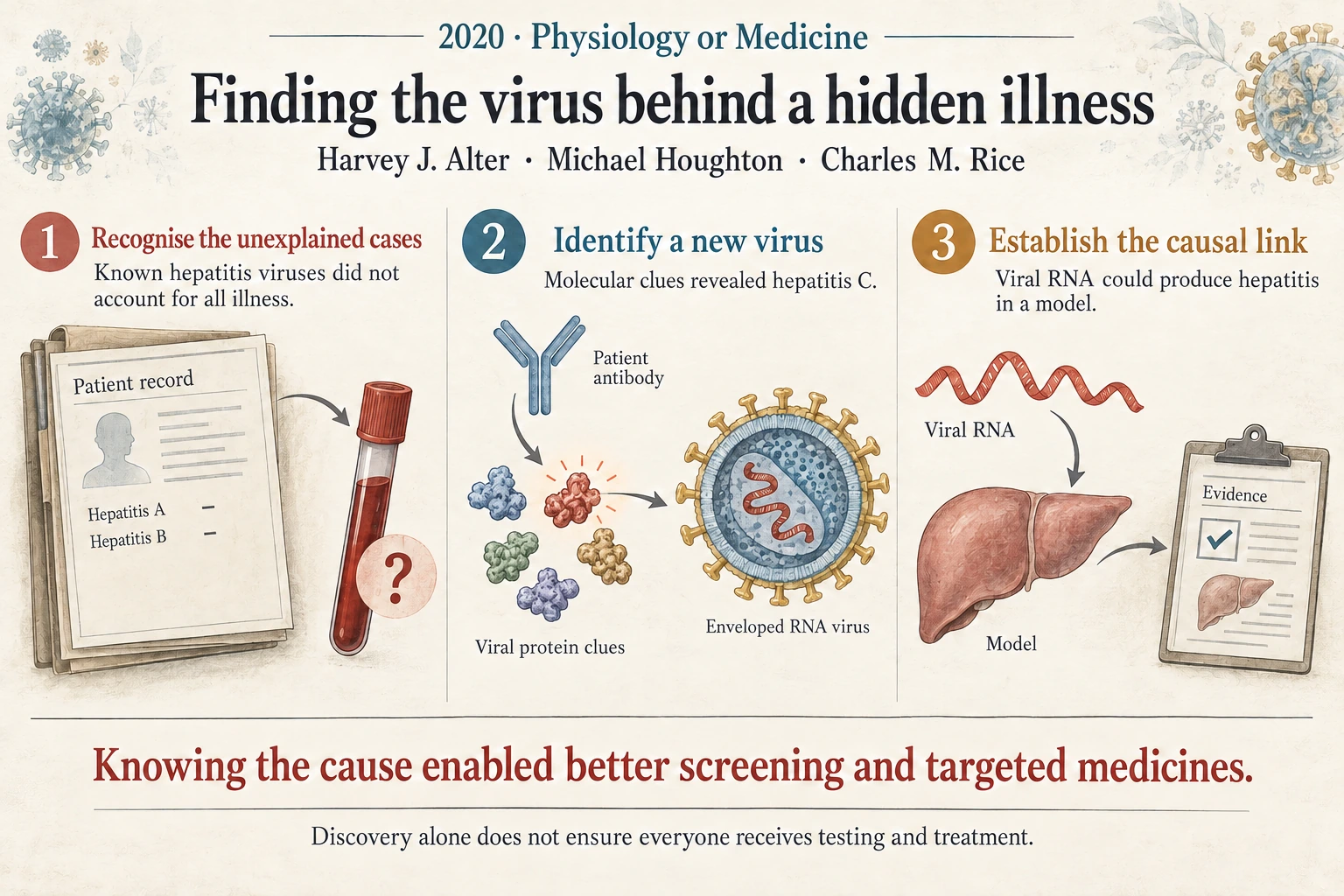
Infographic explaining Finding the virus behind a hidden illness
Original AI-generated infographic. A conceptual overview; the explanations and sources below provide context.
Read the poster text

Knowing the cause enabled better screening and targeted medicines.

  1. Recognise the unexplained cases

    Known hepatitis viruses did not account for all illness.

  2. Identify a new virus

    Molecular clues revealed hepatitis C.

  3. Establish the causal link

    Viral RNA could produce hepatitis in a model.

Discovery alone does not ensure everyone receives testing and treatment.

01 · The discovery

The idea, in everyday language

Some patients developed hepatitis after transfusions even when the blood had been screened for hepatitis B, and hepatitis A did not explain the cases. Alter’s studies showed that another infectious agent was involved. The illness had a description—non-A, non-B hepatitis—but its cause still lacked an identity.

Houghton’s team searched genetic material using antibodies from infected patients and identified a new RNA virus. Rice and colleagues then showed that a reconstructed viral RNA genome could cause hepatitis in an experimental model. The sequence of evidence moved from an unexplained disease to a named virus and a demonstrated causal link.

Why it matters

Identifying hepatitis C enabled sensitive blood tests and helped make transfusions much safer where screening was implemented. Understanding the virus also supported the development of targeted antiviral medicines that can cure infection. Access to testing and treatment remains essential to turning a discovery into public-health benefit.


02 · The people

Who brought the idea to life?

Illustrated portrait of Harvey J. Alter

Harvey J. Alter

Prize share · 1/3

He and colleagues established that many transfusion-associated hepatitis cases were caused by an unknown infectious agent, distinct from hepatitis A and B. Their clinical and transmission studies defined the problem that the later discovery of hepatitis C would solve.

Read the biography ↗
Illustrated portrait of Michael Houghton

Michael Houghton

Prize share · 1/3

His team used a molecular cloning strategy and antibodies from infected patients to identify genetic material from a previously unknown RNA virus in 1989. Naming it hepatitis C made it possible to develop targeted blood-screening tests.

Read the biography ↗
Illustrated portrait of Charles M. Rice

Charles M. Rice

Prize share · 1/3

He and colleagues constructed an infectious hepatitis C RNA genome and showed in 1997 that it could cause hepatitis in an experimental model. This supplied crucial causal evidence linking the identified virus to the previously unexplained disease.

Read the biography ↗

03 · Years in the making

The path here

  1. 1970s

    Alter and colleagues establish an infectious cause of non-A, non-B hepatitis.

  2. 1989

    Houghton’s team identifies hepatitis C viral genetic material.

  3. 1997

    Rice and colleagues show that an infectious viral RNA genome can cause hepatitis.

04 · Read further

From the original sources

Original explanations by Curionode, based on the official records below. Biographical details and affiliations refer to the award year.

  1. Official award announcement nobelprize.org
  2. Scientific background nobelprize.org

More in Physiology or Medicine

Browse this subject ↗