c.curionodeThe Nobel Archive

2021 · Chemistry

Small catalysts, a precise molecular hand

Simple organic molecules can speed up reactions and steer them toward one of two mirror-image products.

CatalysisChiralityMolecular synthesis
2021Chemistry

Visual guide

The prize, pictured

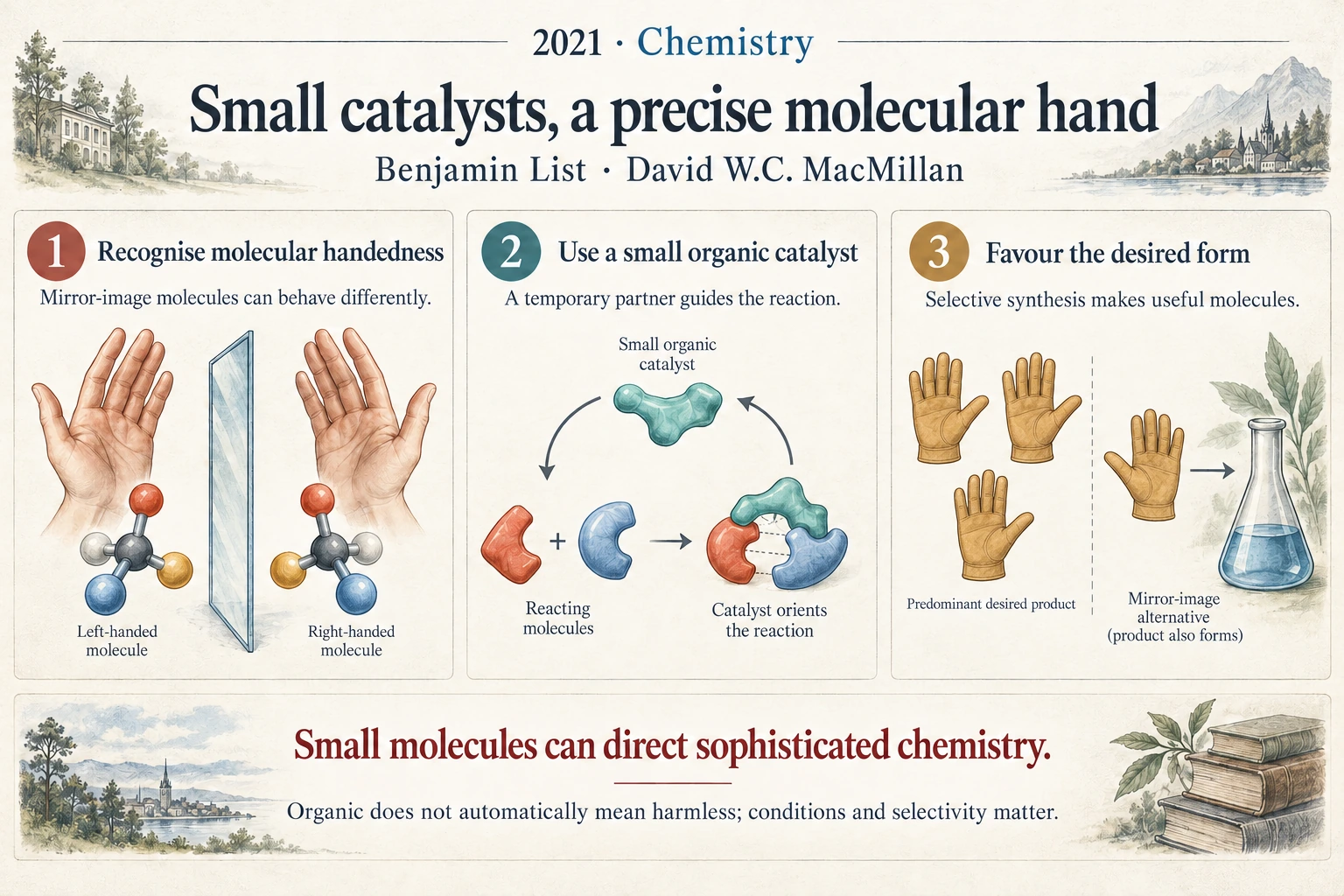
Infographic explaining Small catalysts, a precise molecular hand
Original AI-generated infographic. A conceptual overview; the explanations and sources below provide context.
Read the poster text

Small molecules can direct sophisticated chemistry.

  1. Recognise molecular handedness

    Mirror-image molecules can behave differently.

  2. Use a small organic catalyst

    A temporary partner guides the reaction.

  3. Favour the desired form

    Selective synthesis makes useful molecules.

Organic does not automatically mean harmless; conditions and selectivity matter.

01 · The discovery

The idea, in everyday language

Some molecules come in two forms that are mirror images, like left and right hands. In a living body, their effects can differ because the molecules they meet also have three-dimensional shapes. Building mostly the desired form is therefore a central challenge in chemical synthesis.

List and MacMillan independently showed in 2000 how small organic molecules can guide such reactions. The catalyst briefly interacts with a starting material, helps it react in a preferred way, and is released to act again. Their work developed asymmetric organocatalysis into a powerful alternative to metal catalysts and enzymes.

Why it matters

Organocatalysis expanded the chemist’s toolkit for making medicines and other useful molecules. Small catalysts can be robust and avoid certain metal-related difficulties, while selective reactions can reduce the need to separate unwanted mirror-image products.


02 · The people

Who brought the idea to life?

Illustrated portrait of Benjamin List

Benjamin List

Prize share · 1/2

In 2000, he and colleagues showed that the amino acid proline could catalyse an asymmetric aldol reaction. A small organic molecule could promote formation of a carbon–carbon bond while favouring one mirror-image arrangement of the product.

Read the biography ↗
Illustrated portrait of David W.C. MacMillan

David W.C. MacMillan

Prize share · 1/2

Independently of List, he developed small organic catalysts that temporarily bind reactants and make them more reactive. His 2000 work on iminium-ion catalysis showed how such catalysts could also guide formation of one mirror-image product.

Read the biography ↗

03 · Years in the making

The path here

  1. 2000

    List and colleagues demonstrate proline-catalysed asymmetric aldol chemistry.

  2. 2000

    MacMillan and colleagues develop asymmetric iminium-ion catalysis.

  3. 2021

    The prize recognises the development of asymmetric organocatalysis.

04 · Read further

From the original sources

Original explanations by Curionode, based on the official records below. Biographical details and affiliations refer to the award year.

  1. Official award announcement nobelprize.org
  2. Nobel Committee’s accessible background nobelprize.org

More in Chemistry

Browse this subject ↗