c.curionodeThe Nobel Archive

2022 · Chemistry

Molecules that click into place

Reliable chemical connectors simplify molecular construction—and can help us watch chemistry inside living cells.

Click chemistryBioorthogonal reactionsMolecular tools
2022Chemistry

Visual guide

The prize, pictured

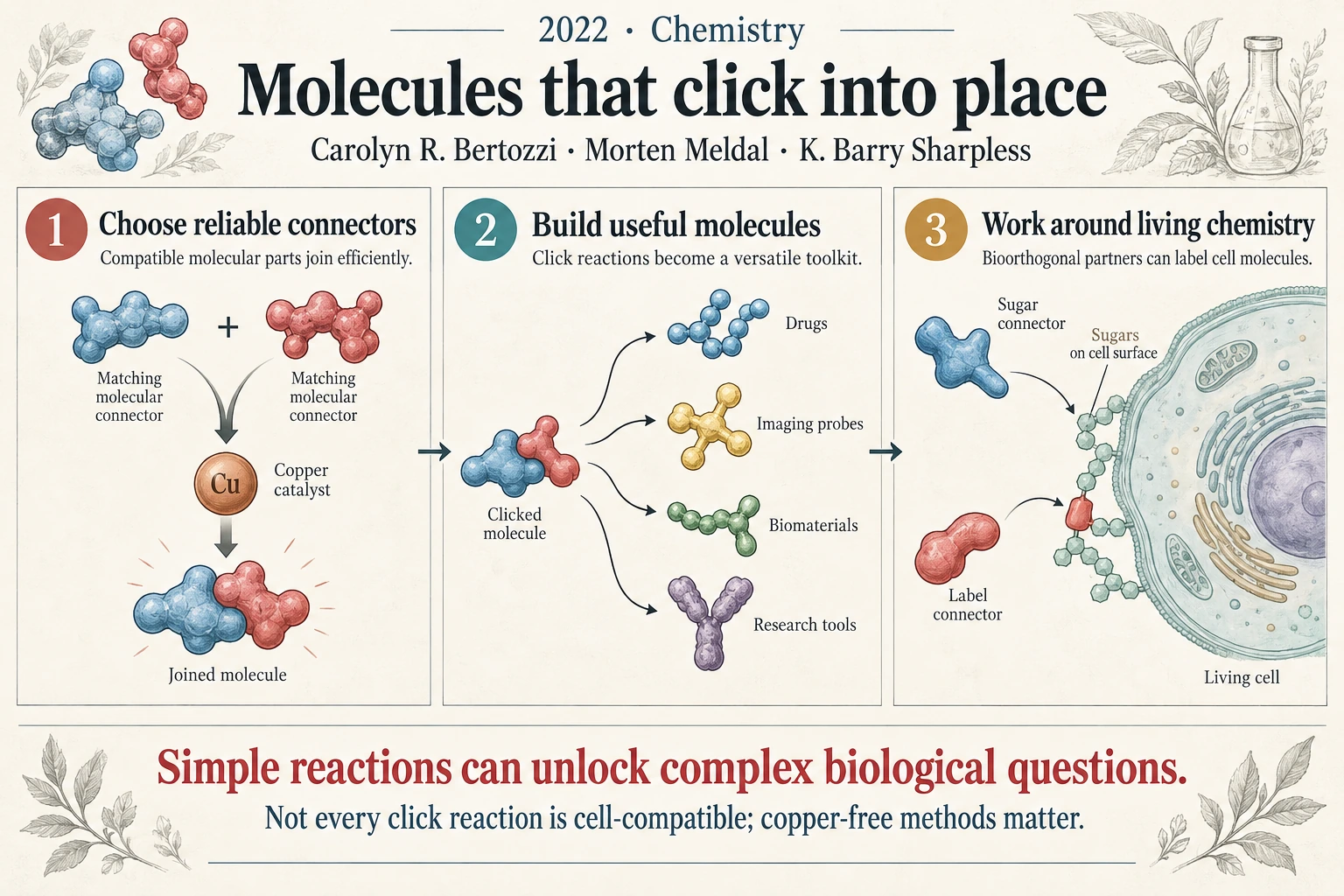
Infographic explaining Molecules that click into place
Original AI-generated infographic. A conceptual overview; the explanations and sources below provide context.
Read the poster text

Simple reactions can unlock complex biological questions.

  1. Choose reliable connectors

    Compatible molecular parts join efficiently.

  2. Build useful molecules

    Click reactions become a versatile toolkit.

  3. Work around living chemistry

    Bioorthogonal partners can label cell molecules.

Not every click reaction is cell-compatible; copper-free methods matter.

01 · The discovery

The idea, in everyday language

Building a complicated molecule can require many fragile steps. Click chemistry instead favours reactions that join compatible building blocks efficiently and reliably. Meldal and Sharpless independently developed a particularly useful copper-catalysed reaction between azides and alkynes.

Bertozzi wanted to follow molecules in living systems, where an ordinary laboratory reaction could disturb the cell. Her bioorthogonal chemistry uses reaction partners that largely ignore the surrounding biology. Copper-free versions made it possible to label important molecules such as cell-surface sugars.

Why it matters

These reactions help researchers assemble useful molecules, design materials and track biological processes. They provide a shared chemical toolkit across laboratories rather than a recipe for only one product.
02 · The people

Who brought the idea to life?

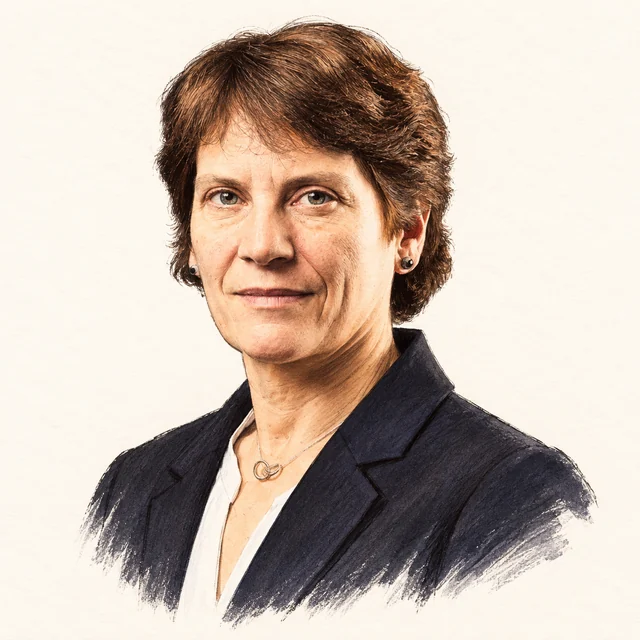
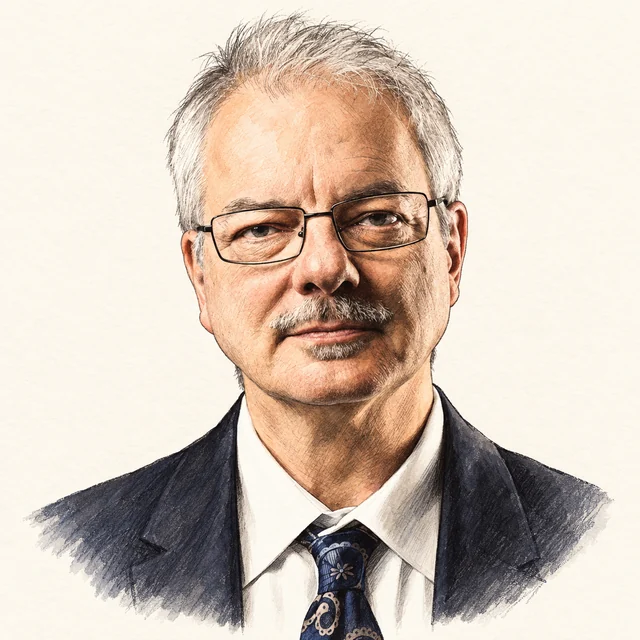
Illustrated portrait of Carolyn R. Bertozzi

Carolyn R. Bertozzi

Prize share · 1/3

She developed bioorthogonal reactions: chemical partners that can find and join one another in a living system while largely leaving its normal chemistry alone. Copper-free reactions allowed researchers to label and follow biomolecules in cells.

Read the biography ↗
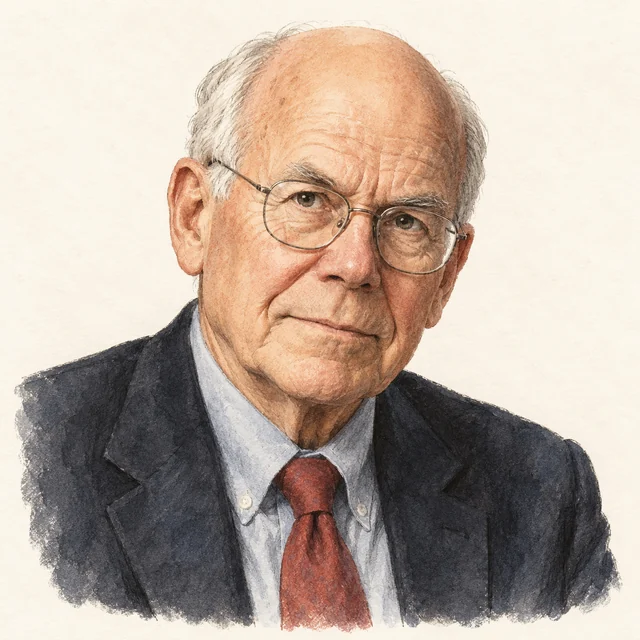
Illustrated portrait of Morten Meldal

Morten Meldal

Prize share · 1/3

While studying reactions on solid supports, his group found that copper could make an azide and an alkyne join efficiently into a particular ring structure. This robust reaction became a central tool of click chemistry, independently developed by Sharpless’s group as well.

Read the biography ↗
Illustrated portrait of K. Barry Sharpless

K. Barry Sharpless

Prize share · 1/3

He proposed click chemistry as a strategy built around dependable, efficient reactions. His group independently developed the copper-catalysed azide–alkyne reaction, helping make molecular assembly useful across chemistry, biology and materials research.

Read the biography ↗

03 · Years in the making

The path here

  1. 2001

    Sharpless and collaborators set out the click-chemistry strategy.

  2. 2002

    Meldal’s and Sharpless’s groups report copper-catalysed azide–alkyne reactions.

  3. 2004

    Bertozzi’s group demonstrates a copper-free route suited to biological labelling.

04 · Read further

From the original sources

Original explanations by Curionode, based on the official records below. Biographical details and affiliations refer to the award year.

  1. Official award announcement nobelprize.org
  2. Nobel Committee’s accessible background nobelprize.org

More in Chemistry

Browse this subject ↗