c.curionodeThe Nobel Archive

2020 · Chemistry

A guide for molecular scissors

A bacterial defence mechanism became a programmable way to cut DNA, opening new possibilities for genome editing.

CRISPRGenome editingRNA
2020Chemistry

Visual guide

The prize, pictured

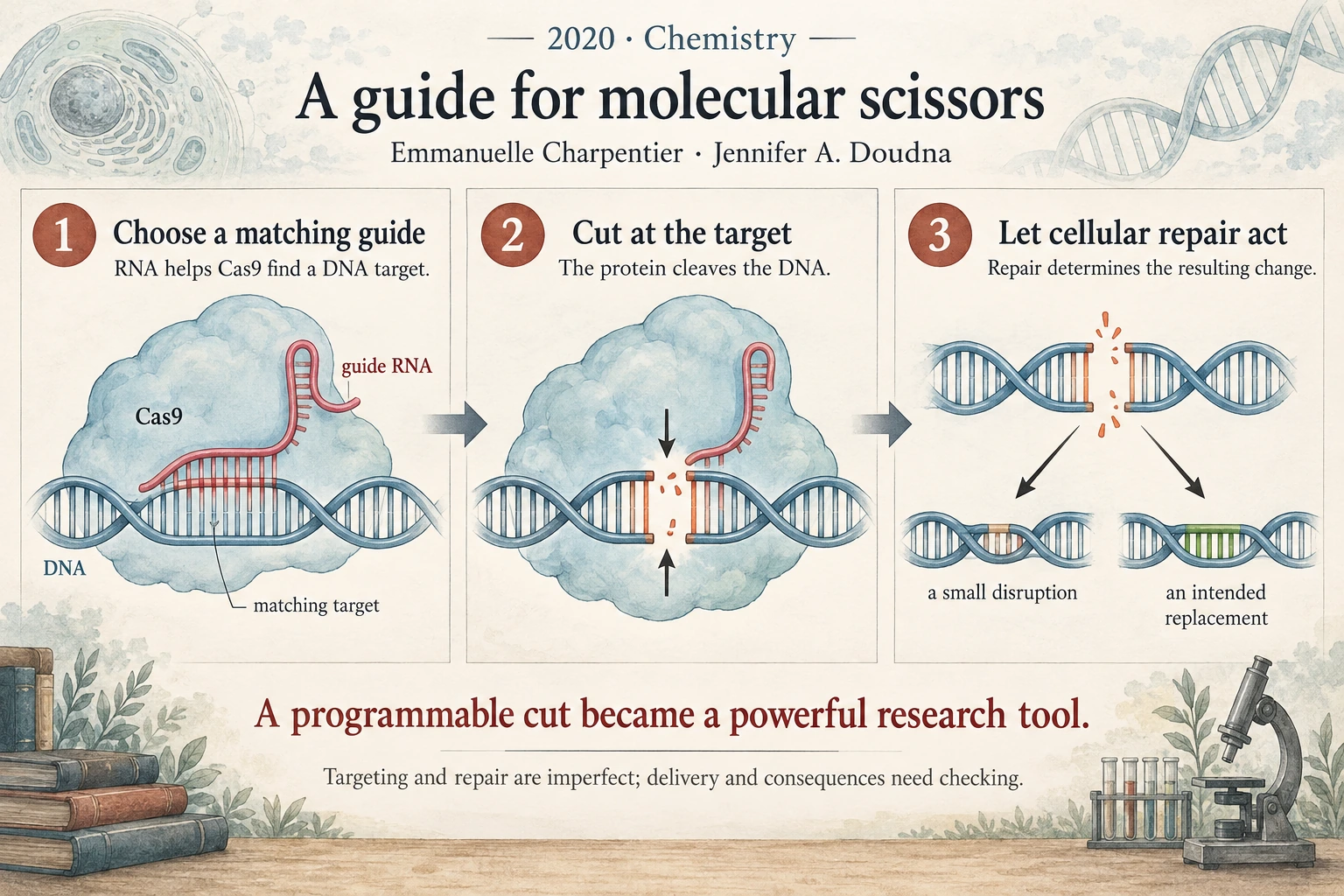
Infographic explaining A guide for molecular scissors
Original AI-generated infographic. A conceptual overview; the explanations and sources below provide context.
Read the poster text

A programmable cut became a powerful research tool.

  1. Choose a matching guide

    RNA helps Cas9 find a DNA target.

  2. Cut at the target

    The protein cleaves the DNA.

  3. Let cellular repair act

    Repair determines the resulting change.

Targeting and repair are imperfect; delivery and consequences need checking.

01 · The discovery

The idea, in everyday language

Bacteria face viruses too. Charpentier’s work revealed an RNA component of a bacterial defence system. Working with Doudna and colleagues, she helped show how RNA could guide the Cas9 protein to a matching DNA target. They simplified the RNA components into a tool whose target could be changed by changing the guide.

In a cell, cutting DNA is only part of editing. The cell’s repair machinery then reconnects the broken DNA; the outcome may disrupt a gene or, under suitable conditions, incorporate an intended change. This combination made experiments on gene function much easier, but delivery, target choice and repair outcomes still need careful control.

Why it matters

CRISPR–Cas9 changed basic research by helping scientists test what genes do. It also opened routes for crop development and medical research. The prize recognised a foundational method; many further discoveries and practical steps were needed to turn it into particular applications.


02 · The people

Who brought the idea to life?

Illustrated portrait of Emmanuelle Charpentier

Emmanuelle Charpentier

Prize share · 1/2

She identified the role of tracrRNA in the CRISPR defence system of Streptococcus pyogenes. In collaboration with Doudna, she helped reconstruct and simplify an RNA-guided Cas9 system that could be programmed to cut chosen DNA targets.

Read the biography ↗
Illustrated portrait of Jennifer A. Doudna

Jennifer A. Doudna

Prize share · 1/2

Working with Charpentier and their colleagues, she demonstrated in 2012 how a simplified guide RNA could direct Cas9 to a selected DNA sequence. This programmable cutting mechanism became a foundation for genome-editing methods used by many research groups.

Read the biography ↗

03 · Years in the making

The path here

  1. 2011

    Charpentier’s team reports the role of tracrRNA in bacterial defence.

  2. 2012

    Charpentier, Doudna and colleagues demonstrate programmable RNA-guided DNA cleavage.

  3. 2013

    Several research groups show that the system can be used to edit genomes in cells.

04 · Read further

From the original sources

Original explanations by Curionode, based on the official records below. Biographical details and affiliations refer to the award year.

  1. Official award announcement nobelprize.org
  2. Nobel Committee’s accessible background nobelprize.org

More in Chemistry

Browse this subject ↗