c.curionodeThe Nobel Archive

2026 · Physiology or Medicine

A light switch for brain circuits

Optogenetics helps researchers test how selected nerve cells influence behaviour.

OptogeneticsNeuronsLight
2026Physiology or Medicine

Visual guide

The prize, pictured

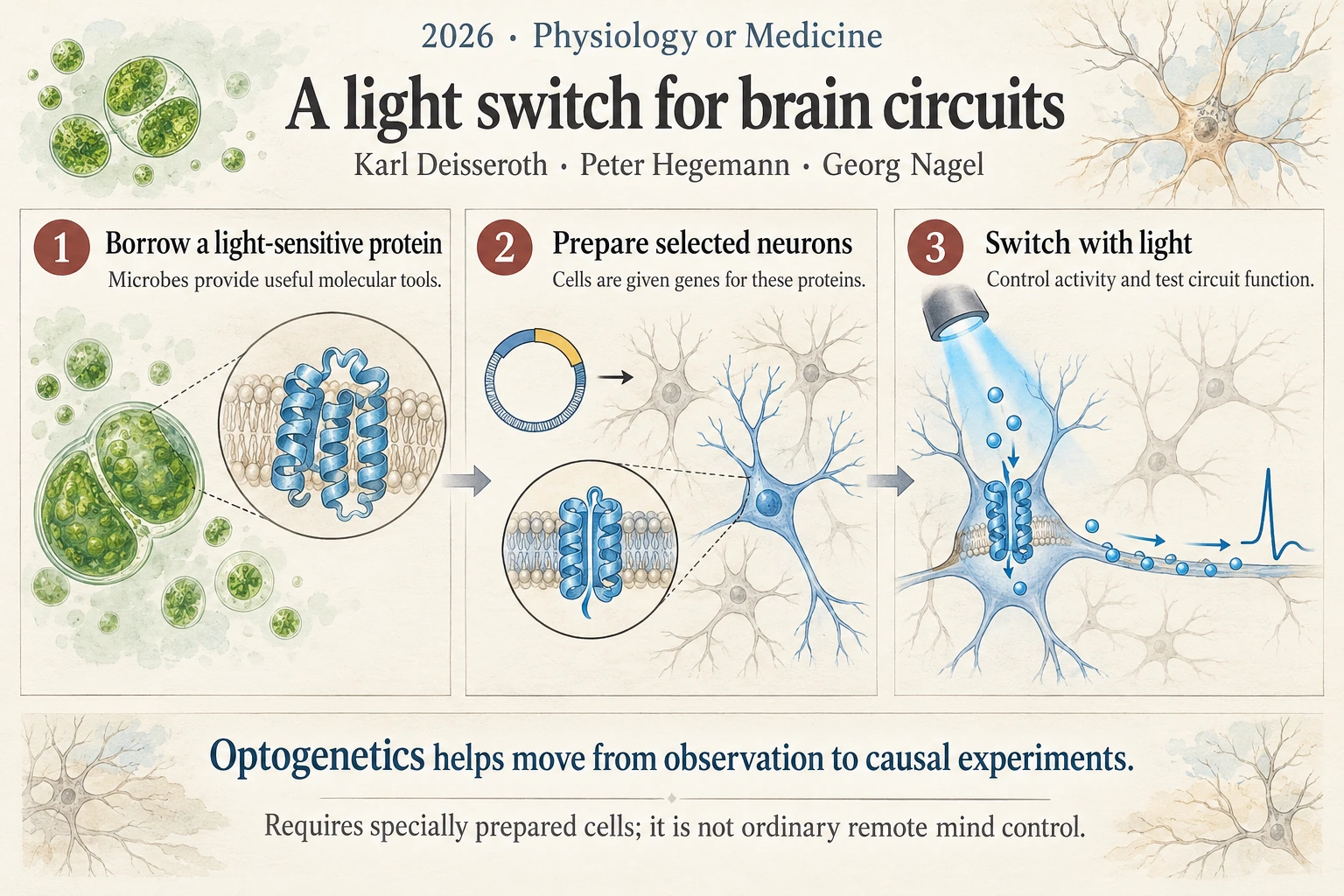
Infographic explaining A light switch for brain circuits
Original AI-generated infographic. A conceptual overview; the explanations and sources below provide context.
Read the poster text

Optogenetics helps move from observation to causal experiments.

  1. Borrow a light-sensitive protein

    Microbes provide useful molecular tools.

  2. Prepare selected neurons

    Cells are given genes for these proteins.

  3. Switch with light

    Control activity and test circuit function.

Requires specially prepared cells; it is not ordinary remote mind control.

01 · The discovery

The idea, in everyday language

Knowing which neurons are active is different from knowing what they cause. Optogenetics lets researchers change the activity of selected cells and observe what follows.

Genes for light-sensitive proteins can be introduced into chosen cells. Light then changes the movement of ions across their membranes, allowing researchers to control activity with precise timing.

Why it matters

The method gives researchers a powerful way to test the roles of brain circuits in sensation, memory and behaviour.


02 · The people

Who brought the idea to life?

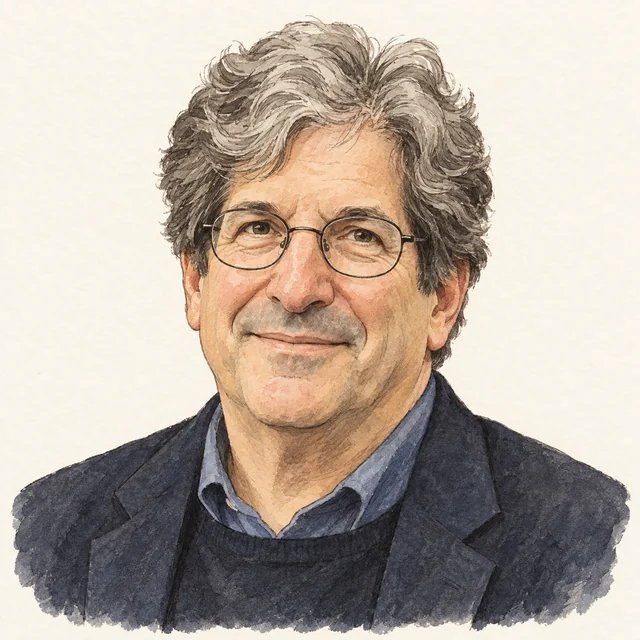
Illustrated portrait of Karl Deisseroth

Karl Deisseroth

Prize share · 1/3

His team helped turn microbial light-sensitive proteins into tools for controlling selected neurons. Experiments could then test what a circuit does, rather than only observe its activity.

Read the biography ↗
Illustrated portrait of Peter Hegemann

Peter Hegemann

Prize share · 1/3

He and collaborators investigated algal light-sensitive proteins, contributing to the discovery of channelrhodopsins that became key optogenetic tools.

Read the biography ↗
Illustrated portrait of Georg Nagel

Georg Nagel

Prize share · 1/3

Working with Hegemann and colleagues, he demonstrated that channelrhodopsins function as light-gated ion channels. Transferring these proteins to other cells made their use as biological switches possible.

Read the biography ↗

03 · Years in the making

The path here

  1. 2002–2003

    Studies establish channelrhodopsins as light-gated channels.

  2. 2005

    Light-sensitive proteins are used to control neurons.

  3. 2026

    The pioneers of optogenetics receive the prize.

04 · Read further

From the original sources

Original explanations by Curionode, based on the official records below. Biographical details and affiliations refer to the award year.

  1. Karolinska Institutet overview news.ki.se
  2. How optogenetics works news.ki.se
  3. Stanford biography med.stanford.edu
  4. Würzburg biography uni-wuerzburg.de

More in Physiology or Medicine

Browse this subject ↗