c.curionodeThe Nobel Archive

1904 · Chemistry

Give hidden gases a place in the periodic system

Air held more elements than its familiar main constituents. Ramsay’s investigations, including work with Rayleigh and Travers, revealed unusually unreactive gases and established a new family in the periodic system.

Noble gasesPeriodic systemChemical discovery
1904Chemistry

Visual guide

The prize, pictured

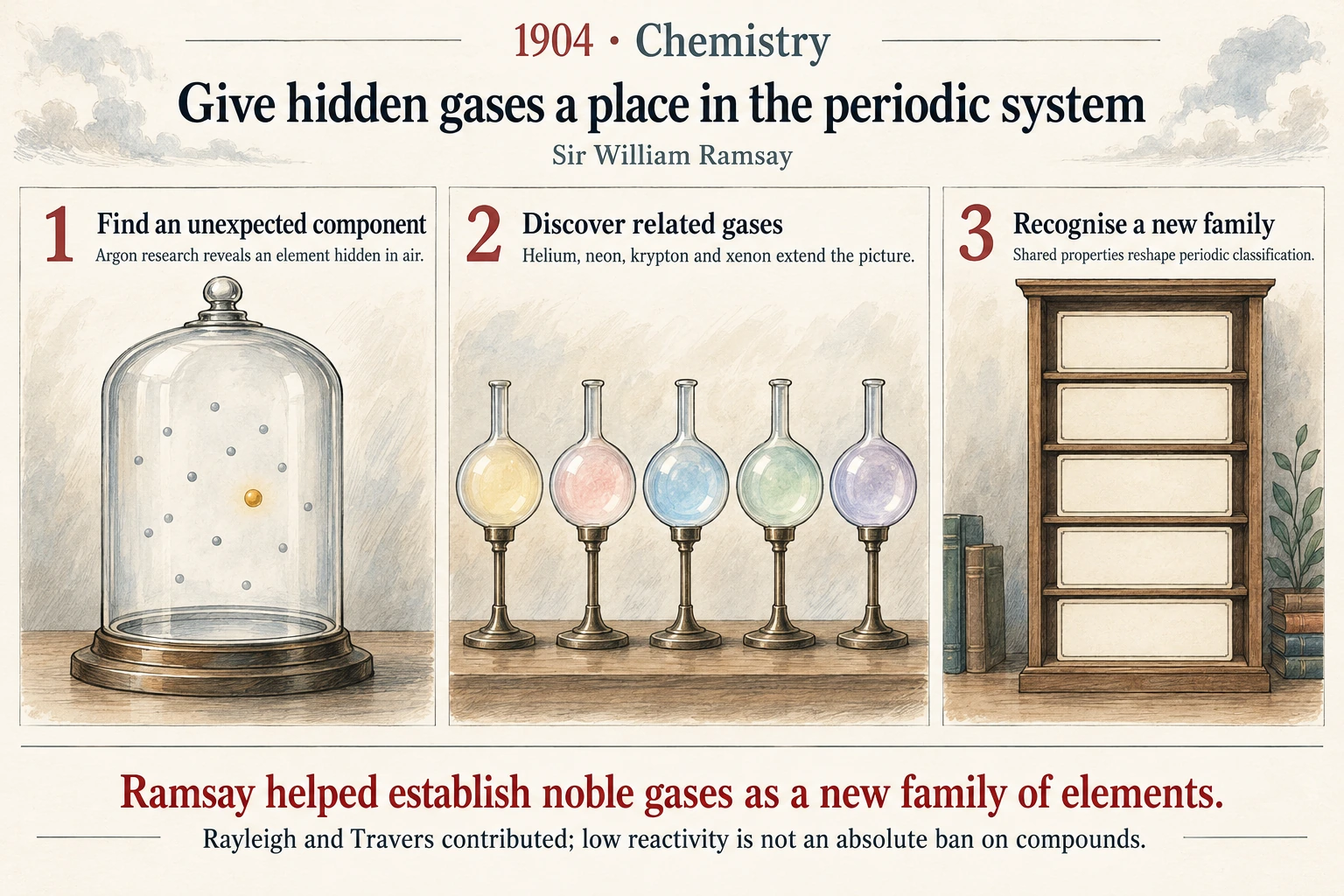
Infographic explaining Give hidden gases a place in the periodic system
Original AI-generated infographic. A conceptual overview; the explanations and sources below provide context.
Read the poster text

Ramsay helped establish noble gases as a new family of elements.

  1. Find an unexpected component

    Argon research reveals an element hidden in air.

  2. Discover related gases

    Helium, neon, krypton and xenon extend the picture.

  3. Recognise a new family

    Shared properties reshape periodic classification.

Rayleigh and Travers contributed; low reactivity is not an absolute ban on compounds.

01 · The discovery

The idea, in everyday language

Argon emerged from the mismatch between nitrogen samples investigated by Rayleigh and Ramsay. Its low chemical reactivity made it difficult to fit into familiar patterns based on combining capacity. Ramsay’s identification of terrestrial helium in 1895 connected a gas on Earth with an element already observed in the solar spectrum.

The possibility of a new family guided further investigation. In 1898 Ramsay and Morris Travers found krypton, neon and xenon. Comparing physical properties and characteristic spectra helped distinguish the gases. The contribution was both discovery and classification: the periodic system had to accommodate a group whose behaviour differed from the more reactive elements around it.

Why it matters

The discoveries expanded the known elements and sharpened the periodic organisation of matter. Low reactivity also made noble gases useful in settings where unwanted chemical reactions needed to be limited; those uses developed through further work.
02 · The people

Who brought the idea to life?

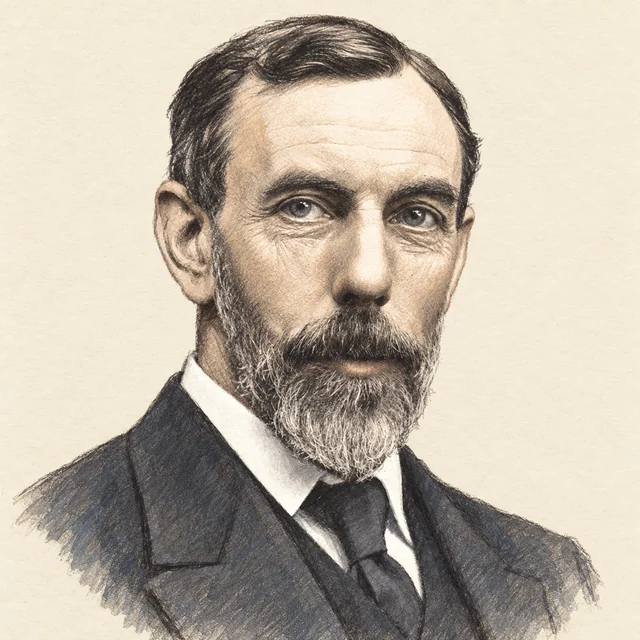
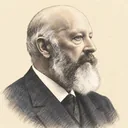
Illustrated portrait of Sir William Ramsay

Sir William Ramsay

Prize share · 1

Ramsay received the full Chemistry Prize for discoveries of noble gases in air and their place in the periodic system. Argon research with Rayleigh and later discoveries with Travers revealed a new family of elements.

Read the biography ↗

03 · Years in the making

The path here

  1. 1852

    Ramsay is born in Glasgow.

  2. 1872

    He completes his doctorate at Tübingen.

  3. 1887

    He joins University College London.

  4. 1894

    Argon is identified through work with Rayleigh.

  5. 1895

    He identifies helium in terrestrial material.

  6. 1898

    Ramsay and Travers discover krypton, neon and xenon.

  7. 1904

    The Chemistry Prize recognises the discoveries and periodic classification.

  8. 1916

    He dies at High Wycombe.

04 · Read further

From the original sources

Original explanations by Curionode, based on the official records below. Biographical details and affiliations refer to the award year.

  1. Official award summary nobelprize.org
  2. Award ceremony speech nobelprize.org
  3. UCL: Ramsay and the missing elements ucl.ac.uk
  4. UCL collections: Ramsay’s laboratory notebooks discovery.ucl.ac.uk
  5. Science History Institute: Ramsay and noble gases sciencehistory.org

More in Chemistry

Browse this subject ↗