01 · The discovery
The idea, in everyday language
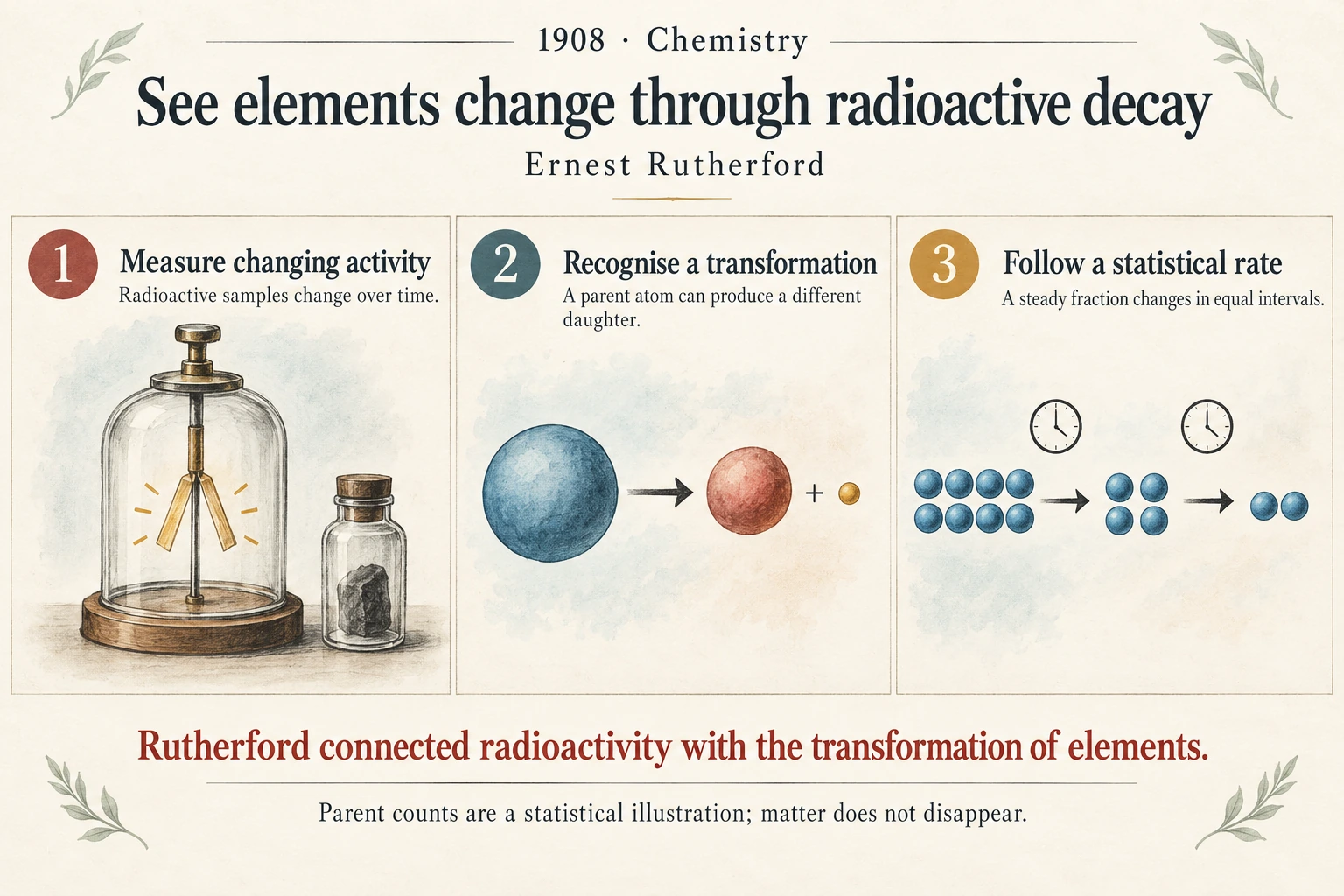
Rutherford distinguished different types of radiation and investigated the changing activity of radioactive preparations. Work on thorium revealed a radioactive gaseous emanation and successive products. Separating substances and following their activity over time showed that the effect could not be understood simply as one ordinary chemical reaction.
With Frederick Soddy, Rutherford proposed the disintegration theory in 1902. Changes occurred within atoms themselves, producing new substances as radiation was emitted. Different products had characteristic rates of change. A sample’s activity could fall while a daughter product’s activity grew, making a sequence of transformations experimentally traceable. The 1908 award was in Chemistry, recognising elemental disintegration and radioactive substances.
Why it matters
The work changed the boundary of chemistry by showing that some elements are not permanently stable. Measured decay rates became tools for studying transformations and later for tracing time, while the experiments also helped create the field of nuclear physics.