c.curionodeThe Nobel Archive

1911 · Physiology or Medicine

Understand how a changing eye forms an image

The eye is an optical system with curved surfaces and a lens whose properties vary internally. Gullstrand developed ways to calculate its refraction and explain how it forms images at different viewing distances.

RefractionAccommodationPhysiological optics
1911Physiology or Medicine

Visual guide

The prize, pictured

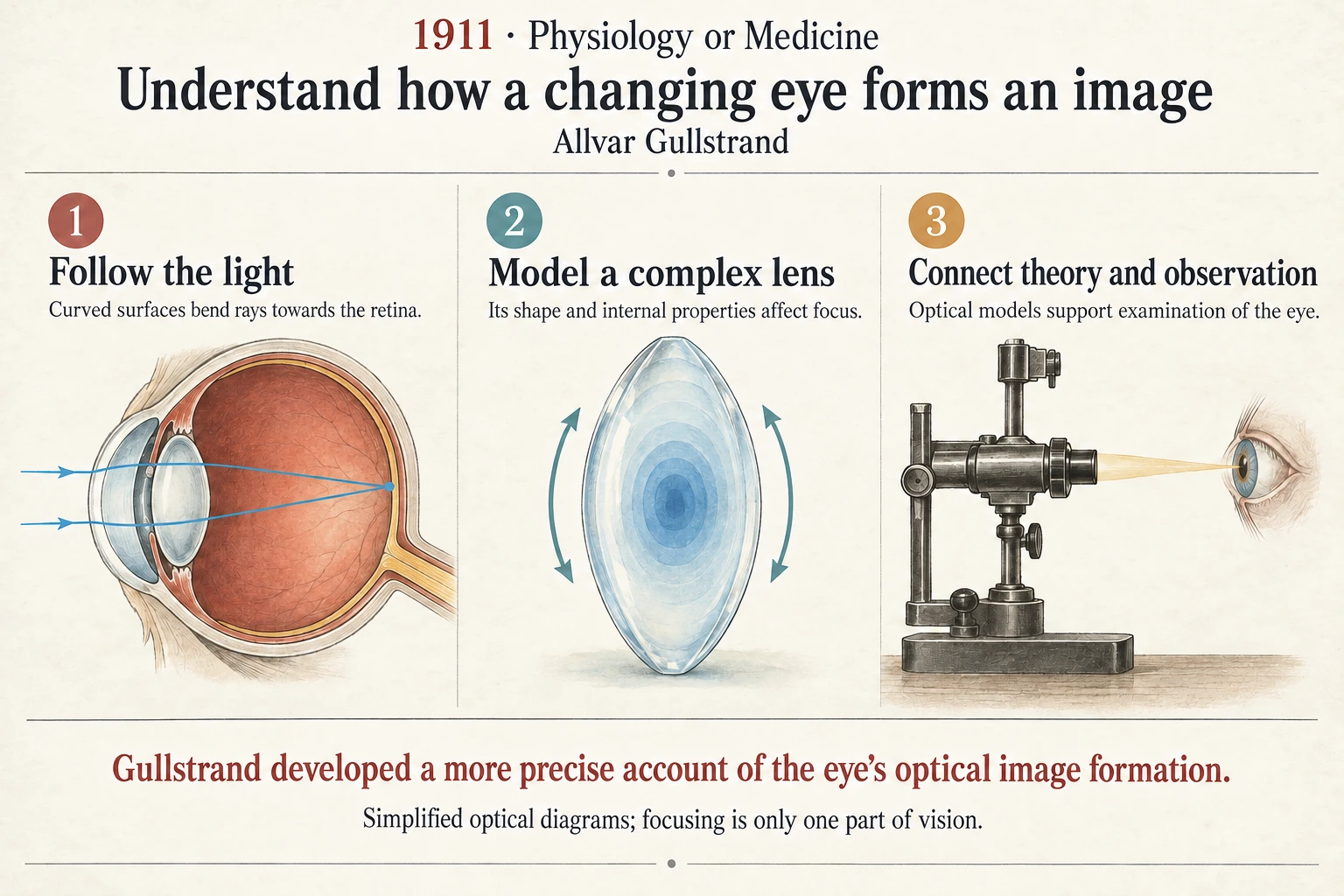
Infographic explaining Understand how a changing eye forms an image
Original AI-generated infographic. A conceptual overview; the explanations and sources below provide context.
Read the poster text

Gullstrand developed a more precise account of the eye’s optical image formation.

  1. Follow the light

    Curved surfaces bend rays towards the retina.

  2. Model a complex lens

    Its shape and internal properties affect focus.

  3. Connect theory and observation

    Optical models support examination of the eye.

Simplified optical diagrams; focusing is only one part of vision.

01 · The discovery

The idea, in everyday language

A simple lens calculation can assume one uniform material and fixed surfaces. The eye is harder: light crosses the cornea and internal media, while the crystalline lens has a refractive index that varies from layer to layer. Its shape also changes during accommodation, allowing near and distant objects to be brought into focus. Gullstrand developed optical analysis suited to such complex systems and used it to study the eye’s image formation.

His work linked general mathematical descriptions with anatomical and clinical questions, including astigmatism and the effect of changing curvature. It was not just a diagram of one ideal eye. Examination instruments, including the slit lamp and reflection-free ophthalmoscope, made structures easier to inspect. Work with Zeiss helped turn optical ideas into instruments, while the Nobel Prize specifically recognised the eye’s dioptrics.

Why it matters

The research gave ophthalmology more precise tools for analysing refractive errors and optical image quality. Theoretical models and examination instruments could inform one another, supporting later developments in eye care.
02 · The people

Who brought the idea to life?

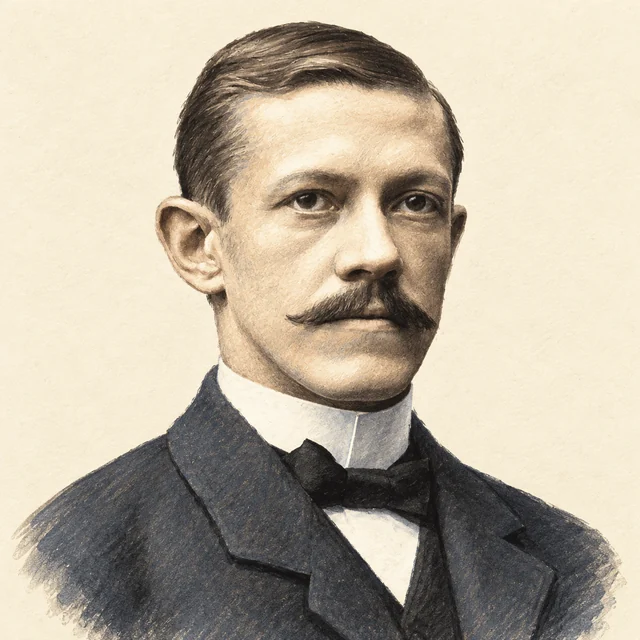
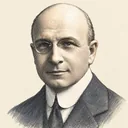
Illustrated portrait of Allvar Gullstrand

Allvar Gullstrand

Prize share · 1

Gullstrand received the full Medicine Prize for work on the eye’s dioptrics. He treated its layered, changing lens as a complex optical system and developed mathematical tools for understanding refraction and image formation.

Read the biography ↗

03 · Years in the making

The path here

  1. 1888

    Gullstrand qualifies in medicine.

  2. 1890

    He completes a thesis on astigmatism.

  3. 1894

    He becomes Uppsala’s first ophthalmology professor.

  4. 1911

    He receives the full Physiology or Medicine Prize.

  5. 1914

    He takes a personal chair in physical and physiological optics.

  6. 1930

    He dies in Stockholm.

04 · Read further

From the original sources

Original explanations by Curionode, based on the official records below. Biographical details and affiliations refer to the award year.

  1. Official award summary nobelprize.org
  2. Award ceremony speech nobelprize.org
  3. Uppsala University: Gullstrand’s eye models and instruments uu.se

More in Physiology or Medicine

Browse this subject ↗