01 · The discovery
The idea, in everyday language
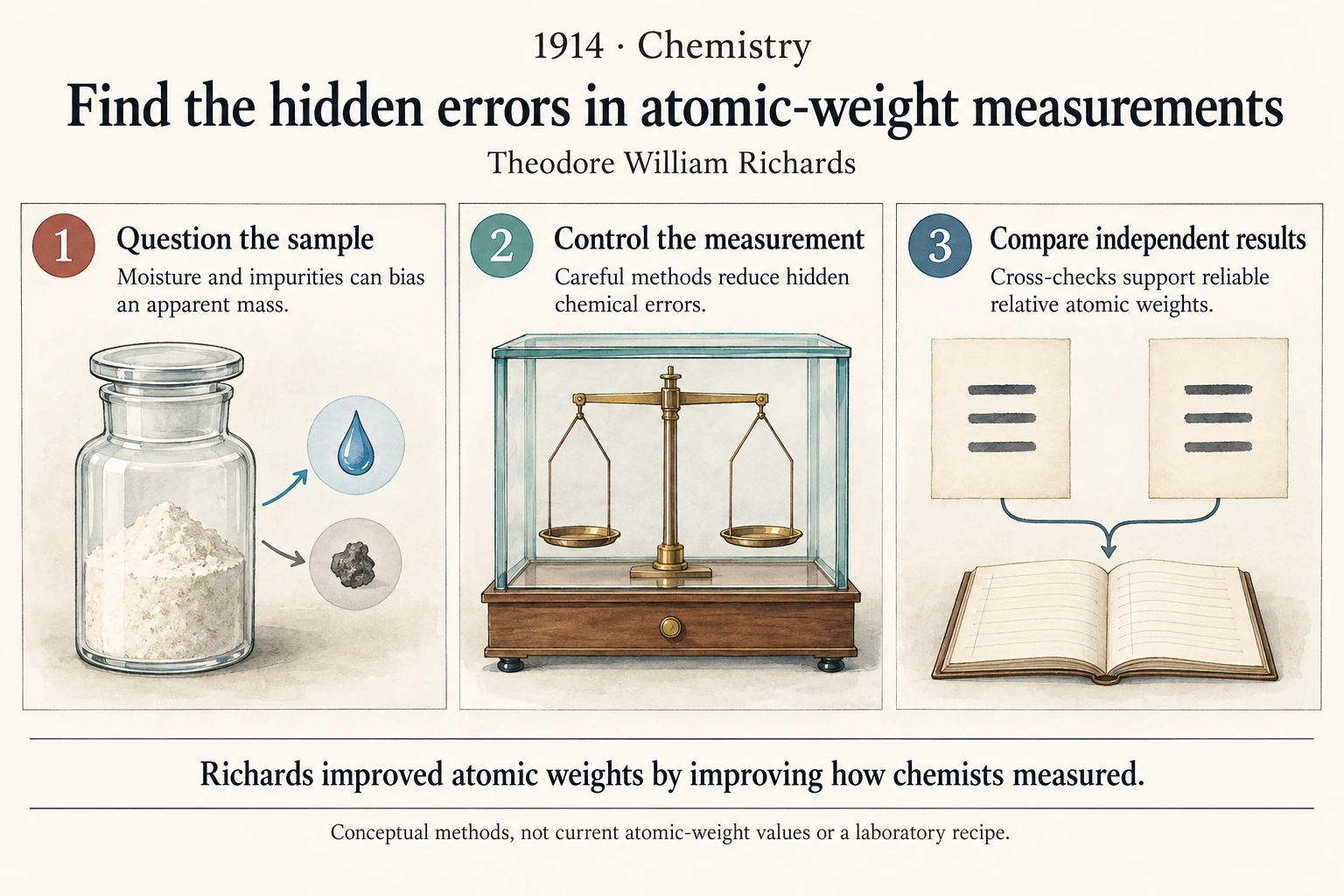
Chemists could infer relative atomic weights from the masses of substances entering or emerging from reactions with known composition. The difficulty was that a measured mass might include something unintended: retained water, trapped gases, contamination or material that had not been fully separated. Repeating the same biased procedure could yield impressively consistent values without making them correct.
Richards and his research school improved purification, weighing conditions, detection of small residual quantities and independent checks. They revised values for many elements and identified causes of earlier errors. The 1914 prize recognised accurate determinations as well as the methodological work that sustained them. It was reserved and announced on 11 November 1915.
Why it matters
Reliable relative atomic weights support quantitative chemistry: they help connect the masses of substances to their chemical proportions. Richards’s work showed why chemical control and independent checks are central to precision measurement, beyond simply reporting more decimal places.