01 · The discovery
The idea, in everyday language
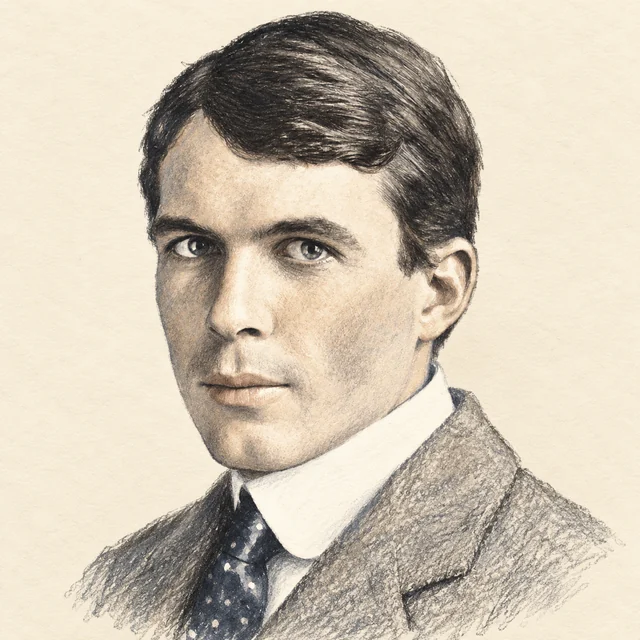
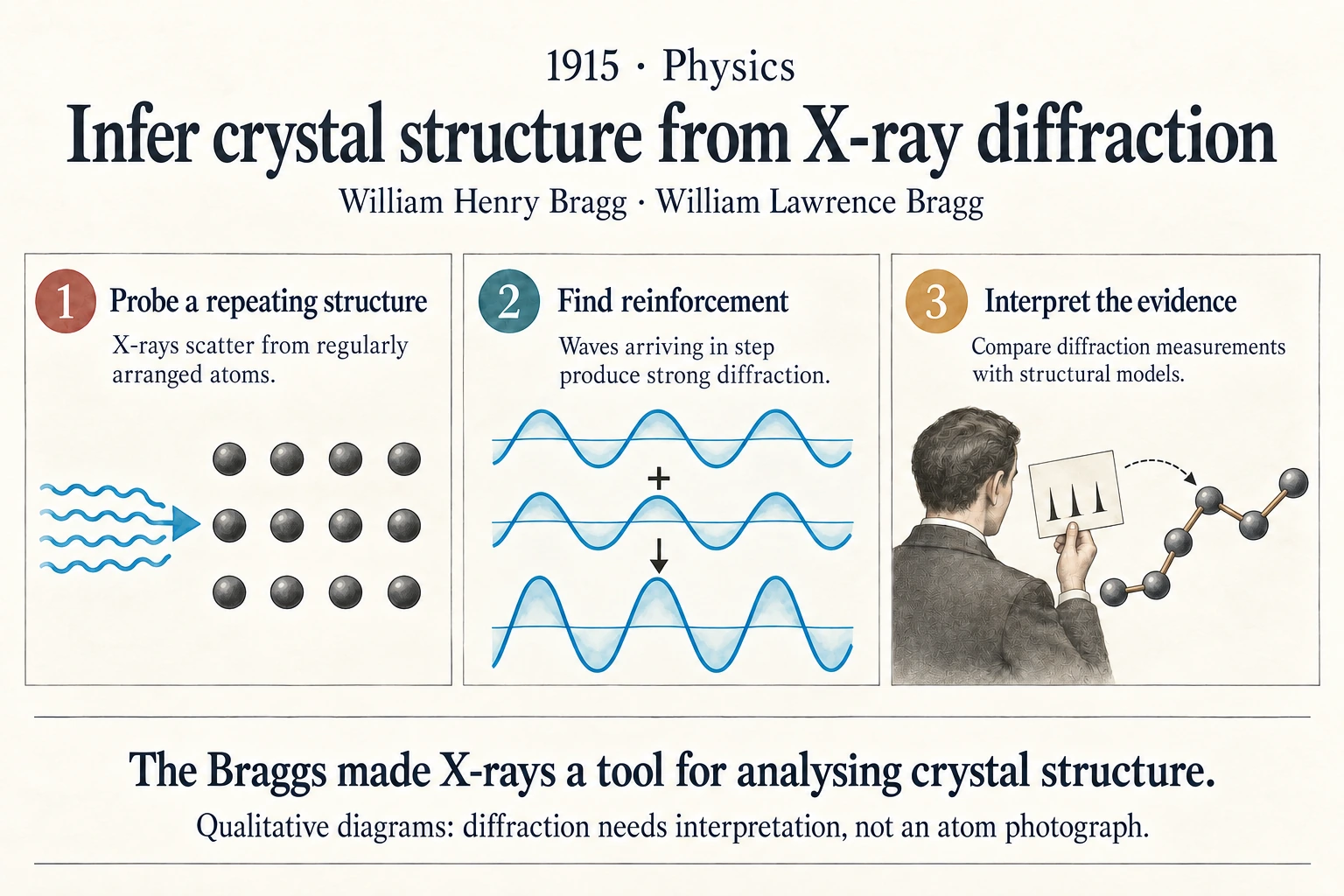
A crystal scatters X-rays from a repeating arrangement of atoms. Contributions from different parts can reinforce or cancel. Lawrence Bragg described the strong directions using families of parallel crystal planes: 2d sin θ = nλ. Here d is the spacing between planes, λ the wavelength, n an integer and θ the angle measured from the planes, not from their normal. This geometrical reflection picture expresses an interference condition; the planes are not ordinary tiny mirrors.
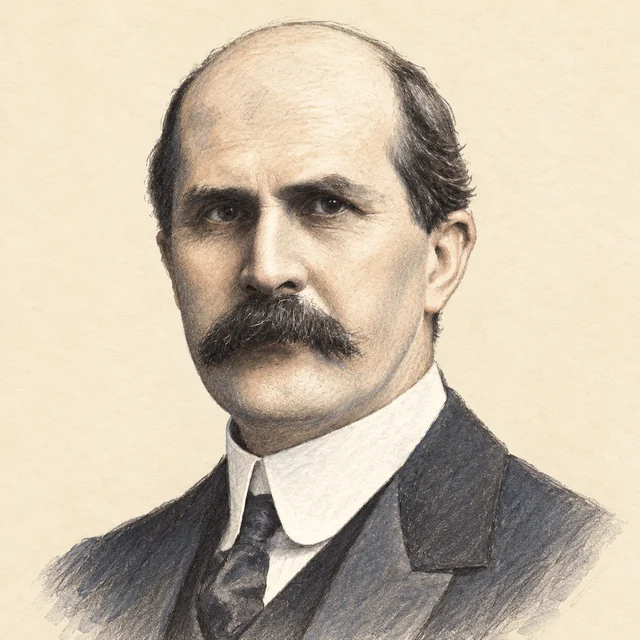
William Henry developed an X-ray spectrometer and made measurements that could be interpreted alongside this condition. Together, father and son investigated crystal arrangements and showed that diffraction could become a structural tool. Their prize concerned analysis of crystal structure. Laue’s earlier discovery of crystal diffraction and Barkla’s separate work on characteristic X-radiation are related parts of X-ray history, with different contributions.
Why it matters
X-ray crystallography opened a route from measurable diffraction to the arrangement of atoms. It became important across chemistry, mineralogy, materials and later biological structure research. A diffraction pattern still needs interpretation: it is evidence for a structure, rather than a direct photograph of atoms.