c.curionodeThe Nobel Archive

1932 · Chemistry

Understanding chemistry one molecular layer at a time

At an interface, a small amount of material can strongly alter a system’s behaviour. Langmuir studied adsorbed layers and thin films, connecting surface occupancy with molecular organization.

Surface chemistryAdsorptionMonolayersMolecular films
1932Chemistry

Visual guide

The prize, pictured

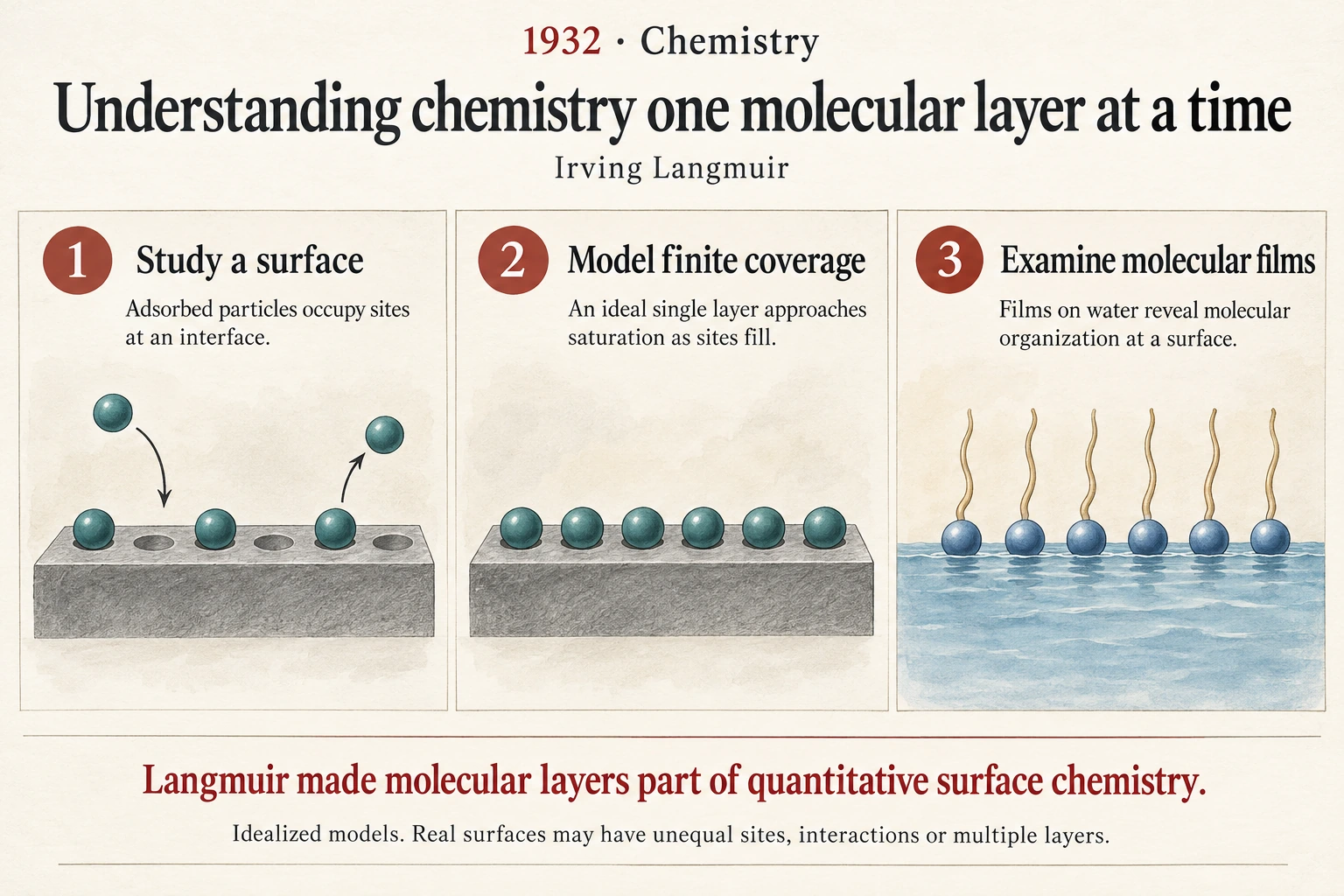
Infographic explaining Understanding chemistry one molecular layer at a time
Original AI-generated infographic. A conceptual overview; the explanations and sources below provide context.
Read the poster text

Langmuir made molecular layers part of quantitative surface chemistry.

  1. Study a surface

    Adsorbed particles occupy sites at an interface.

  2. Model finite coverage

    An ideal single layer approaches saturation as sites fill.

  3. Examine molecular films

    Films on water reveal molecular organization at a surface.

Idealized models. Real surfaces may have unequal sites, interactions or multiple layers.

01 · The discovery

The idea, in everyday language

A surface is where substances in different phases meet, such as a solid exposed to a gas or water in contact with air. What happens there can differ from what happens in the bulk material. Langmuir’s work on vacuum systems and lamp filaments led him to study particles retained at surfaces. Under suitable conditions, a stable adsorbed layer can be only one atom or molecule thick. Measuring the amount retained and the area available helped test this molecular picture.

In an idealized adsorption model, the surface has a finite number of equivalent sites, each holding at most one adsorbed particle. Occupancy reflects a balance between arrival and departure, so increasing gas pressure can increase coverage toward saturation. Langmuir also studied films spread on water, where molecular arrangement and lateral forces could be examined. This was a wider programme than one equation. Katharine Burr Blodgett’s later work extended film transfer to multilayers in 1935; it should not disappear into Langmuir’s sole 1932 award.

Why it matters

Surface chemistry became a quantitative way to investigate adsorption, molecular films and catalysis. It connected industrial questions with fundamental measurements of atoms and molecules at interfaces. Later coating and materials technologies drew on a broad field of subsequent work, rather than being finished products of the 1932 prize.
02 · The people

Who brought the idea to life?

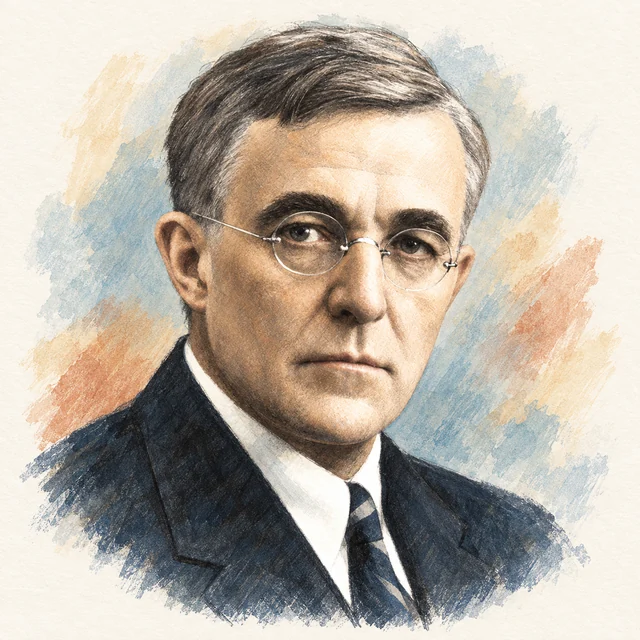
Illustrated portrait of Irving Langmuir

Irving Langmuir

Prize share · 1

Langmuir received the full Chemistry Prize for discoveries and investigations in surface chemistry. His work made adsorbed monolayers and molecular films objects of quantitative study, linking surface occupancy with physical and chemical behaviour.

Read the biography ↗

03 · Years in the making

The path here

  1. 1909

    Langmuir joins General Electric’s research laboratory.

  2. 1917

    His studies of molecular films help establish a quantitative surface picture.

  3. 1932

    Langmuir receives the Chemistry Prize for surface chemistry.

  4. 1935

    Blodgett develops multilayer film deposition after the prize.

04 · Read further

From the original sources

Original explanations by Curionode, based on the official records below. Biographical details and affiliations refer to the award year.

  1. Official award summary nobelprize.org
  2. Award ceremony speech nobelprize.org
  3. Blodgett: later multilayer films invent.org

More in Chemistry

Browse this subject ↗