01 · The contribution
The idea, in everyday language
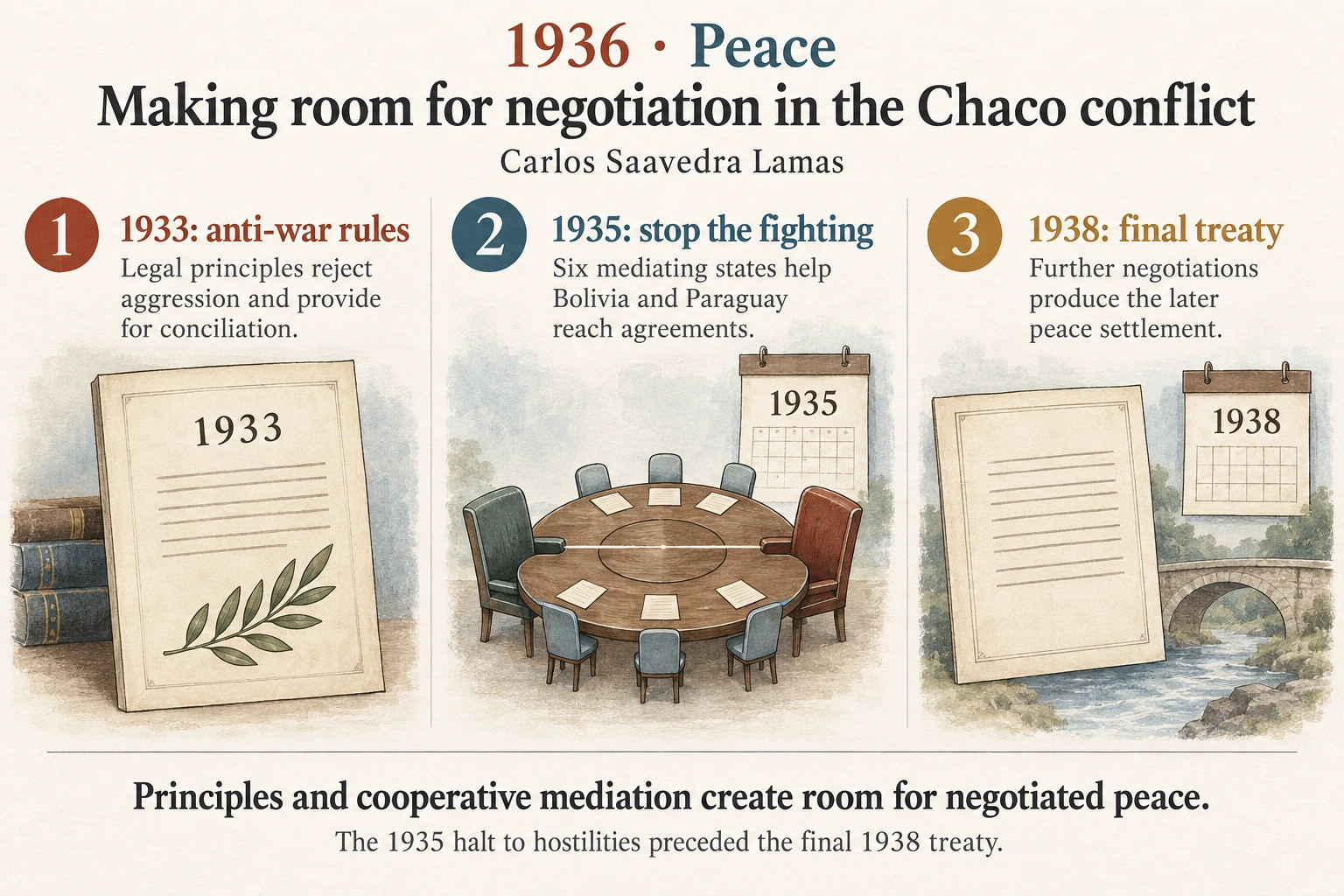
Bolivia and Paraguay fought over the Chaco from 1932. A declaration against war could establish a principle without itself stopping a battlefield. As Argentina’s foreign minister, Saavedra Lamas promoted the 1933 Anti-War Treaty of Non-Aggression and Conciliation. It condemned aggressive war and territorial changes imposed by force, and set out peaceful procedures for disputes. His diplomacy also helped restore Argentina’s active participation in the League of Nations in 1933, after its long absence from the Assembly.
In 1935 he chaired a mediating group involving Argentina, Brazil, Chile, Peru, the United States and Uruguay. Bringing the belligerents into negotiations produced agreements in June that stopped hostilities. The contribution depended on the other mediators and on Bolivia and Paraguay accepting terms. The final treaty was signed in July 1938, after the Nobel award. Saavedra Lamas also presided over the League Assembly in 1936. His work showed a practical connection between regional conciliation and wider international institutions, including cooperation with states outside the League.
Why it matters
The ceasefire ended the fighting and made further negotiations possible. The legal and diplomatic work offered an alternative to deciding borders by force. Recognition of Saavedra Lamas’s leadership should not erase the work of the mediating states, the belligerents or the people who bore the war’s costs.