01 · The discovery
The idea, in everyday language
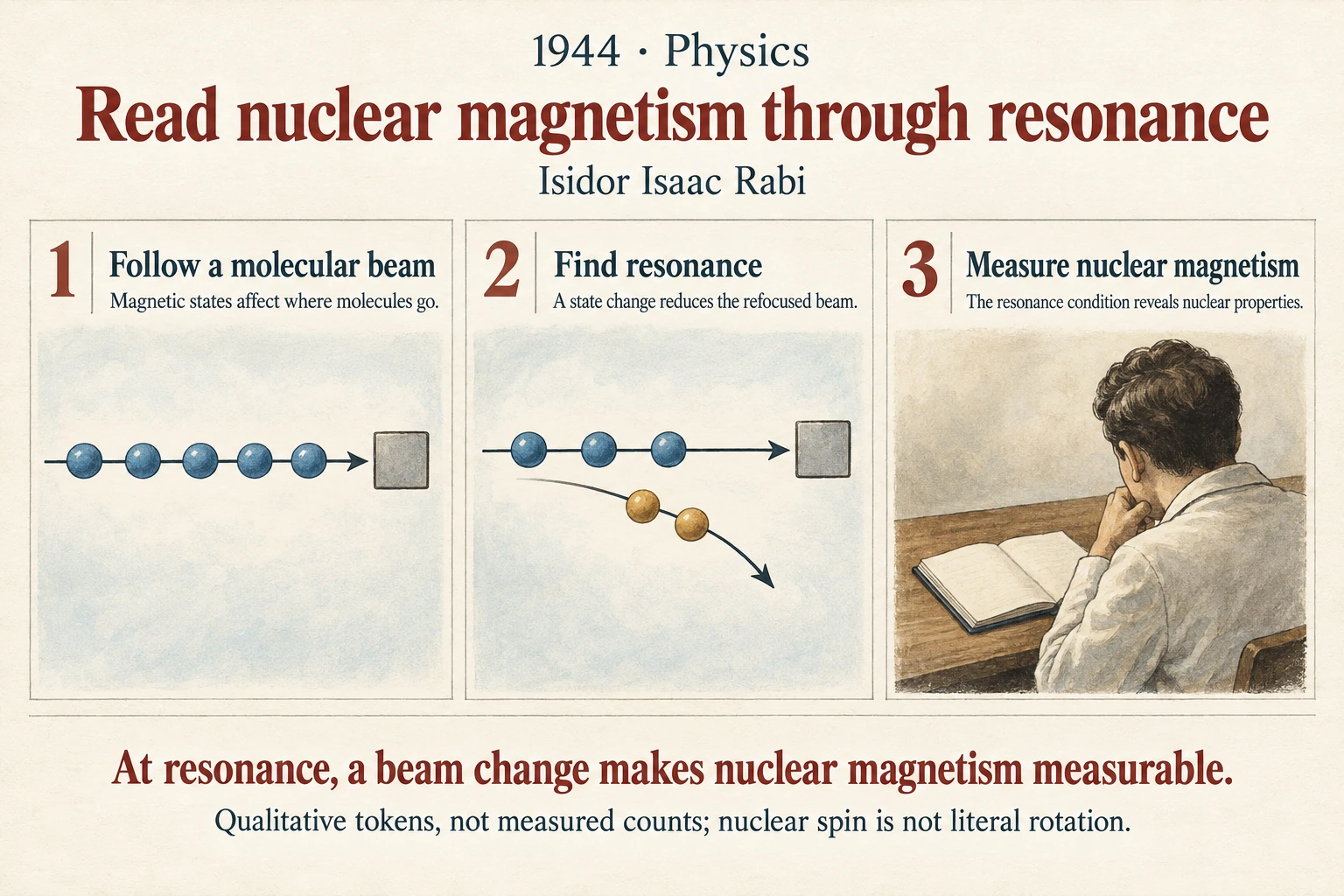
How could physicists measure the magnetic properties of an atomic nucleus with precision? A molecular beam offered a way to connect an internal quantum property to something observable: how molecules were deflected and refocused by magnetic fields. Rabi developed a resonance method that made the connection much more precise.
In the 1938 experiment reported with Zacharias, Millman and Kusch, an oscillating magnetic field could drive transitions between nuclear magnetic states under a suitable resonance condition. Molecules whose state changed were no longer refocused in the same way, so fewer reached the detector. The observable was a change in beam intensity. It was not a detector collecting light emitted by nuclei. The resonance condition allowed nuclear magnetic moments to be inferred.
Why it matters
The method greatly improved the study of nuclear magnetic properties and helped establish magnetic resonance as a precise tool. Later bulk-material resonance and medical imaging developed through further work by many researchers; a molecular-beam measurement in 1938 was not already a clinical MRI scan.